
QGRW
U.S. Quality Growth Fund

Published June 25, 2024

Research Analyst

Director, Research
The Nasdaq 100 Index is considered by many as the default benchmark for growth.
The methodology is straightforward—the 100 largest non-financial companies by market cap listed on the Nasdaq Exchange. Securities are weighted by modified market capitalization.
One of the drawbacks to this simplicity for a growth benchmark is that mature, slow-growth companies can populate the Index because of the absence of fundamental selection criteria.
In our view, WisdomTree has created a better way to capture growth—the WisdomTree U.S. Quality Growth Index. Since its launch near the end of 2022, it has outperformed the Nasdaq 100 while being more directly targeted to high-growth, high-profitability companies.
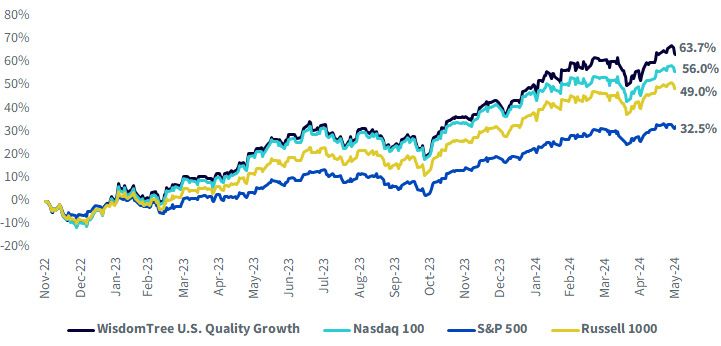
Sources: WisdomTree, Nasdaq, S&P, Russell. Returns from 11/30/22. You cannot invest directly in an index. Past performance is not
indicative of future returns.
The Wisdom U.S. Quality Growth Fund (QGRW), which tracks the performance of the WisdomTree U.S. Quality Growth Index, has outperformed its peers in the Morningstar Large Growth Category across various periods by an even wider margin than its performance relative to traditional growth benchmarks.
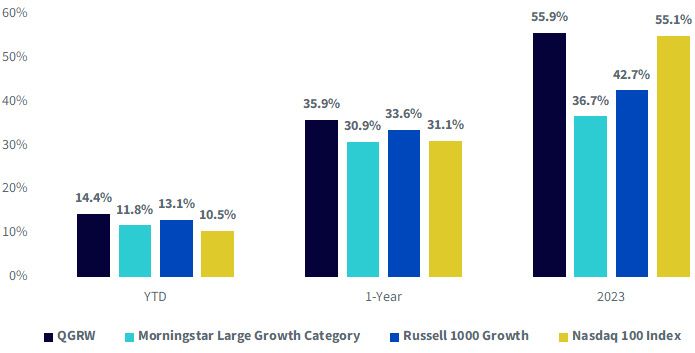
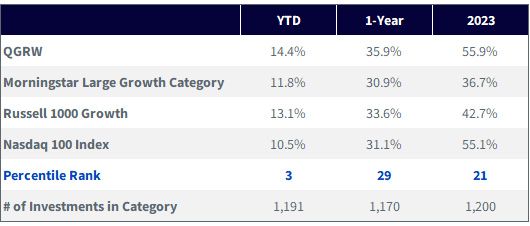
Sources: WisdomTree, Nasdaq, Russell, Morningstar, as of 5/31/24. You cannot invest directly in an index. Performance data quoted
represents past performance and is no guarantee of future results. Investment return and principal value of an investment
will fluctuate so that an investor’s shares, when redeemed, may be worth more or less than their original cost. Current
performance may be lower or higher than the performance data quoted.
For QGRW’s full standardized and most recent month-end performance, please click here.
The WisdomTree U.S. Quality Growth Index underwent its semiannual rebalance this June. During each rebalance, the Index selects the 100 U.S. companies with the highest scores in quality and profitability metrics.
This rebalance saw the addition of pharmaceutical giant Eli Lilly and Company, whose common stock is up 46% this year, at 3.45%.
Eli Lilly has an approximately 2.6% weight in the Russell 1000 Growth Index, but the security is excluded from the Nasdaq 100 Index as its primary listing is on the NYSE, not the Nasdaq.
This is despite the premium sales growth of the company from its wildly successful Mounjaro weight loss drug.
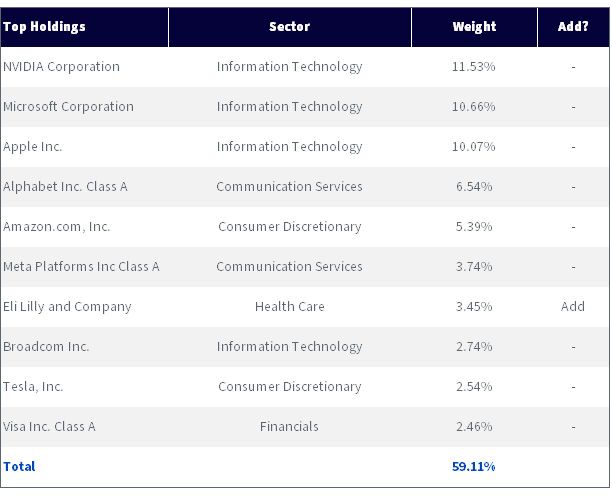
Sources: WisdomTree, FactSet, as of 5/31/24. You cannot invest directly in an index.
The WisdomTree U.S. Quality Growth Index has outperformed the Russell 1000 Growth Index since its inception in November 2022 by more than 8.5%.
The bulk of this outperformance can be attributed to high-growth sectors like Information Technology and Communication Services.
Within the Information Technology sector, the Index saw the most outperformance through stock selection—a direct consequence of its screening process and methodology.
In addition to Information Technology and Communication Services, the Index benefited from its allocations to all other sectors except for Utilities and Financials.
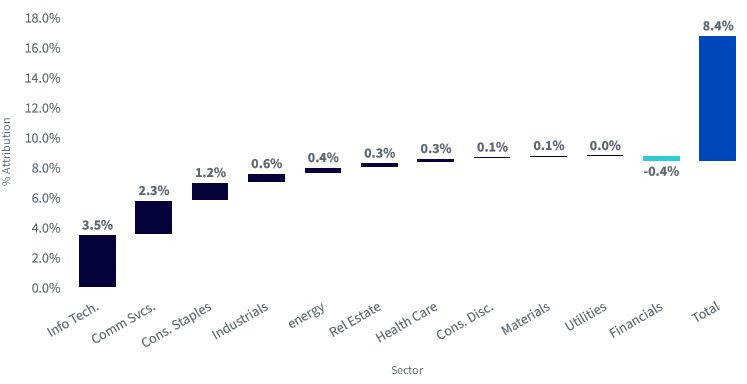
Sources: WisdomTree, FactSet, Russell, as of 5/31/24. Attribution shows the contribution to outperformance by sector for the WisdomTree U.S. Quality
Growth Index relative to the Russell 1000 Growth Index. You cannot invest directly in an index. Past performance is not indicative of future returns.
Like the Nasdaq 100, the WisdomTree Index selects 100 securities. The Indexes hold 37 securities in common with a common holdings score (or overlap) of 63%.
If we look at the chart below, we can see the difference in trailing earnings growth of constituents held in QGRW that are not held in the Nasdaq 100 and vice versa.
The main takeaway: Because the Nasdaq 100 has no fundamental selection criteria, it sacrifices on its growth criteria by including some slower-growth securities that happen to pass its market-cap and listing requirements.
For investors considering a more pure-play exposure to growth while also including a profitability bet, consider the Wisdom U.S. Quality Growth Fund (QGRW).
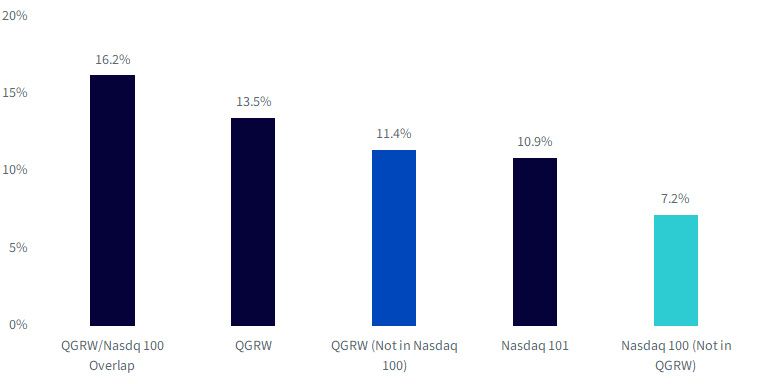
Sources: WisdomTree, Nasdaq, FactSet, as of 5/31/24. You cannot invest directly in an index.
The “Magnificent Seven” group of stocks, led by its poster child NVIDIA (NVDA)—which recently surpassed the combined market cap of the entire German stock market—is still mostly going strong after a breakout performance in 2023. Putting aside a floundering Tesla (TSLA) for now (down 25% year-to-date), the million-dollar question is: how long will this last?
The WisdomTree U.S. Quality Growth Index has a rules-based methodology that reconstitutes on a semiannual basis each June and December. The design of the Index is to not bet on individual names or a basket of several names over the long run but to represent a relatively high-conviction allocation to 100 companies with high profitability and growth characteristics.
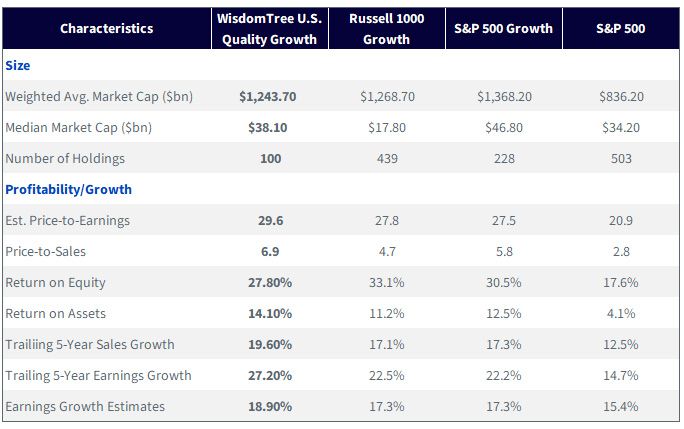
Sources: WisdomTree, Russell, S&P, FactSet, as of 5/31/24. You cannot invest directly in an index. Past performance is not indicative
of future results.
There are risks associated with investing, including the possible loss of principal. Growth stocks, as a group, may be out of favor with the market and underperform value stocks or the overall equity market. Growth stocks are generally more sensitive to market movements than other types of stocks. The Fund is non-diversified; as a result, changes in the market value of a single security could cause greater fluctuations in the value of Fund shares than would occur in a diversified fund. The Fund invests in the securities included in, or representative of, its Index regardless of their investment merit. The Fund does not attempt to outperform its Index or take defensive positions in declining markets, and the Index may not perform as intended. Please read the Fund’s prospectus for specific details regarding the Fund’s risk profile.
U.S. Quality Growth Fund

Research Analyst
Hyun Kang joined WisdomTree in July 2022 as a Research Analyst. As a part of the Index team, he assists with the creation and maintenance of the firm’s indexes and supports the group’s research initiatives across various strategies. Hyun graduated from Carnegie Mellon University, with a B.S. in Business Administration and an additional major in Statistics and Machine Learning.

Director, Research
Matt Wagner joined WisdomTree in May 2017 as an Analyst on the Research team. He currently serves as a Director, where he supports the creation, maintenance, and reconstitution of WisdomTree’s indexes and actively managed ETFs. Matt began his career at Morgan Stanley, working as an analyst in Treasury Capital Markets from 2015 to 2017, focusing on unsecured funding planning, execution, and risk management. He graduated magna cum laude from Boston College in 2015 with a B.A. in International Studies, concentrating in Economics. In 2020, he earned a Certificate in Advanced Valuation from NYU Stern. He is also a Chartered Financial Analyst (CFA) charterholder.
