


When Will the Yield Curve “Un”Invert?
Published July 10, 2024

Kevin Flanagan
Head of Investment and Fixed Income Strategy
Key Takeaways
- The UST yield curve has been inverted, but there is speculation about when it will “un”invert and move out of negative territory.
- Short-term and long-term rates do not always move in the same direction, and the magnitude of their movement affects yield curve developments.
- The potential for Fed rate cuts could impact the timing of the yield curve moving out of negative territory, with the UST 2-Year/10-Year spread potentially being the first to do so.
In my last blog post, I discussed how the inverted Treasury (UST) yield curve may have lost some of its predictive luster with respect to foreshadowing a recession, at least up to this point anyway. However, there’s another topic that I’ve been discussing in client meetings that is slowly becoming a “hot” topic, and that is the timing for when the UST curve could “un”invert, i.e., move out of negative territory.
Before I delve further, it is important to understand the dynamics behind yield curve movements. Remember, we are talking about two potentially moving parts: short-term rates and longer-term rates. Interestingly, there can be a misconception that all rates tend to move in the same direction, but history has shown us that is not necessarily the case. In addition, even if short-term and long-term rates are moving in the same direction, it is the magnitude of these movements that can dictate yield curve developments.
U.S. Treasury Yield Curves
Source: Bloomberg, as of 7/2/24.
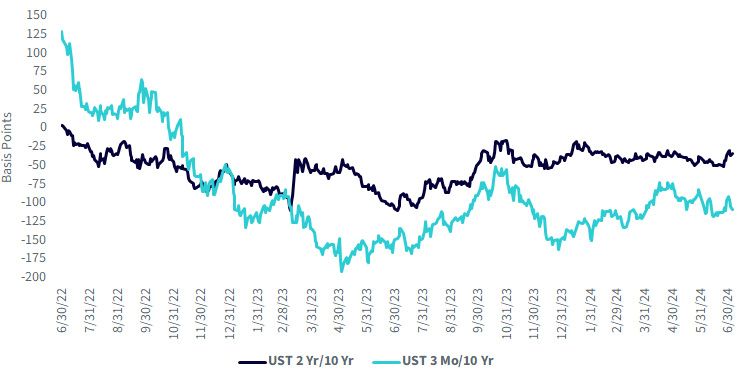
The two yield curves that are closely followed by market participants are the UST 3-Month/10-Year and UST 2-Year/10-Year differentials. These two constructs went into inverted territory during the fall and summer of 2022, respectively. In addition, the magnitude of these negative spread relationships reached historical proportions. For example, the “peak” negative reading for the UST 3-Month/10-Year relationship reached a low watermark of -190 basis points (bps), while the UST 2-Year/10-Year spread plummeted to a low of almost -110 bps, with both of these milestones occurring around the spring of 2023.
Let’s put those readings into some perspective for where things stand as of this writing. In the case of the former spread, the level is now -107 bps, while for the latter, it is -32 bps. This “steepening” has helped to bring about the very topic I am blogging about, but it should be noted that we have “seen this movie” before during the current inverted cycle.
So, what could make this time different? The potential for Fed rate cuts. In fact, that’s the underlying premise behind the discussion of when the yield curve could move out of negative territory. Let’s go back to what impacts rates along the maturity spectrum for a better understanding. Short-term yields are going to be anchored by the Fed Funds Rate, while longer-dated maturities are affected by not only monetary policy but also economic and inflation expectations and, at times, fiscal policy as well.
Given the current level of inversion for the two yield curves under discussion here, one could make the case that the UST 2-Year/10-Year spread could be the first to move out of negative territory. If the Fed cuts rates twice this year and continues into early 2025, odds would favor this differential going back to zero, or even positive, because the UST 2-Year yield would more than likely fall to, or below, the rate for the 10-Year given its tighter correlation to the Fed Funds Rate. Remember, the negative reading here is “only” -32 bps.
The timing for the UST 3-Month/10-Year “un”inversion could take longer due to the negative reading being more than one full percentage point (-107 bps). In order to reverse this negative spread, the Fed would need to be more aggressive in cutting rates than is currently expected. For instance, keeping the UST 10-Year yield where it is now at around 4.30%, technically, the Fed would need to cut rates more than four times (>100 bps total) just to get the spread back to zero.
Indeed, unless the economy—especially the labor markets—falters in a visible fashion, our reasonable case scenario sees the Fed rate cut cycle as being a more “choppy” one where easing moves are limited to 25-bp increments and do not occur at consecutive FOMC meetings. For all intents and purposes, this type of rate-cut cycle should more than likely result in yield curve steepening, but the timing could certainly be different depending on what curve you are analyzing.
Conclusion
As you can see, in the grand scheme of themes, when analyzing yield curve trends, sometimes it just comes down to the math.
Categories

About the contributor

Kevin Flanagan
Head of Investment and Fixed Income Strategy
Kevin serves as the Head of Investment and Fixed Income Strategy. In this role, he writes macro and fixed income-related content and works closely with the sales, research and marketing teams. In addition, Kevin conducts client-facing webinars and meetings, providing expertise on WisdomTree’s existing and future bond ETFs. Prior to joining WisdomTree, Kevin spent 30 years at Morgan Stanley, where he was Managing Director and Chief Fixed Income Strategist for Wealth Management. He was responsible for tactical and strategic recommendations and created asset allocation models for fixed income securities. He was a contributor to the Morgan Stanley Wealth Management Global Investment Committee, primary author of Morgan Stanley Wealth Management’s monthly and weekly fixed income publications, and collaborated with the firm’s Research and Consulting Group Divisions to build ETF and fund manager asset allocation models. Kevin has an MBA from Pace University’s Lubin Graduate School of Business, and a B.S. in Finance from Fairfield University.