

U.S. Fixed Income: "Won't Get Fooled Again"
Published January 4, 2017

Head of Investment and Fixed Income Strategy
Here we are, ready to begin a new calendar year. Economic and rate forecasts filled the just finished holiday season, but the question now becomes: Will these prognostications actually prove accurate? Remember, it is a long way to December 31, and as we have seen in the last few years, a lot can happen between the opening days of January and New Year’s Eve.
There seems to be very little doubt that the lion’s share of market participants are beginning 2017 under the assumption that economic growth will improve, inflation expectations will increase and, of course, interest rates will be on the rise. We’re not about to debate any of these assumptions, but the journey on the rate front that we begin on New Year’s Day does not often go according to script . The last three years offer a clear illustration of this phenomenon, and we “won’t get fooled again” if recent history tries to repeat itself.
What exactly is this phenomenon we are referring to? At year-end 2013 through 2015, the U.S. Treasury (UST) 10-Year Yield finished with an upward bias, only to reverse course and visibly decline the following January and February. To provide some perspective: on average, the 10-Year Yield declined by nearly 60 basis points (bps) between the end of December and the first half of February in each of these instances.
U.S. Treasury 10-Year Yield
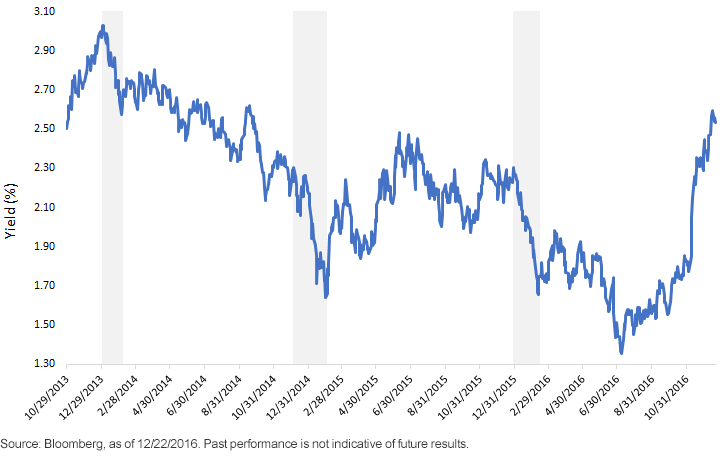
Given its similarities in terms of Federal Reserve (Fed) policy to today, let’s look at last year’s experience. In both cases, the Fed lifted its target range for Fed Funds by a ¼ point and forecast additional increases for the following calendar year. Accordingly, the UST market recalibrated its thought process to allow for this development, pushing the 10-Year Yield higher. However, sentiment shifted rather quickly once the calendar turned and the money and bond markets doubted the Fed would tighten quite that aggressively as new headlines hit the news. Indeed, concern began to grow about China’s economy, oil prices plunged, eurozone bank issues surfaced, and here at home, growth was once again underperforming rather noticeably. As a result, the expectation of four rate hikes in 2016 was reduced to one single increase. For 2017, the Fed’s median forecast is for three rate hikes, but the futures market is already discounting that number down to only two, as of this writing. For the record, my base case is for two Fed rate increases as well.
Conclusion
In the post-election fixed income environment, investors appear to be fixated on the prospect of fiscal stimulus and how that will lead to the Fed raising rates and, in turn, UST yields heading higher as well. This “student body right” mindset does not seem to allow for any negative news that might emerge to cause history to repeat itself in the New Year. Some food for thought on that note: Incoming data is suggesting a slower pace of growth for Q4 real GDP, and core goods inflation in the November Personal Consumption Report had the fourth-largest decline since 1959. Even if history were to repeat itself in 2017, if some form of fiscal stimulus and regulatory relief is delivered later this year, Treasury yields would most likely reverse course. While we will have a new leader in the White House, from a Fed perspective, it’s a case of: “meet the new boss, same as the old boss.”
Unless otherwise noted, source is Bloomberg, as of 12/22/2016.
Important Risks Related to this Article
Fixed income investments are subject to interest rate risk; their value will normally decline as interest rates rise. In addition, when interest rates fall, income may decline. Fixed income investments are also subject to credit risk, the risk that the issuer of a bond will fail to pay interest and principal in a timely manner or that negative perceptions of the issuer’s ability to make such payments will cause the price of that bond to decline.
Categories
About the contributor

Head of Investment and Fixed Income Strategy
Kevin serves as the Head of Investment and Fixed Income Strategy. In this role, he writes macro and fixed income-related content and works closely with the sales, research and marketing teams. In addition, Kevin conducts client-facing webinars and meetings, providing expertise on WisdomTree’s existing and future bond ETFs. Prior to joining WisdomTree, Kevin spent 30 years at Morgan Stanley, where he was Managing Director and Chief Fixed Income Strategist for Wealth Management. He was responsible for tactical and strategic recommendations and created asset allocation models for fixed income securities. He was a contributor to the Morgan Stanley Wealth Management Global Investment Committee, primary author of Morgan Stanley Wealth Management’s monthly and weekly fixed income publications, and collaborated with the firm’s Research and Consulting Group Divisions to build ETF and fund manager asset allocation models. Kevin has an MBA from Pace University’s Lubin Graduate School of Business, and a B.S. in Finance from Fairfield University.