
WTBN
Bianco Total Return Fund

Published April 16, 2025

Head of Investment and Fixed Income Strategy
The month of April will go down in media lore as a month to remember for the financial markets. We have been advocating an active-passive barbell strategy as our core solution for fixed income investors as a way to navigate what we thought would be an uncertain and volatile investment landscape. This time-tested approach offers investors a means of having flexibility for what will ultimately lie ahead, with the “active” portion of the solution offering a means to be responsive to changing investment conditions. The Bianco Research Fixed Income Total Return Index (BTRINDX) is an active core strategy that underscores the importance of this approach to fixed income investing, where a repositioning was recently implemented.
BTRINDX is based on qualitative and quantitative inputs, including economic data and interpretations of government policy. The characteristics below reflect how BTRINDX would presently position a portfolio of fixed income ETFs seeking to achieve maximum total return over a comparable baseline or a benchmark neutral portfolio of fixed income securities.
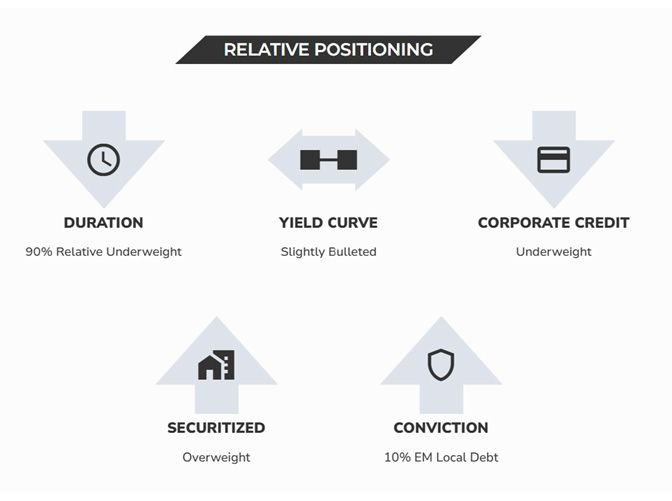
Let’s look at the rationale behind this repositioning using the five key areas involved.
The potentially changing bond investment landscape and heightened volatility compared to years past can present a challenging backdrop for fixed income investors. The WisdomTree Bianco Total Return Fund (WTBN), which seeks to track the price and yield performance, before fees and expenses, of BTRINDX, offers investors an active core strategy to help navigate their bond portfolio for what may lie ahead.
Unless otherwise stated, all charts in this blog post are sourced from Bianco Research as of April 11, 2025.
There are risks associated with investing, including the possible loss of principal. Please read the Fund’s prospectus for specific details regarding the Fund’s risk profile.
ELD: Foreign investing involves special risks, such as risk of loss from currency fluctuation or political or economic uncertainty. Investments in emerging, offshore or frontier markets are generally less liquid and less efficient than investments in developed markets and are subject to additional risks, such as risks of adverse governmental regulation and intervention or political developments. Derivative investments can be volatile, and these investments may be less liquid than other securities and more sensitive to the effects of varied economic conditions.
Fixed income investments are subject to interest rate risk; their value will normally decline as interest rates rise. In addition, when interest rates fall, income may decline. Fixed income investments are also subject to credit risk, the risk that the issuer of a bond will fail to pay interest and principal in a timely manner or that negative perceptions of the issuer’s ability to make such payments will cause the price of that bond to decline. Unlike typical exchange-traded funds, there is no index that the Fund attempts to track or replicate. Thus, the ability of the Fund to achieve its objective will depend on the effectiveness of the portfolio manager. Due to the investment strategy of this Fund, it may make higher capital gain distributions than other ETFs.
WTBN: Fixed income investments are subject to interest rate risk; their value will normally decline as interest rates rise. Fixed income investments are also subject to credit risk, the risk that the issuer of a bond will fail to pay interest and principal in a timely manner or that negative perceptions of the issuer’s ability to make such payments will cause the price of that bond to decline. While the Fund attempts to limit credit and counterparty exposure, the value of an investment in the Fund may change quickly and without warning in response to issuer or counterparty defaults and changes in the credit ratings of the Fund’s portfolio investments. The Fund invests in the securities included in, or representative of, its Index regardless of their investment merit, and the Fund does not attempt to outperform its Index or take defensive positions in declining markets.

Head of Investment and Fixed Income Strategy
Kevin serves as the Head of Investment and Fixed Income Strategy. In this role, he writes macro and fixed income-related content and works closely with the sales, research and marketing teams. In addition, Kevin conducts client-facing webinars and meetings, providing expertise on WisdomTree’s existing and future bond ETFs. Prior to joining WisdomTree, Kevin spent 30 years at Morgan Stanley, where he was Managing Director and Chief Fixed Income Strategist for Wealth Management. He was responsible for tactical and strategic recommendations and created asset allocation models for fixed income securities. He was a contributor to the Morgan Stanley Wealth Management Global Investment Committee, primary author of Morgan Stanley Wealth Management’s monthly and weekly fixed income publications, and collaborated with the firm’s Research and Consulting Group Divisions to build ETF and fund manager asset allocation models. Kevin has an MBA from Pace University’s Lubin Graduate School of Business, and a B.S. in Finance from Fairfield University.
