QGRW
U.S. Quality Growth Fund

Published December 23, 2025

Director, Research
For many investors, the Nasdaq 100 is the default proxy for U.S. growth stocks.
Its methodology is simple: select the 100 largest non-financial companies listed on the Nasdaq exchange and weight by market cap.
But that simplicity comes with trade-offs. Because the Nasdaq 100 does not screen for fundamentals like growth or profitability, mature companies with slower growth can still make the cut, while truly high-growth firms can be excluded simply because they're not listed on Nasdaq.
A simple comparison helps illustrate this.
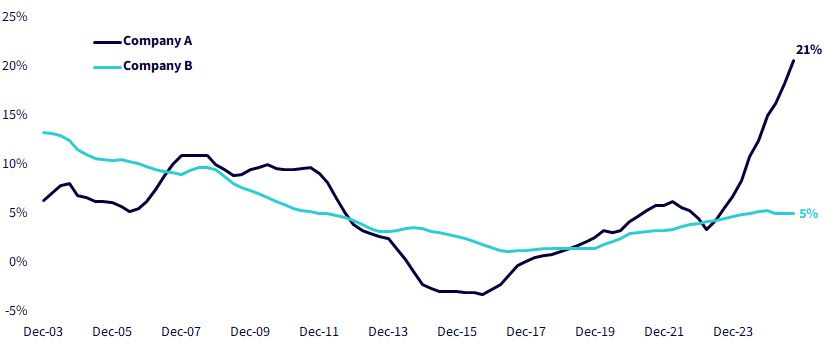
Consider two companies: "Company A" and "Company B." Both are real companies, and neither is in the Nasdaq 100 today. Their growth profiles over time look very different:
All else equal, one would assume that Company A would be the clear Nasdaq 100 candidate between the two.
Rolling Five-Year Annualized Sales Growth: Company A vs. Company B
Sources: WisdomTree, FactSet, 12/31/98–10/31/25.
Here's the twist:
Just one of these companies appears to be knocking on the door of the Nasdaq 100, and it's Company B: Walmart.
Company A, Eli Lilly, is listed on the New York Stock Exchange (NYSE) and therefore ineligible for inclusion in the Nasdaq 100.
Why Walmart May Join the Nasdaq 100
Being included in the Nasdaq 100 carries weight. A significant amount of assets track or benchmark to the index, which makes exchange selection increasingly important for large companies.
Walmart recently shifted its listing from the NYSE to Nasdaq, effective December 9. With a market cap around $800 billion, it is positioned to become a top 10 holding in the Nasdaq 100 once it qualifies.
An example like this highlights a broader point: a growth benchmark based solely on exchange listing and market cap may miss the companies that fundamentally represent "growth."
The WisdomTree U.S. Quality Growth Index (WTQGRW) takes a different approach, one grounded in fundamentals.
Since launching three years ago, WTQGRW has outperformed the Nasdaq 100 by over 16% cumulatively, more than 300 basis points (bps) annualized.
Cumulative Index Total Returns since 11/30/22
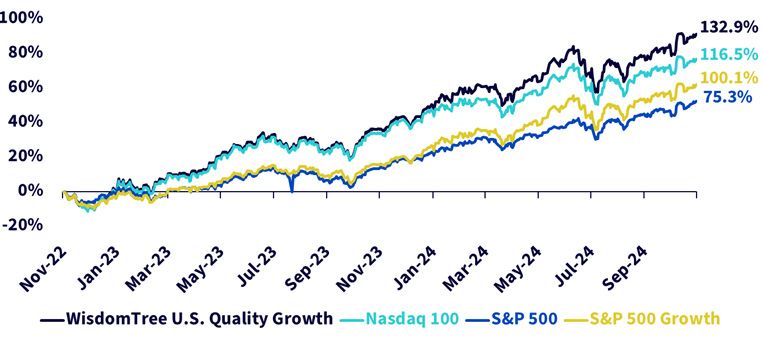
Sources: WisdomTree, Russell, Nasdaq, S&P, 11/30/22–11/28/25. You cannot invest directly in an index. Past performance is not indicative of future returns.
The Index begins with the largest 500 U.S. companies (across any major U.S. exchange) and ranks them on two equally weighted pillars:
The top 100 companies, those in the highest composite quintile, form the Index, which is weighted by market cap.
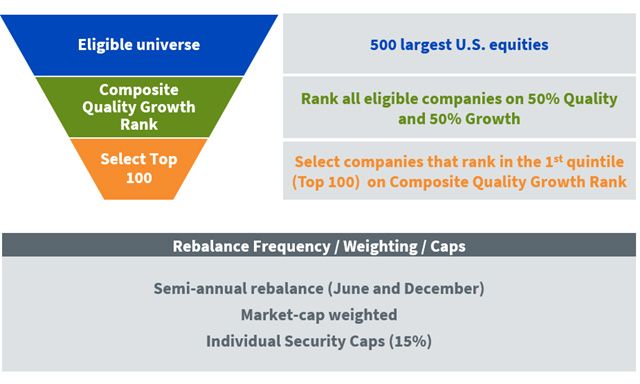
The result is a high-conviction, concentrated growth portfolio, with 62% of Index weight in its top 10 holdings.
At the latest rebalance, the Index held an approximately 3% weight in Eli Lilly, while Walmart was not included due to its lower growth and quality profile.
WisdomTree U.S. Quality Growth Index: Top 10 Holdings
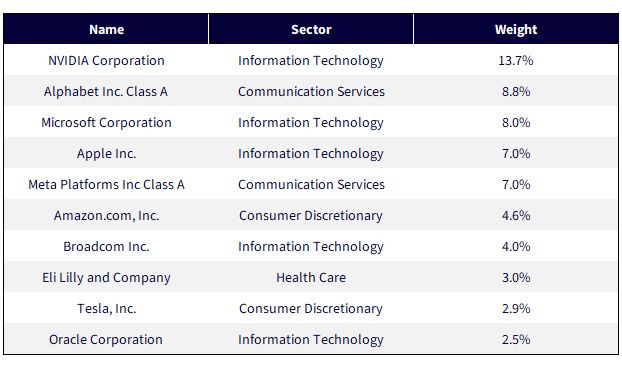
Source: WisdomTree, as of 11/28/25. Holdings based on post-rebalance holdings. The rebalance was effective at the close of 12/8/25. Holdings and weights subject to change. You cannot invest directly in an index.
Like the Nasdaq 100, WTQGRW holds 100 securities. Forty names appear in both indexes, resulting in a 62% overlap score. But the growth characteristics diverge meaningfully.
When we examine forward three-year earnings growth estimates:
These meaningful differences in growth rates reinforce the impact of WisdomTree's fundamentals-driven stock selection process.
Forward Three-Year Earnings Growth
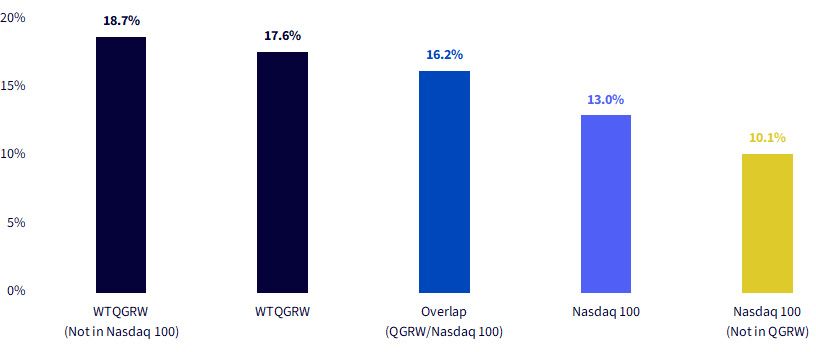
Sources: WisdomTree, Nasdaq, FactSet, as of 11/28/25. WisdomTree U.S. Quality Growth (WTQGRW) holdings based on post-rebalance holdings. The rebalance was effective at the close of 12/8/25. Growth estimates aggregated as medians. You cannot invest directly in an index.
Why a Fundamentals-Based Rebalance Matters
Each June and December, the Index systematically refreshes its exposure to high-quality, high-growth companies. These fundamental updates lead to meaningful improvements relative to broad benchmarks:
This disciplined process keeps the Index aligned with the companies that define quality growth, not just the largest companies in the market.
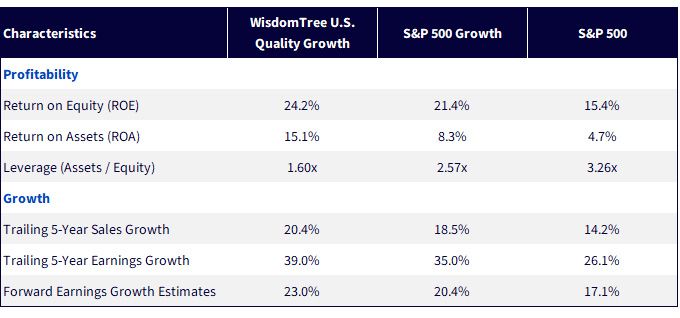
Sources: WisdomTree, FactSet, Russell, S&P, as of 11/28/25. WisdomTree U.S. Quality Growth (WTQGRW) holdings based on post-rebalance holdings. The rebalance was effective at the close of 12/8/25. Return on Equity, Return on Asset and Leverage are adjusted for investments in intangible assets. You cannot invest directly in an index.
Conclusion
As the Walmart example shows, relying solely on exchange rules and market cap can create a very different picture of “growth” than what fundamentals would indicate.
The WisdomTree U.S. Quality Growth Index takes a more deliberate approach, systematically targeting companies with the strongest blend of quality and growth and refreshing that exposure every six months. The result is an Index that delivers the type of growth exposure investors expect, rather than one that simply includes the largest companies based on where they happen to trade.
U.S. Quality Growth Fund

Director, Research
Matt Wagner joined WisdomTree in May 2017 as an Analyst on the Research team. He currently serves as a Director, where he supports the creation, maintenance, and reconstitution of WisdomTree’s indexes and actively managed ETFs. Matt began his career at Morgan Stanley, working as an analyst in Treasury Capital Markets from 2015 to 2017, focusing on unsecured funding planning, execution, and risk management. He graduated magna cum laude from Boston College in 2015 with a B.A. in International Studies, concentrating in Economics. In 2020, he earned a Certificate in Advanced Valuation from NYU Stern. He is also a Chartered Financial Analyst (CFA) charterholder.