
GDT
Efficient TIPS Plus Gold Fund

Published January 22, 2026

Global Head of Research
Inflation is no longer a passing threat; it's an enduring feature of a world defined by fiscal expansion, supply shocks, and strategic competition. Investors seeking to preserve purchasing power need tools that protect against both realized and expected inflation. A dual exposure to gold futures and Treasury Inflation-Protected Securities (TIPS) offers a balanced, capital-efficient defense. Gold delivers torque to shifting expectations and policy risk, while TIPS anchor returns to the math of inflation itself. Together, they form a modern inflation hedge designed not just to survive volatility, but to thrive in it—a two-pronged strategy for an unstable monetary era.
Over nearly eight decades, gold has demonstrated an extraordinary ability to preserve purchasing power across vastly different monetary regimes. From the Bretton Woods era through the stagflation of the 1970s, the disinflationary 1990s, and today's era of fiscal expansion and policy uncertainty, gold's real value has held remarkably steady, outpacing most fiat-based assets. The chart reveals that while nominal prices have soared, it's the real price stability that defines gold's role as a long-term store of value. As inflation erodes the reliability of cash and bonds, gold continues to serve as the asset investors turn to when credibility falters.
Figure 1: Gold's Enduring Power: A Seventy-Year Record of Real Wealth Preservation
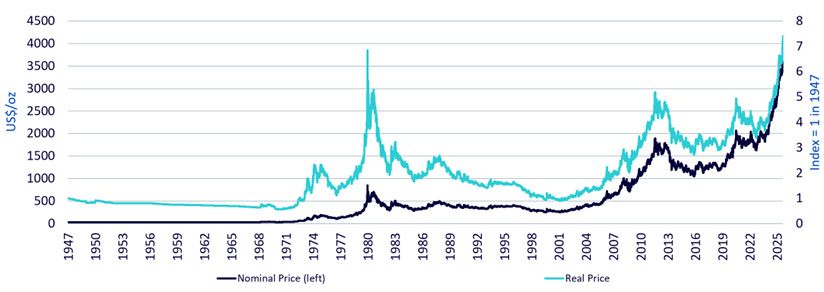
Sources: WisdomTree, Bloomberg. Nominal is represented by the LBMA PM fixing for the price of gold. Real has the gold price deflated by the U.S. CPI Index. January 1947 to October 2025. Gold data is sourced daily. CPI data is updated monthly. Past performance is not indicative of future results.
Gold's price often anticipates rather than reacts to inflation, spiking ahead of major CPI surges and moderating before inflation crests. Since the end of the gold standard in 1971, the metal has repeatedly foreshadowed periods of rising price pressures, acting as the market's real-time gauge of monetary credibility. While short-term divergences occur, the long-run rhythm is unmistakable: gold rallies when inflation expectations accelerate, capturing both fear and foresight. This dynamic underscores why gold remains a vital complement to traditional inflation hedges, its sensitivity to future policy risk—not just past inflation—makes it a leading indicator in volatile macro regimes.
Figure 2: Gold Moves First: The Market's Early Warning Signal for Inflation
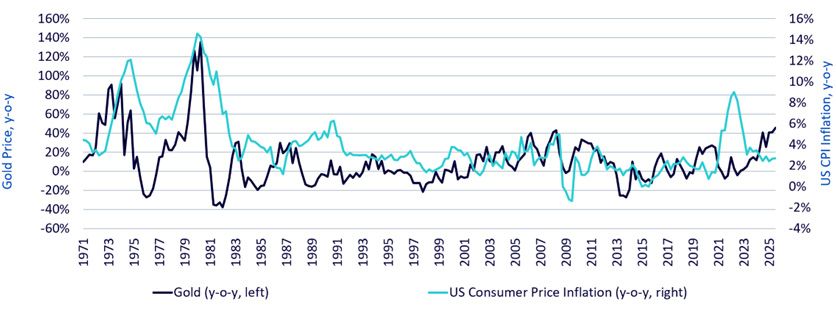
Sources: WisdomTree, Bloomberg. Quarterly data from Q1 1971 to Q3 2025. Past performance is not indicative of future results.
After half a century of dollar dominance, the world's central banks are quietly rebalancing. The chart reveals a profound shift: gold, once displaced by U.S. Treasuries as the anchor of global reserves, is regaining ground. Persistent fiscal deficits, negative real yields and rising geopolitical fragmentation have eroded trust in sovereign paper assets. Gold's share of official reserves, after bottoming in the early 2000s, is climbing steadily, reflecting a structural diversification away from dollar dependency. This resurgence marks more than portfolio prudence; it signals a reassertion of monetary sovereignty, with gold once again serving as the ultimate hedge against policy and currency risk.
Figure 3: The Great Reversal: Gold Reclaims Its Place in Global Reserves
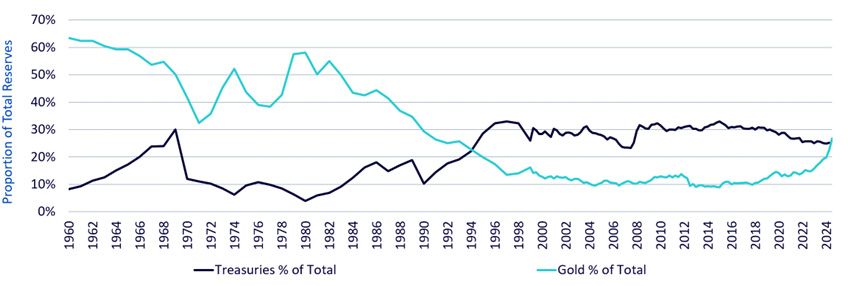
Sources: World Gold Council, 2025. Central banks' gold percentage of total international reserves, extracted from IMF International Financial Statistics (IFS). Retrieved from World Gold Council Goldhub data portal; International Monetary Fund, 2025. International Financial Statistics (IFS) and Currency Composition of Official Foreign Exchange Reserves (COFER), via Central Banking's "Appendix 3: Reserve Statistics." Central Banking. Retrieved from Appendix 3: Reserve Statistics. Central Banking, 2025. Past performance is not indicative of future results.
Conclusion: Introducing WisdomTree's Efficient TIPS Plus Gold Strategy
The WisdomTree Efficient TIPS Plus Gold Fund (GDT) represents a new evolution in inflation protection, an intentionally engineered, two-pronged approach for a more complex world. By combining 90% exposure to gold futures with 90% exposure to Treasury Inflation-Protected Securities, the strategy unites two of the most enduring inflation hedges into one capital-efficient framework. Gold captures the market's forward-looking pulse on monetary credibility, while TIPS ground the portfolio in the mathematics of realized inflation. Together, they provide balance, adaptability, and real return potential in a landscape where traditional fixed income often struggles. This launch redefines how investors can fight inflation efficiently, intelligently and decisively.
There are risks associated with investing including possible loss of principal. The Fund invests in a portfolio composed of Inflation-protected U.S. Treasury Bonds (“TIPS”) and U.S. listed gold futures contracts. The interest and principal payments of TIPS are adjusted for inflation and typically have lower yields than conventional fixed-rate bonds. The Fund’s income from TIPS may decline due to deflation or changes in inflation expectations. The value of gold and commodity-linked derivative instruments such as gold futures contracts typically is based upon the price movements of the physical commodity or an economic variable linked to such price movement. Price movements in gold and gold futures contracts may fluctuate quickly and dramatically, have a historically low correlation with the returns of the stock and bond markets. Derivatives are used by the Fund to gain exposure to inflation swaps and U.S. listed gold future contracts. Derivative investments can be volatile and may be less liquid than other investments. As a result, the value of an investment in the Fund may change quickly and without warning you may lose money. While the Fund is actively managed, the Fund's investment process is heavily dependent on quantitative models and the models may not perform as intended. Please read the Fund’s prospectus for specific details regarding the Fund’s risk profile.

Global Head of Research
Christopher Gannatti began at WisdomTree as a Research Analyst in December 2010, working directly with Jeremy Schwartz, CFA®, Director of Research. In January of 2014, he was promoted to Associate Director of Research where he was responsible to lead different groups of analysts and strategists within the broader Research team at WisdomTree. In February of 2018, Christopher was promoted to Head of Research, Europe, where he was based out of WisdomTree’s London office and was responsible for the full WisdomTree research effort within the European market, as well as supporting the UCITs platform globally. In November 2021, Christopher was promoted to Global Head of Research, now responsible for numerous communications on investment strategy globally, particularly in the thematic equity space. Christopher came to WisdomTree from Lord Abbett, where he worked for four and a half years as a Regional Consultant. He received his MBA in Quantitative Finance, Accounting, and Economics from NYU’s Stern School of Business in 2010, and he received his bachelor’s degree from Colgate University in Economics in 2006. Christopher is a holder of the Chartered Financial Analyst Designation.
