
DHSA LN
WisdomTree US High Dividend UCITS ETF - Acc

Published 20 March 2025

Associate Director, Quantitative Research at WisdomTree in Europe
WisdomTree has been involved in model portfolios for more than a decade. Currently, the assets under management for our model portfolio business sits at more than $3 billion US dollars1. For clients considering model portfolios for their practice, WisdomTree’s model portfolios stand out for their innovative approach, marrying the performance potential of active strategies with the discipline of passive investments.
Our house-view model portfolios integrate our long-term strategic perspectives with near-term tactical positions informed by our latest market outlook.
WisdomTree’s strategic asset allocation framework reflects a disciplined, long-term investment philosophy designed to balance risk and reward across diverse economic cycles. Our guiding principle is that robust diversification across asset classes—including equities, fixed income, commodities, and alternative investments—can enhance a portfolio’s overall resilience to market volatility while seeking strong risk-adjusted returns. At the start of 2025, WisdomTree's exchange-traded fund (ETF) model portfolios’ strategic positioning pivots around the following ideas:
Our five highest-conviction tactical bets based on our latest outlook are as follows:
In the current environment, we favour a barbell strategy that balances US large-cap quality growth equities (WisdomTree US Quality Growth UCITS ETF (QGRW)) with value stocks (WisdomTree US Equity Income (DHSA)). High-quality growth companies typically demonstrate strong balance sheets, consistent earnings, and solid secular growth trends, making them an appealing choice for investors looking to preserve some defensive characteristics while capturing potential equity market upside. Value stocks, by contrast, have historically fared well during periods of rising interest rates and cyclical rebounds, helping to cushion the portfolio and ensure broader exposure to different stages of the economic cycle.
Japan remains both a strategic allocation and a key tactical focus, thanks to several converging tailwinds. Corporate governance reforms have led many Japanese companies to improve capital efficiency and boost shareholder returns, often through dividends and share buybacks. At the same time, modest wage increases, and ongoing policy support, are energising domestic demand. Although Japanese equities have seen substantial gains in recent years, valuations remain below long-term averages, suggesting room for further growth. Moreover, a persistently accommodative stance by the Bank of Japan may keep the yen relatively weak, supporting export competitiveness. The WisdomTree Japan Equity UCITS ETF (DXJZ) is designed to capitalise on these developments.
Emerging market small caps have emerged as a tactical opportunity for investors seeking higher growth potential alongside diversification benefits. These smaller-cap companies tend to have a more domestic revenue focus, making them less exposed to global trade tensions or currency shifts. In an environment where many global central banks are expected to maintain or resume accommodative monetary policies, EM small caps stand to benefit from better liquidity conditions, reduced borrowing costs, and resilient local demand. Through the WisdomTree Emerging Markets Small Cap Dividend UCITS ETF (DGSE), we incorporate a dividend-weighted methodology that aims to mitigate volatility while enhancing total return potential.
Silver offers an intriguing opportunity, fuelled by both its role as a monetary metal—often moving in tandem with gold—and its growing industrial applications. Rapid expansion in solar technology and other clean energy sectors increases the industrial demand for silver, while constrained supply growth could drive price support. In addition, investors commonly view silver as a way to potentially hedge geopolitical risks, benefiting from flight-to-safety flows. WisdomTree Core Physical Silver (WSLV) can offer this exposure.
Digital assets, notably bitcoin, also occupy a modest but meaningful place within our tactical allocation. As institutional acceptance grows and innovative use cases for blockchain technology proliferate, an allocation of 1–3% to bitcoin can enhance the portfolio’s return potential without significantly increasing overall risk. WisdomTree Physical Bitcoin (BTCW) can offer this exposure.
Our suite of core, multi-asset portfolios range from conservative to aggressive, offering five portfolios with increasing risk levels:
While the portfolios are built with European-based investors in mind, the equity and alternative sleeve would not change significantly for other base currencies.
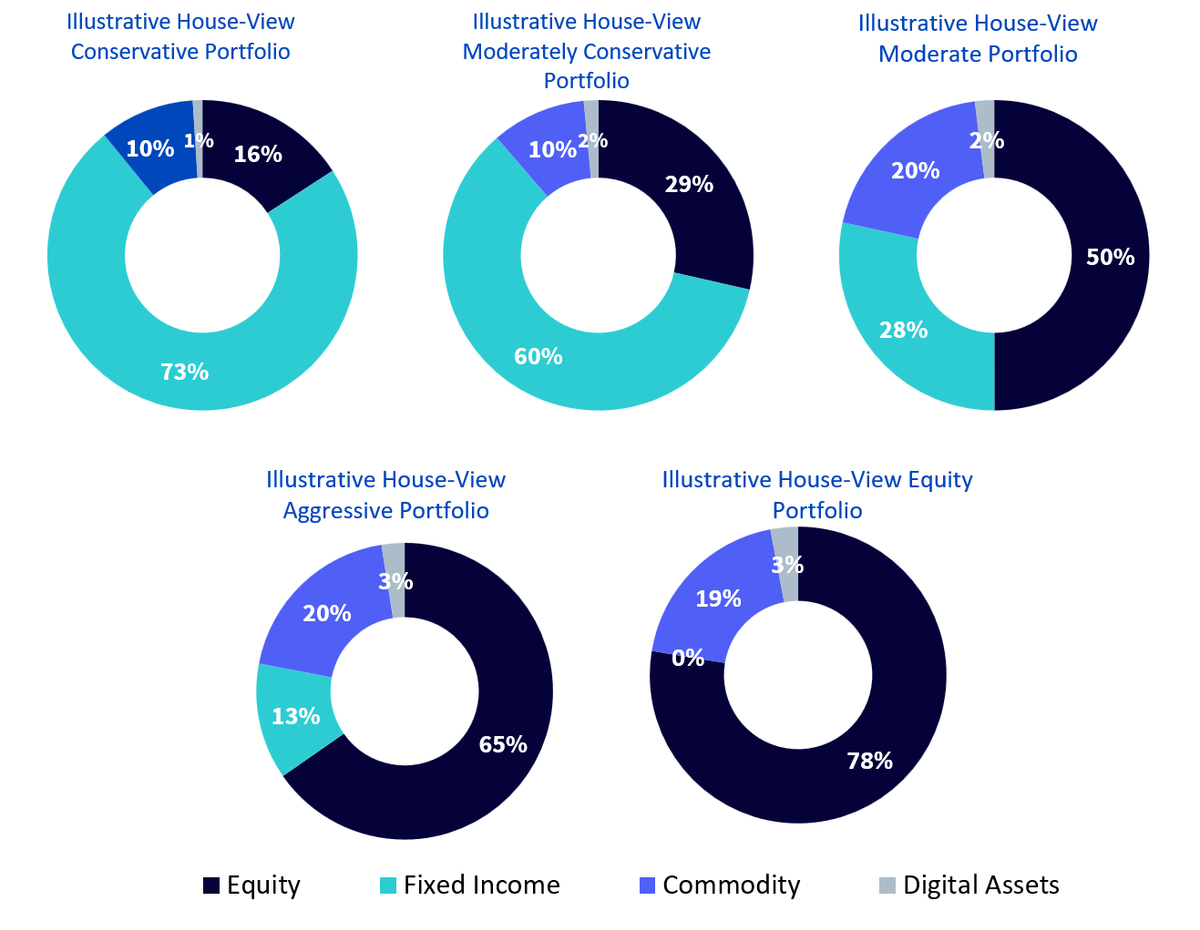
Source: WisdomTree. As of 31 December 2024.
Each house-view model portfolio combines equities, fixed income, thematic strategies, commodities, and digital assets. Figure 2 highlights the Aggressive Model Portfolio as an example, illustrating both the strategic baseline and the allocation after implementing tactical overlays.
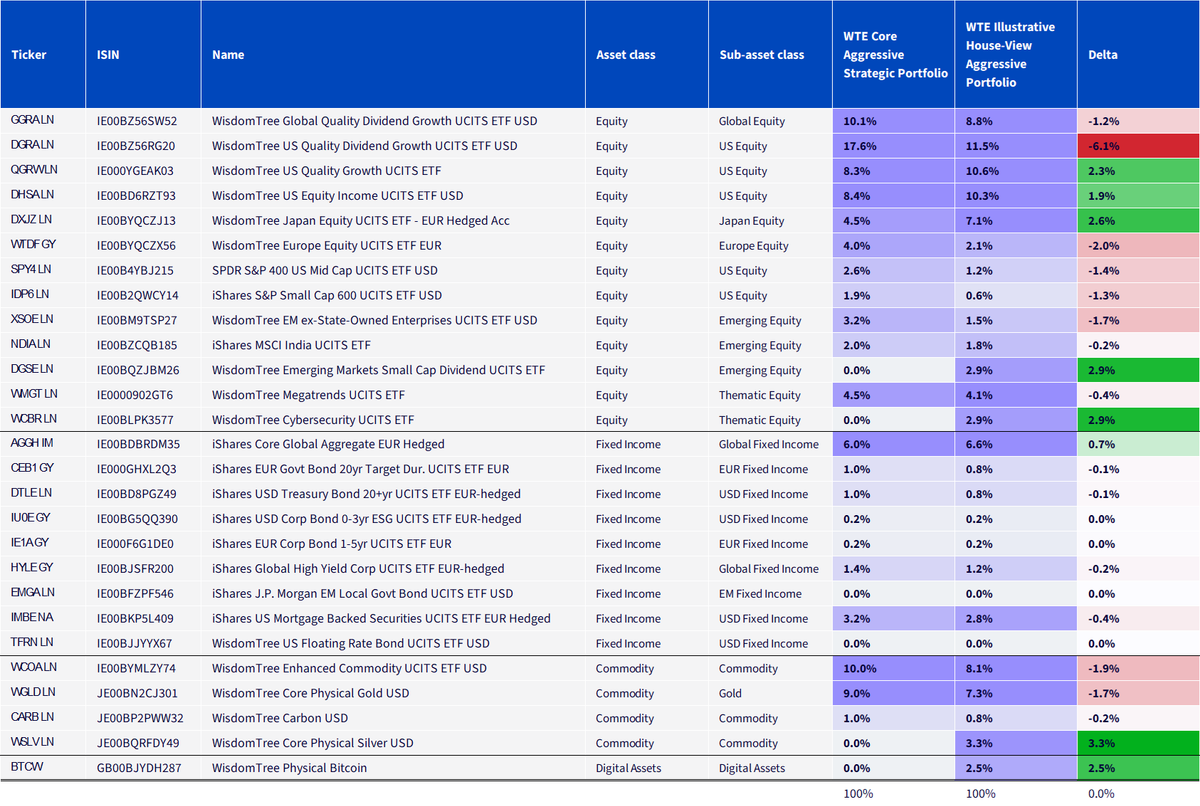
Source: WisdomTree. As of 31 December 2024.
Equity Sub Portfolio | Illustrative House-View Aggressive Model Portfolio | MSCI AC World |
|---|---|---|
Weight | 65.3% | |
Return on Equity | 17.8 | 14.1 |
Return on Asset | 5.4 | 2.3 |
Price to Earnings | 22.1 | 22.6 |
Price to Book | 3.1 | 3.3 |
Forward Dividend Yield | 2.08% | 1.86% |
Country Allocation | ||
Developed Markets | 89.52% | 90.03% |
Emerging Markets | 10.48% | 9.97% |
US | 68.36% | 66.56% |
Europe | 7.69% | 13.38% |
Japan | 11.98% | 4.83% |
Market Cap Split | ||
Large Cap | 79.10% | 95.64% |
Mid Cap | 14.32% | 4.33% |
Small Cap | 6.58% | 0.04% |
Source: WisdomTree, FactSet, Bloomberg. As of 31 December 2024.
Overall, the equity portion of our sub-portfolio exhibits a clear overweight to Japan and a small one to emerging markets, while European equities are clearly underweighted. Through our investment in small cap directly, but also indirectly in thematic equity, the proportion of mid and small caps is higher in our portfolio.
The portfolio's fundamentals reflect our continued focus on high-quality, highly profitable companies with increased returns on equity and return on assets.
Sector-wise, the portfolios exhibit only small overweight or underweights to the market. Financials is the biggest underweight across all the portfolios. The underweight is also net in Communication Services and Utilities. Energy is also underweighted for the most conservative portfolio. Consumer Staples is the biggest overweight.
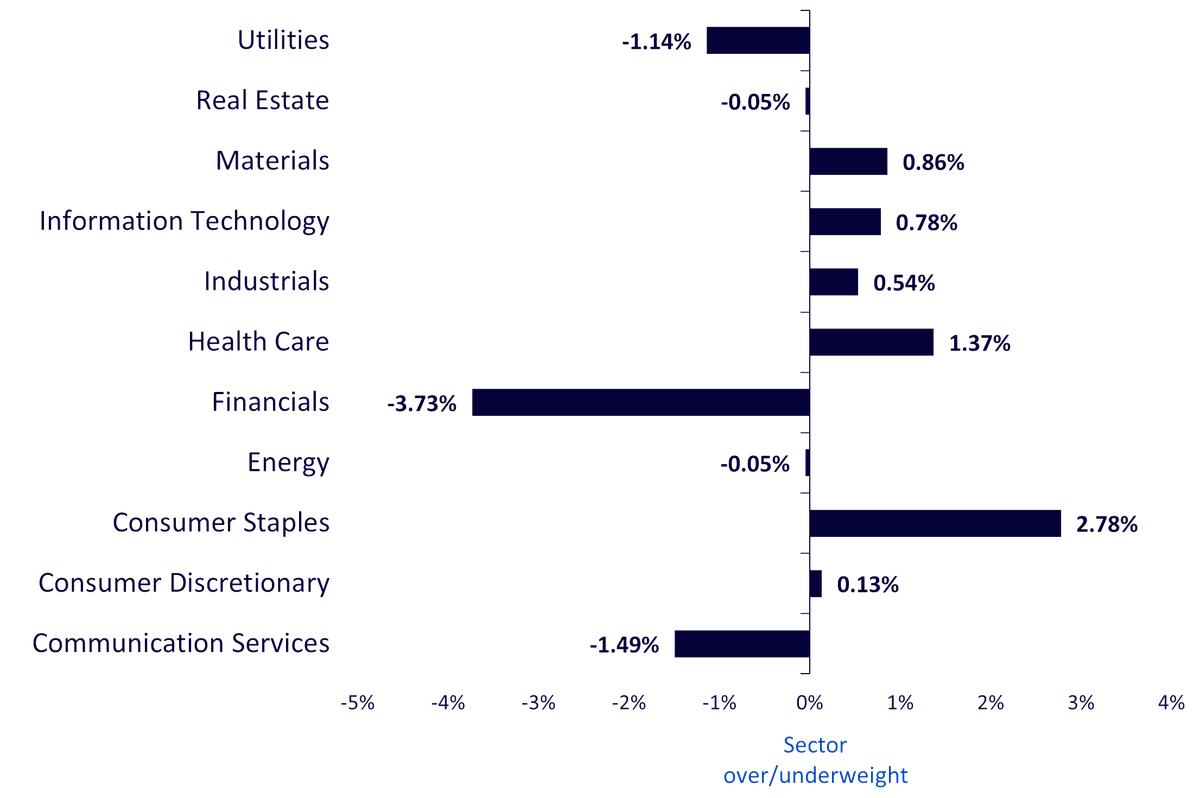
Source: WisdomTree, FactSet, Bloomberg. As of 31 December 2024.
Our current tactical stance seeks to capitalise on near-term market opportunities while reinforcing our strategic pillars of quality, diversification, and long-term growth. Specifically, we balance Large-Cap Value with High-Quality Growth in a barbell approach to navigate today’s rate environment and economic backdrop. We also emphasise Japanese equities, driven by corporate governance reforms, policy support, and valuation advantages, as well as emerging market small caps for their local revenue focus and growth potential. Outside of equities, we see silver and bitcoin as targeted diversifiers that can offer upside potential amid structural and technological shifts.
By integrating these tactical overlays with our core strategic allocations, WisdomTree’s model portfolios remain positioned to adapt to evolving market conditions and capture multiple sources of alpha. We continue to monitor macroeconomic developments, policy changes, and global investment themes, all with the aim of delivering consistent risk-adjusted returns across a range of market scenarios.
The full WisdomTree Market Outlook can be viewed here.
1 WisdomTree, March 2025.

Associate Director, Quantitative Research at WisdomTree in Europe
Luca is an Associate Director in WisdomTree Europe's Research team, where he conducts quantitative research to enhance or develop new investment strategies, particularly in commodities and thematic equities. He also focuses on portfolio construction and optimisation. Before joining WisdomTree in 2022, Luca worked as a Quantitative Portfolio Manager at Euclidea SIM, a Milan-based fintech where he quantitatively managed multi-asset portfolios and developed and implemented statistical and machine learning models for investment strategies and fund selection. Luca holds a Master's degree in Finance from Bocconi University, Milan.


