

US tax cuts: small cap and dividend growth strategies to benefit
Published 1 December 2017

Contributor
US equities have risen to record levels over the past year, based on expectations of positive macro data, policy factors and corporate tax cuts. The prospect of tax cuts, which flow through to shareholders in the form of higher earnings and potentially higher dividends, has helped justify the relatively elevated valuations that the equity market exhibited in 2017.
A key challenge for investors this year has been the high level of uncertainty in relation to prospective corporate tax rates. At the start of the year, the market was expecting a 15% marginal rate of corporate tax. However, a flat rate of 20% has now been proposed and appears more likely to be adopted. Policymakers have also targeted multinationals’ foreign profits, proposing a one-off 12% tax on liquid assets such as cash and securities, and a 5% tax on illiquid assets including factories and property. Such proposals have created expectations of special dividend windfalls, due to the potential repatriation of substantial cash balances held overseas, particularly in the technology sector, and to a lesser extent the health care sector.
In the context of these revised proposals, we examine the benefits to a number of US equity strategies and the impact on valuations.
Valuations to fall
At a broad market level, the proposed tax changes are set to reduce the S&P 500’s current effective tax rate of just under 28%, to 19.7%. This reduction reflects the 69% share of domestic profits at the index level. Earnings would increase for many S&P 500 constituents, and consequently, the P/E ratio of the index would fall below 20x. So which WisdomTree indices are best placed to capitalise as a result?
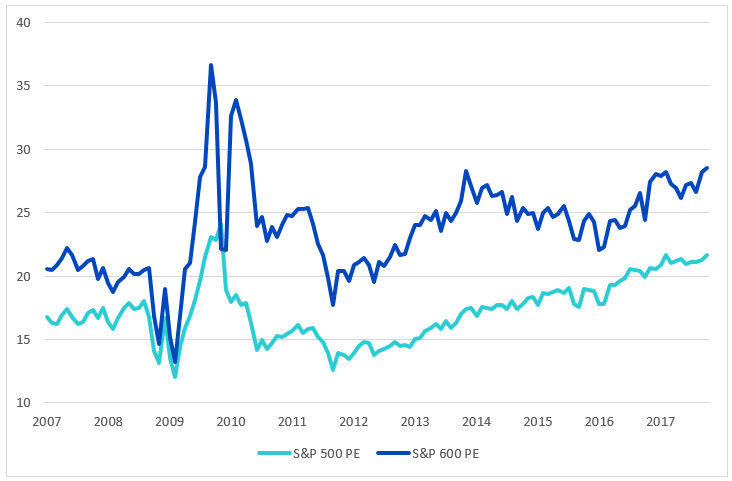
Figure 1: US equities are at elevated valuations (US equity indices’ average PE ratio over time)
Source: Bloomberg
Smaller companies to benefit
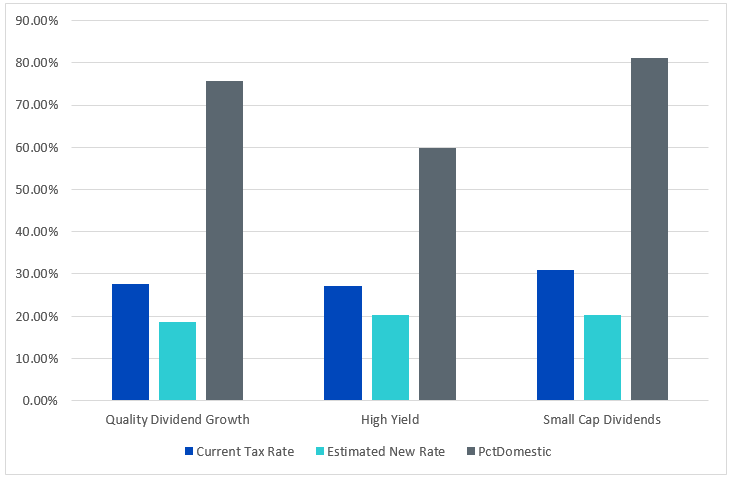
Given the nature of the tax proposals, companies with a bias towards domestic earnings, such as small and mid-cap companies, will benefit more from a shift to a 20% marginal tax rate. It is estimated that the effective tax rate for companies of this size will decrease significantly, from close to 31% to just over 20%.
The WisdomTree US SmallCap Dividend Index, for which domestic earnings account for over 81% of total profits, should be a beneficiary. From a valuation perspective, the lower tax rate would reduce the index’s P/E ratio from 23.8x to 20.6x, based on a 15.6% increase in earnings.
In contrast, other small cap indices, whilst benefitting from an aggregate tax rate reduction from 32.3% to 21.2%, will still remain on relatively elevated valuations. For example, the P/E ratio of the S&P 600 SmallCap Index is expected to decline from 29.5x to 25.3x. Unlike the WisdomTree Index which focuses on dividend-paying small-cap stocks, the S&P 600 includes stocks irrespective of their earnings or dividend policy. The result is that the index has a considerably higher valuation.
Dividend growth potential
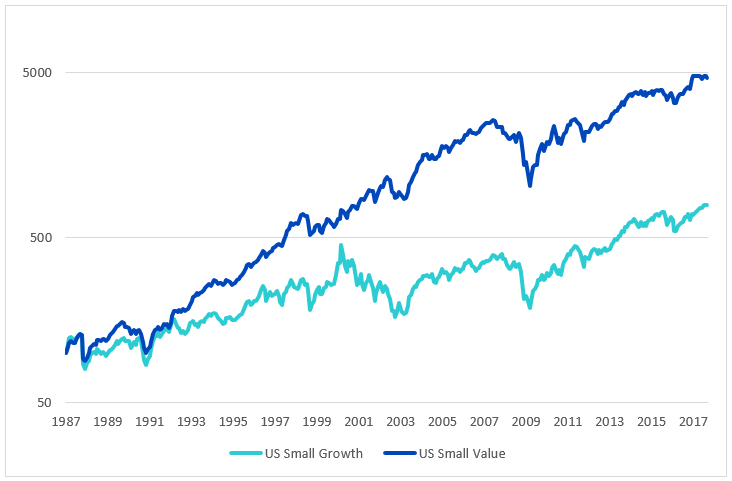
The focus on valuation is an important feature of small-cap investing, as value has consistently outperformed growth over time. When considering small-cap exposure in the US equity market a focus on dividend-paying stocks provides a value tilt, whilst also offering an enhanced way of accessing size as a risk premia.
Figure 2: Small-cap value outperforms growth (Average value-weighted monthly returns: Small LoBM vs Small HiBM)
Source: Fama French Library
Another index that should benefit from lower tax rates is the WisdomTree US Quality Dividend Growth Index. This Index focuses on dividend-paying companies with quality fundamentals including high return on equity and return on asset rankings, and long-term expected earnings growth.
Although this Index has a slightly lower bias to domestic US profits at 75.7%, the estimated tax benefit is still significant, with a potential tax rate reduction from 27.7% to 18.7%. Critically, the Index’s P/E ratio could fall from 20.9x to 18.6x, resulting in a lower valuation than the broad US equity market, despite higher than expected earnings growth.
Figure 3: Impact of tax cuts on WisdomTree US equity indices, as of October 2017
Source: WisdomTree
Overall, WisdomTree’s US equity indices, which typically focus on dividend-paying stocks that have positive earnings, are set to benefit from the revised proposed tax cuts. We highlight small-cap dividend-paying stocks and quality dividend growth opportunities as key beneficiaries of the changes, as valuations look attractive from a post-tax cut perspective.
You may also be interested in reading…
+ US corporate tax cuts: What’s the upside for equities?
+ Why you can't afford to miss European small caps
+ Why European investors are allocating to growth strategies
Related products
+ WisdomTree US SmallCap Dividend UCITS ETF (DESE)
+ WisdomTree US Quality Dividend Growth UCITS ETF - USD (DGRW)
About the contributor
