
BTCW LN
WisdomTree Physical Bitcoin

Published 19 March 2024

Head of Research, WisdomTree Europe.
After a strong performance in 2023, bitcoin rose 157% over the year, and an eventful January 2024 with the launch of 11 spot bitcoin Exchange-Traded Funds (ETFs) in the US, the signs are looking positive for cryptocurrencies. Looking toward the remainder of the year we note that many bullish catalysts are already in place and could push the price of cryptocurrencies up:
The performance of cryptocurrencies in February and early March is clearly not leading us to review our expectations. While predicting a price target for crypto is a fool’s errand, if history is any guide, we could see a supply demand shock that could push bitcoin to reach new highs in the next 18 to 24 months.
When looking at the adoption of technological innovations over time, we see that they all go through the same cycle – starting from the early adopters all the way up to mass adoption. As time goes by, innovation has tended to be adopted at a faster pace. The internet went though a very fast adoption cycle going from less than 10 millions users in 1992 to a billion users in 2005; a period of 13 years. Bitcoin went already from 1 million users in 2016 to 350 million in 2021. It is expected that the billion users mark will be breached as early as 2025, only nine years after.
This exponential adoption speed is one source of extra demand that could put pressure on an already limited supply. Let’s not forget that at the time of the fourth halving, 96.9% of all possible bitcoins will have already been issued.
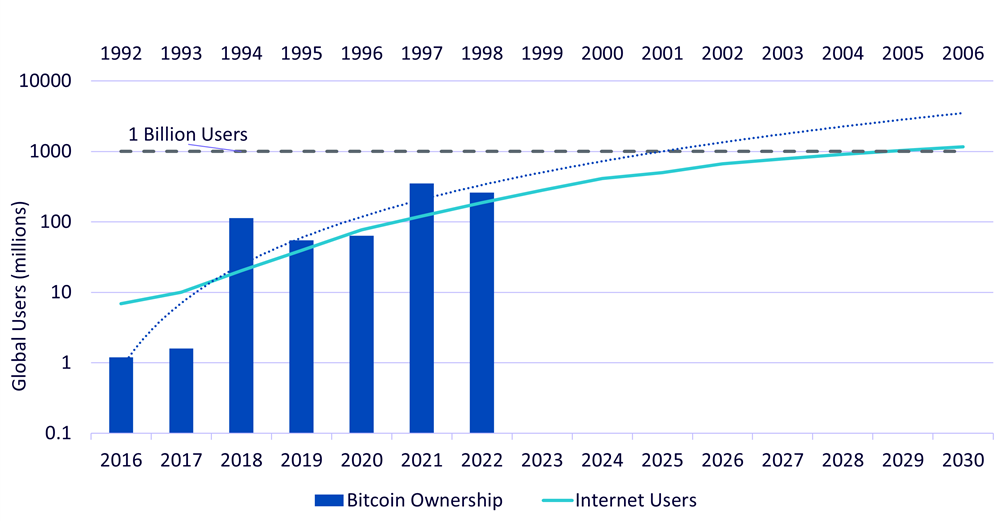
Sources: Our World in Data, based on International Telecommunication Union (via World Bank) and UN (2022). Raoul Pal, Global Macro Investor, Coinshares, WisdomTree
In Europe, physically backed cryptocurrencies Exchange-Traded Products (ETPs) have been available for years. At WisdomTree we launched our first Bitcoin ETP in 2019 and for the last five years we have been demonstrating that we are leading through the birth of a new asset class – one that should be part of any diversified, multi-asset portfolios. And, after initially feeling lonely in the cryptocurrency space, we are now seeing the finish line so to speak. With the launch of spot bitcoin Exchange-Traded Funds (ETFs) in the US on 10 January, regulated cryptocurrency investment vehicles are now available in most jurisdictions and discussions around the inclusion of crypto in portfolios has moved on from “why?” to “how much?”. Established multi-asset fund managers, such as Blackrock, are now adding Bitcoin to their portfolios. We are well past the point where managers were worried to be the first to add bitcoin to their asset allocation.
The last asset to go through an institutionalisation phase was gold. Before the launch of GLD in 2004, investors would have needed to find ways to store physical gold, creating a significant operational barrier to institutional investment. The launch of GLD opened the door to the institutionalisation of Gold and its inclusion in multi asset portfolios leading to a price rally that never really stopped. Over the last 20 years the price of gold has never dropped even close to the pre-GLD levels.
The extra demand created by investors around the world having easy access to the asset, combined with a constrained supply, led to price increase. The $7.6 billion of NET flows that poured in spot bitcoin ETF in the US in the space of eight weeks could be just the start.1
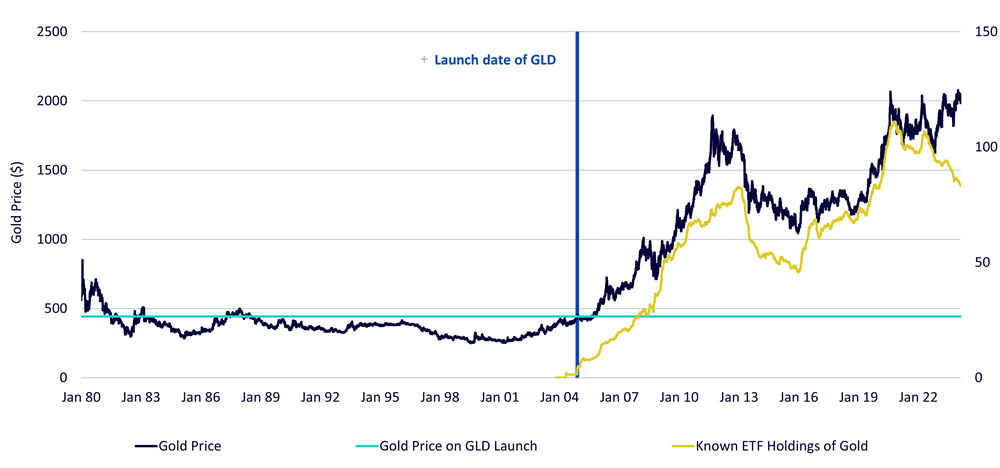
Source: Bloomberg, WisdomTree. From 1st January 1980 to 14 February 2024. In USD. GLD stands for SPDR Gold Shares and is the biggest Gold Exchange Traded Product in the world. Historical performance is not an indication of future performance and any investment may go down in value.
The “halving” refers directly to the reward miners get for solving the proof-of-work algorithm. This reward is expected to half again in April 2024 as coded in the bitcoin “monetary policy”. Historically, previous halvings have led to price increases both before the halving itself, but mostly after it. Following the previous halvings we observed in the 15 to 18 months following percentage gains of:
Even a modest 100% gain from the current levels could lead us to bitcoin levels above $100k.
Min in the two years prior | Date of minimum | Days of min before halving | Gain pre halving | Level on halving | Gain post halving | Days of max after halving | Date of new high | Post halving max level | |
|---|---|---|---|---|---|---|---|---|---|
First halving | 0.2 | 06/12/2010 | 723 | 6075.0% | 12.35 | 9106.5% | 366 | 29/11/2013 | 1137.0 |
Second halving | 183.1 | 14/01/2015 | 542 | 260.9% | 660.7 | 2782.0% | 526 | 17/12/2017 | 19041.6 |
Third halving | 3156.9 | 14/12/2018 | 514 | 173.6% | 8636.21 | 684.3% | 547 | 09/11/2021 | 67734.0 |
Fourth halving | 15632.0 | 21/11/2022 | 511 | 75% (?) | 50000 (?) | 100% (?) | 530 (?) | September 2025 (?) | 100,000 (?) |
Source: WisdomTree.
Moving on to other cryptocurrencies, in 2024 Ethereum is expected to make the ‘proto-dank sharding’ upgrade, which will enable cheaper and faster transactions for layer 2 solutions. Layer 2 solutions are protocols that run on top of Ethereum and handle transactions off-chain, bundling and settling them on Ethereum, reducing the congestion and fees on the main network.
With these upgrades, Ethereum aims to solve the scalability problem that has plagued many blockchain platforms and to gain an edge over its competitors, such as Solana, which claims to offer higher throughput and lower costs. Ethereum’s vision is to become the base decentralised blockchain that supports a variety of layer two solutions and decentralised applications (dApps), creating a web3 world where users have more control, privacy, and freedom over their online activities. This is a compelling scenario for Ethereum investors.
The full outlook can be viewed here.
1 Source: WisdomTree, Bloomberg. As of 1st March 2024

Head of Research, WisdomTree Europe.
Pierre Debru leads WisdomTree’s European research team and plays a pivotal role in the strategic direction of our European research efforts. His key areas of expertise extend across equity factors and quantitative strategies, portfolio construction and model portfolios, and thematic and crypto investments. Before joining the company in 2019, Pierre worked in Investment Research for DWS and the Xtrackers range for over five years. During this period, he focused on smart beta investments, model portfolio construction and thought leadership. Pierre has over 20 years of experience in investments and structured asset management. He graduated from Ecole Central Paris and obtained a Master of Science in Mathematics applied to Finance.

