


Physical AI: investing in humanoids, drones and the automation of the real economy
Published 18 February 2026

Blake Heimann
Senior Associate, Quantitative Research
Key Takeaways
- AI is entering a new phase, shifting from digital applications to physical systems that directly influence production, logistics and mobility.
- Physical AI adoption is accelerating due to structural forces including labour shortages, defence investment and industrial reshoring.
- The WisdomTree Physical AI, Humanoids and Drones UCITS ETF offers diversified exposure to companies at the forefront of Physical AI development, where intelligence is being embedded directly into machines, infrastructure and other real-world applications.
- Related Products WisdomTree Physical AI, Humanoids and Drones UCITS ETF - USD Acc Find out more
Why the next phase of artificial intelligence (AI) adoption has arrived
In early January 2026, investors and industry leaders arrived in Las Vegas for CES expecting the familiar showcase of new technology. What stood out instead was the presence of humanoid robots throughout. Though largely prototypes, they marked a turning point: artificial intelligence was no longer confined to screens and software, but beginning to take physical form.
The shift was clearest in Boston Dynamics’ Atlas, named ‘Best Robot’ at the Best of CES 2026 Awards and positioned within a long-term industrial roadmap. Hyundai has indicated plans to deploy Atlas in US manufacturing environments as early as 2028. Similar momentum is building elsewhere. China’s UBTECH expects to deliver more than 5,000 humanoid robots in 2026 for industrial use, signalling the first move from demonstration to early commercial scale.
Artificial intelligence enters the physical world
These developments reflect a broader transition in artificial intelligence. The first major wave of AI adoption transformed digital environments, software and content, with intelligence largely concentrated in the cloud. A second phase is now underway, extending intelligence into the physical world. This shift has been enabled by advances in AI model efficiency, edge computing and sensing systems, allowing AI to operate autonomously, respond in real time and execute physical actions. This marks a shift in how AI generates economic value, directly influencing production across the real economy.
What is Physical AI?
Physical AI refers to intelligent systems that can perceive their environment, make decisions and execute physical actions autonomously in real time. Unlike earlier forms of automation, these systems are designed to operate in dynamic, less structured environments.
Its scope spans multiple industries. Humanoid robots aim to introduce flexible automation into environments designed for humans. Drones and autonomous mobility systems are already deployed across defence, inspection, surveillance, logistics and transportation. Industrial robotics and smart manufacturing underpin modern automation, with applications extending into healthcare, agriculture, construction and other complex real-world settings.
Why Physical AI is accelerating now
The acceleration of Physical AI is being driven not only by technological progress, but by structural economic forces.
- Demographic pressures are creating persistent labour shortages across developed economies, particularly in manufacturing, logistics, healthcare and skilled trades, shifting automation from cost optimisation to operational necessity.
- Industrial-scale automation is reinforcing adoption. Robotics systems are embedded across factories and warehouses globally, generating operational data that improves performance and lowers unit costs.
- Supply-chain reshoring is driving renewed investment in domestic manufacturing, structurally improving the return profile of automation in higher-cost regions.
- Defence adoption is providing early volume, funding and validation for autonomous systems, with lessons increasingly transferring into commercial use.
Figure 1: Declining labour force participation accelerates the need for automation
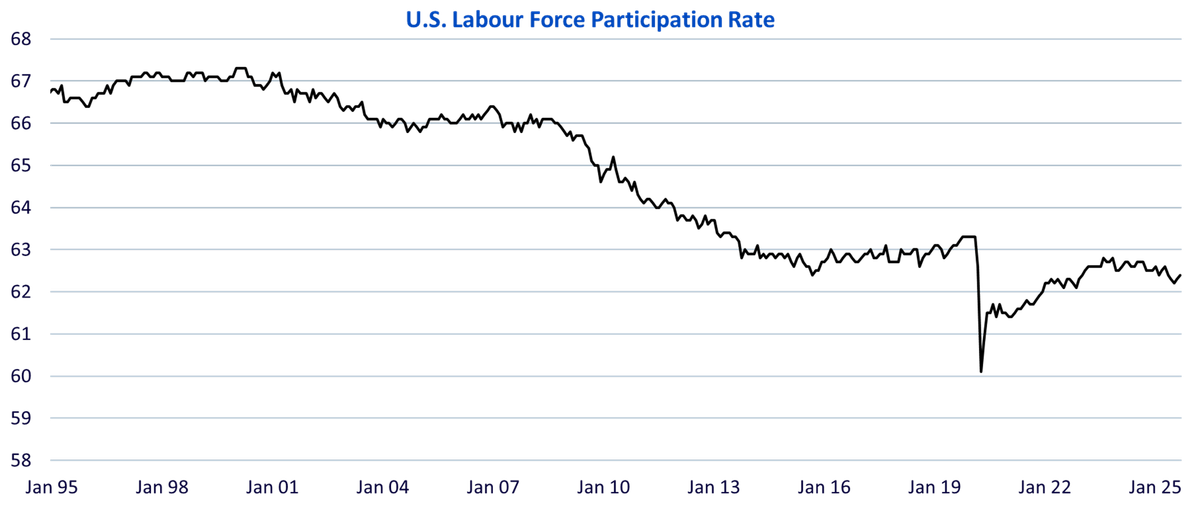
Source: Federal Reserve Economic Data, Federal Reserve Bank of St. Louis, https://fred.stlouisfed.org. Data Series: CIVPART for period January 1995 to September 2025. Data accessed December 2025. Historical performance is not an indication of future performance and any investments may go down in value.
An ecosystem approach to investing in Physical AI
As Physical AI scales across industries, the investment opportunity is best understood as an ecosystem rather than a single technology or use case.
The WisdomTree Physical AI, Humanoids and Drones UCITS exchange-traded fund (ETF) is designed to provide targeted exposure to this ecosystem through a structured, rules-based framework. The strategy focuses on five core Physical AI industry verticals: humanoid robotics, drones and autonomous mobility, smart manufacturing, logistics and supply-chain robotics, and emerging applications.
Each industry vertical is assigned a Thematic Score that reflects its importance within the Physical AI ecosystem, with a current emphasis on humanoid robotics, drones and autonomous mobility. Companies are further evaluated using a Relevancy Score, which measures the significance of their Physical AI activities based on technological capabilities, intellectual property, company disclosures and, where applicable, revenue exposure.
The approach is designed to prioritise companies with demonstrable exposure to Physical AI deployment, while limiting exposure to businesses where AI remains primarily experimental or only indirectly linked to revenues.
Constituents begin from an equal-weight baseline, with final weights adjusted using both scores to emphasise industry verticals and companies most closely tied to real-world Physical AI deployment, while maintaining diversification and liquidity discipline.
What this looks like in practice
The ETF is a modified equal-weighted portfolio of approximately 60 companies, with allocations tilted toward segments where Physical AI adoption is visible and long-term growth potential is strongest.
Figure 2: Top 20 constituents
Name | Physical AI Thematic Vertical | Thematic Score | Relevancy Score | Weight (%) | |
|---|---|---|---|---|---|
1 | Ondas Holdings | Drones / Autonomous Mobility | 3 | 2 | 6.41 |
2 | UBTech Robotics | Humanoid Robotics | 3 | 3 | 4.49 |
3 | AeroVironment | Drones / Autonomous Mobility | 3 | 3 | 4.12 |
4 | Rainbow Robotics | Humanoid Robotics | 3 | 2 | 3.34 |
5 | FANUC | Next-Gen Factories (Smart Manufacturing) | 2 | 3 | 3.11 |
6 | Joby Aviation | Drones / Autonomous Mobility | 3 | 2 | 3.03 |
7 | Tesla | Humanoid Robotics | 3 | 2 | 3.03 |
8 | NVIDIA | Humanoid Robotics | 3 | 2 | 2.97 |
9 | Xpeng | Humanoid Robotics | 3 | 2 | 2.93 |
10 | Pony AI | Drones / Autonomous Mobility | 3 | 2 | 2.9 |
11 | Xiaomi | Humanoid Robotics | 3 | 2 | 2.88 |
12 | Yaskawa Electric | Next-Gen Factories (Smart Manufacturing) | 2 | 3 | 2.83 |
13 | Red Cat Holdings | Drones / Autonomous Mobility | 3 | 2 | 2.53 |
14 | Siasun Robot & Automation | Next-Gen Factories | 2 | 3 | 2.47 |
15 | Harmonic Drive Systems | Humanoid Robotics | 3 | 1 | 2.17 |
16 | Symbotic | Next-Gen Logistics & Supply Chain Robotics | 2 | 3 | 2.11 |
17 | Shenzhen Dobot | Next-Gen Factories (Smart Manufacturing) | 2 | 3 | 1.82 |
18 | RoboSense Technology | Drones / Autonomous Mobility | 3 | 1 | 1.79 |
19 | ROBOTIS | Drones / Autonomous Mobility | 3 | 1 | 1.79 |
20 | Allegro MicroSystems | Next-Gen Factories (Smart Manufacturing) | 2 | 2 | 1.69 |
Weight in top 20: | |||||
Source: WisdomTree, Bloomberg. Weights as of January 6, 2026. The index was launched on October 31, 2025. You cannot invest directly in an index. Historical performance is not an indication of future performance and any investments may go down in value.
In humanoid robotics, breadth is reflected through exposure to both end-system developers, such as UBTECH, Boston Dynamics (via Hyundai), XPeng, and Xiaomi, as well as component suppliers. Companies such as Schaeffler and Robotis provide actuators and motion systems that underpin humanoid joints and extremities.
In drones and autonomous systems, the portfolio captures scaled deployment driven by defence demand. AeroVironment illustrates this dynamic, with US and allied government contracts lifting total contract ceiling awards to a record US $3.5 billion in fiscal 2026.
In industrial automation, FANUC (Fuji Automatic Numerical Control) highlights how Physical AI is being embedded into existing manufacturing platforms. By integrating on-robot intelligence alongside NVIDIA’s Jetson edge-computing platform and Isaac Sim digital-twin technology, FANUC is accelerating the transition from simulation to factory deployment at scale.
At the enabling layer, NVIDIA and Siemens extend this exposure beyond individual machines. NVIDIA provides the intelligence layer across industrial robots and emerging humanoid systems through its Jetson platform and GR00T foundation model, while Siemens integrates AI-driven automation software, digital twins and simulation to coordinate intelligent machines within adaptive, self-optimising factory environments.
Around 60% of exposure is allocated to humanoid robotics, drones, and autonomous mobility; the areas where Physical AI is moving most rapidly from experimentation to scalable deployment. The remainder is focused on established industrial robotics and automation platforms integrating advanced AI capabilities, alongside selective exposure to earlier-stage applications.
Geographically, the portfolio reflects where Physical AI deployment is most advanced. Approximately one quarter of exposure is allocated to China, reflecting integrated supply chains, manufacturing scale, and early commercial deployment of humanoid and autonomous systems. This is complemented by exposure to the United States and Japan, where defence spending, industrial automation and enabling technologies continue to drive adoption.
Figure 3: Industry vertical and country exposures
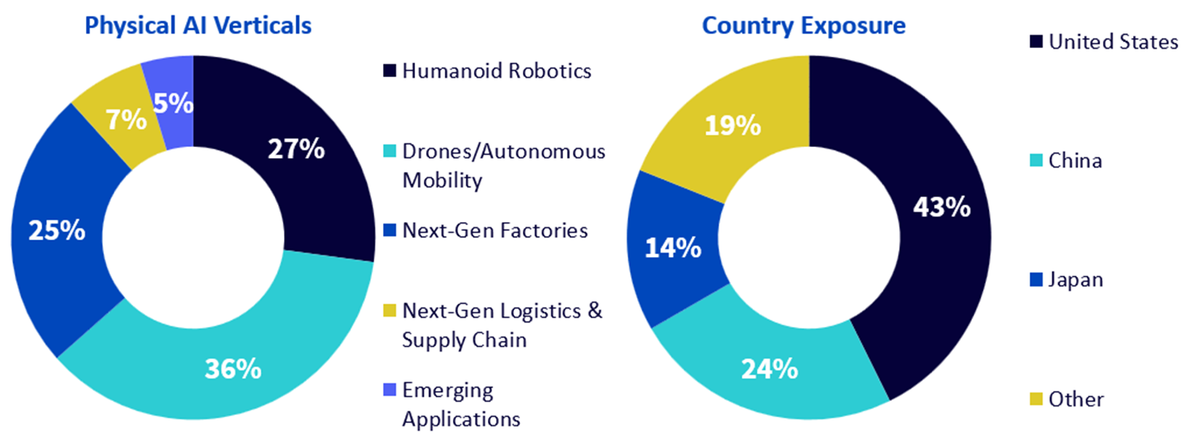
Source: WisdomTree, as of 6 January 2026. You cannot invest directly in an index. Historical performance is not an indication of future performance and any investments may go down in value.
Why this matters for investors
Physical AI represents the point at which artificial intelligence begins to reshape how goods are produced and moved. Structural forces, from labour shortages to defence investment and industrial reshoring, are turning deployment into a necessity rather than a choice. For investors, this creates an opportunity to access a productivity theme defined by real-world adoption rather than distant technological promises. The WisdomTree Physical AI, Humanoids and Drones UCITS ETF provides diversified exposure to the companies at the centre of this transition.
ETF Information: WisdomTree Physical AI, Humanoids and Drones UCITS ETF
Ticker | Exchange | ISIN | Bloomberg Code | Listing Currency | Base Currency | TER % |
|---|---|---|---|---|---|---|
WPAI | LSE | IE000LCKJ888 | WPAI LN | USD | USD | 0.45% |
PAIG | LSE | IE000LCKJ888 | PAIG LN | GBx | USD | 0.45% |
WPAI | Borsa Italiana | IE000LCKJ888 | WPAI IM | EUR | USD | 0.45% |
PAIW | Xetra | IE000LCKJ888 | PAIW GY | EUR | USD | 0.45% |
WPAI | Paris | IE000LCKJ888 | WPAI | EUR | USD | 0.45% |
WPAI | SIX | IE000LCKJ888 | WPAI SW | USD | USD | 0.45% |
Categories
Related articles

About the contributor

Blake Heimann
Senior Associate, Quantitative Research
Blake Heimann joined WisdomTree in 2020 and, in his current role as Senior Associate, supports the creation, maintenance, and reconstitution of our indices. Blake began his career in finance in 2017 as an Analyst at TD Ameritrade, and later a Quantitative Analyst with focuses on research and development of machine learning applications in finance. Blake has bachelor’s degrees in Mathematics and Economics from Iowa State University, as well as his Masters in Computer Science at Georgia Tech, with a specialization in Machine Learning. He is currently pursuing a Masters in Finance from the London School of Economics.