
WTAI LN
WisdomTree Artificial Intelligence UCITS ETF - USD Acc

Published 24 November 2025

Senior Associate, Quantitative Research and Multi Asset Solutions
The latest earnings from companies exposed to artificial intelligence (AI) show continued strength across the supply chain. Demand for advanced manufacturing, memory and connectivity remains robust, while hyperscalers have reaffirmed higher capital spending plans and customers are still securing compute capacity ahead of need. Cloud revenues remain resilient, and several software firms are beginning to see early benefits from AI deployment. Together, these trends offer a solid foundation for assessing the next phase of AI investment and adoption.
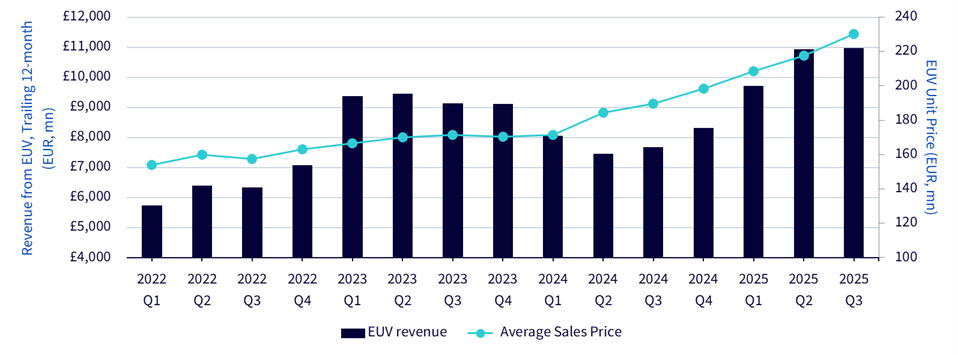
At the top of the AI supply chain, ASML remains the only company in the world that makes extreme ultraviolet (EUV) scanners, the machines used to produce the most advanced computer chips. In its third-quarter update, the company reported steady demand for both EUV and deep ultraviolet (DUV) systems, driven by the ongoing growth of AI-related technology. Orders and future demand were further supported by the rollout of ASML’s next generation of tools. Strong interest in EUV systems has also pushed prices up by around 21% over the past year.
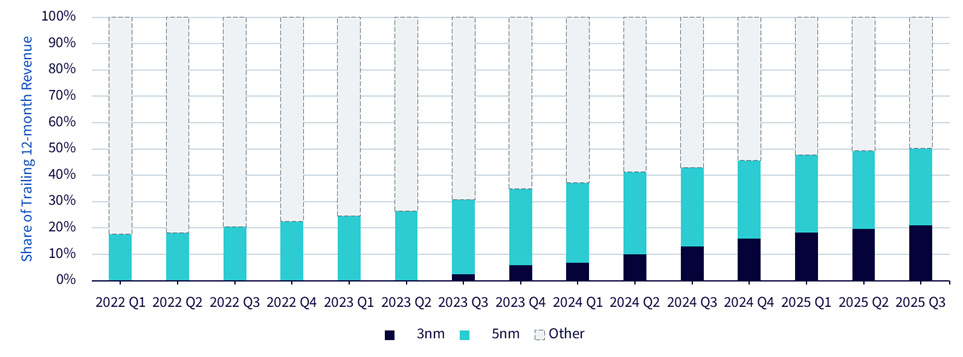
At the chip manufacturing stage, TSMC (Taiwan Semiconductor Manufacturing Company) remains the clear industry leader and a good indicator of overall AI-related demand. In its third-quarter results, the company reported that 3-nanometre (nm) chips, its most advanced and efficient semiconductors, made up a record 22.4% of total revenue. When combined with 5 nm chips, these cutting-edge products now account for about half of TSMC’s revenue, up from less than 20% previously. This shift highlights the surge in demand for advanced chips used to power AI technologies.
Beyond graphics processing units (GPUs), the tightest supply constraints today are in memory and connectivity, with power and heat limits becoming increasingly significant. Shortages of memory chips, including dynamic random-access memory (DRAM), high-bandwidth memory (HBM), double data rate (DDR) and NAND flash, reflect the rapid build-out of AI infrastructure. A clear sign of this is the sharp rise in DRAM spot prices in recent months. As Samsung’s management noted in their latest earnings call: “It is expected that customers’ demand for next year will exceed our supply, even considering our investment and capacity expansion plan.”
These supply shortages were also evident in the latest results from Samsung and SK hynix. SK hynix reported record profits driven by booming orders for AI-focused memory (HBM) and expects more than 30% annual growth in demand for AI memory over the next five years. Samsung’s memory business also delivered record revenue, up around 20% year on year. Connectivity demand is rising in parallel. Astera Labs, a company specialising in high-speed data connections, reported third-quarter revenue of about US $231 million, up roughly 104% year on year. Overall, the ongoing expansion of AI infrastructure is benefiting the wider semiconductor sector, from memory and connectivity through to GPUs.
Hyperscalers continued to push capital expenditures (capex) higher in Q3 and pointed to another leg up in 2026. The combined capex of Alphabet, Amazon, Microsoft and Meta increased by roughly 65% year on year to an all-time high. Meanwhile, the three major cloud service providers among them: Alphabet, Amazon and Microsoft, reported strong cloud growth, which in turn is driving demand for AI infrastructure.
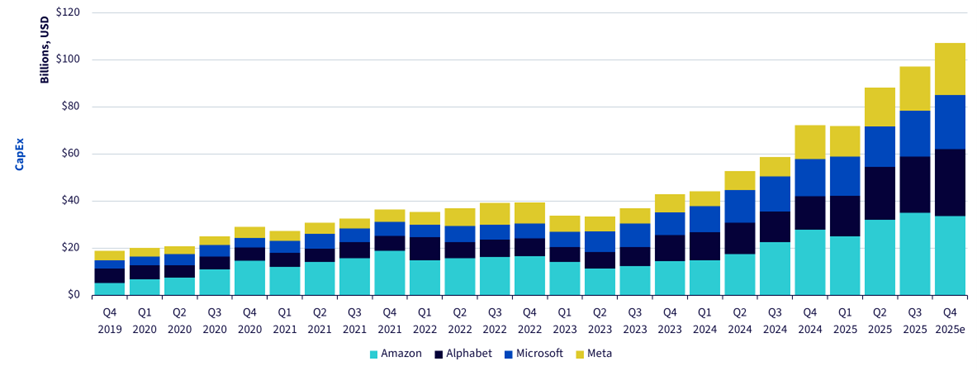
Alphabet raised its 2025 capex outlook again to US $91–93 billion and disclosed Google Cloud revenue growth of 34%, with backlog up to US $155 billion, a strong forward indicator of demand for compute and AI services. Meta guided to US $70–72 billion, with 2026 set to step up as training capacity scales. Microsoft’s Azure revenue grew 40%, and management indicated capex will step up again, with the CFO flagging more than $30 billion of spend in the current quarter to support AI infrastructure. Amazon’s AWS (Amazon Web Services) grew 20% year on year in Q3, its best pace since 2022, and the company highlighted a sharp increase in property and equipment purchases that depressed free cash flow, another clear sign that physical capacity is being added.
Compute demand is rising faster than self-build capacity, so large buyers are pre-securing supply from neocloud operators. The gating factor is often facility readiness rather than chips, with deployment timing tied to powered-shell availability.
CoreWeave illustrates this dynamic. Q3 revenue reached about US $1.36 billion and its contracted backlog rose to US $55.6 billion1, but guidance was trimmed after a third-party data-centre partner delayed a powered shell. Management emphasised that this was a timing issue and that customers extended contract windows, so demand and deal value remained intact.
Nebius reported a similar pattern of strong demand, with third-quarter sales rising 355% to US $146 million and capacity fully sold for the period2. The company also announced new multi-year contracts with large cloud customers, giving it better visibility on future revenue. Taken together, these developments suggest that customers are increasingly turning to neocloud providers to secure computing power in advance. The short-term changes in revenue mainly reflect how quickly new data-centre sites can come online, rather than a slowdown in demand.
The application cycle is still in its early stages, but earnings are showing more tangible signs. Palantir’s Q3 reported continued growth in commercial revenue alongside brisk adoption of its AI platform, and management emphasised deal velocity for AI-driven use cases. Akamai pointed to progress with its AI Inference Cloud and noted AI-related workloads as a contributor. These are small next to hyperscaler numbers, yet they mark a shift from pilots to production.
A broader look across large-cap companies shows the momentum building. In recent research from Morgan Stanley3, 28% of S&P 500 companies discussed a measurable AI cost or revenue impact this quarter; across the full index, 15% cited at least one measurable benefit, up from 14% in Q2 and 11% a year ago. This steady rise suggests that AI-driven revenue effects are beginning to extend beyond semiconductors and cloud computing.
Q3 points to an investment cycle that is broadening from wafers to workloads. Supply remains tight where it matters most, particularly in memory and connectivity, with power and cooling often dictating deployment pace. Buyers are still increasing capital plans and are pre-securing compute through neocloud contracts, which extend visibility beyond the next couple of quarters. Financial impact from AI application is now showing up in reported numbers, albeit from a small base.
Bubble concerns deserve context. Past manias left long-lived assets such as railway networks and fibre backbones. Today’s AI build involves faster-depreciating chips, but it is also creating durable capacity in data centre infrastructure and network fabrics, and it is generating revenue and backlog now rather than hypothetical demand later. Sector valuations remain below the most extreme levels seen in 2000, Nvidia’s forward price-to-earnings multiple is elevated but sits in the high-20s on recent readings, whereas Cisco peaked above 100x at the top of the 2000 cycle. This is not a prediction about future returns, but it does indicate a more moderate starting point than the extreme valuations seen during the dot-com era.
The WisdomTree Artificial Intelligence UCITS exchange-traded fund (ETF) (WTAI) was launched in November 2018 and is developed in partnership with industry experts, the Consumer Technology Association (CTA).
The ETF invests in three types of companies:
Rather than weighting companies by market capitalisation, the ETF uses an AI intensity score, calculated by the CTA. This score measures each company’s relevance and involvement within the AI ecosystem.
1Source: CoreWeave, third quarter 2025 results, 10 November 2025.
2Source: Nebius, third quarter 2025 financial results, 11 November 2025.
3Source: “Momentum Around AI Adoption Is Building”, Morgan Stanley, 06/11/2025.
WisdomTree Artificial Intelligence UCITS ETF - USD Acc

Senior Associate, Quantitative Research and Multi Asset Solutions
Baoqi Zhu joined WisdomTree in 2023 as a Senior Associate on the Research team. Baoqi focuses on quantitative research on thematic equity indices and portfolio solutions. Prior to WisdomTree, Baoqi spent over two years at Ernst & Young (EY) in their Quantitative Advisory Services, where he was involved in the research and development of quantitative risk models. Earlier in his career, Baoqi served as a quantitative analyst within a multi-asset structuring team at Maven Global for more than three years. His responsibilities included designing and optimising bespoke hedging strategies based on derivatives. Baoqi holds a MSc in Financial Engineering & Risk Management from Imperial College London and a BSc in Actuarial Science from Nankai University, China. He is also a certified Financial Risk Manager (FRM).


