
WCLD LN
WisdomTree Cloud Computing UCITS ETF - USD Acc

Published 10 July 2024

Global Head of Research
Do you remember November and December 2023, when the market expected a quick series of interest rate cuts from the US Federal Reserve Open Market Committee?
Those looking for a ‘high-duration’ equity exposure could say they found it during this period in SaaS companies. And then the rate cuts, as of the time of writing, did not come…
When we look at how the BVP Nasdaq Emerging Cloud Index has performed for the first six months of 2024, we see a return of -9.38%, during a time when the Nasdaq 100 Index returned 16.98% and the S&P 500 Index returned 14.48%3. In short, no one has been impressed with the returns of software stocks.
But returns are one thing—it is harder to look under the hood to get a better gauge of how software companies are doing.
The COVID-19 pandemic created an interesting backdrop for judging SaaS companies. Many of them were ideally positioned to help companies in other industries stay in business as the environment changed and different physical restrictions were imposed.
It’s also important to remember that one of the main reasons companies subscribe to software is to generate efficiencies—they’re not hoping that the accounting or compliance software will make those overall business functions cost even more. While some software packages could be at risk in a more difficult economic environment, others could actually have a tailwind.
ChatGPT, introduced to the world in November 2022, created an entirely new impression of what software can accomplish. This is another variable that all software companies need to contend with. It isn’t just thinking about the value proposition of the individual software package anymore—now it’s the value proposition relative to what generative AI software either can do already or may be able to do in the near future.
Against that background, we look to Figure 1 to see how revenue growth of software companies has been:
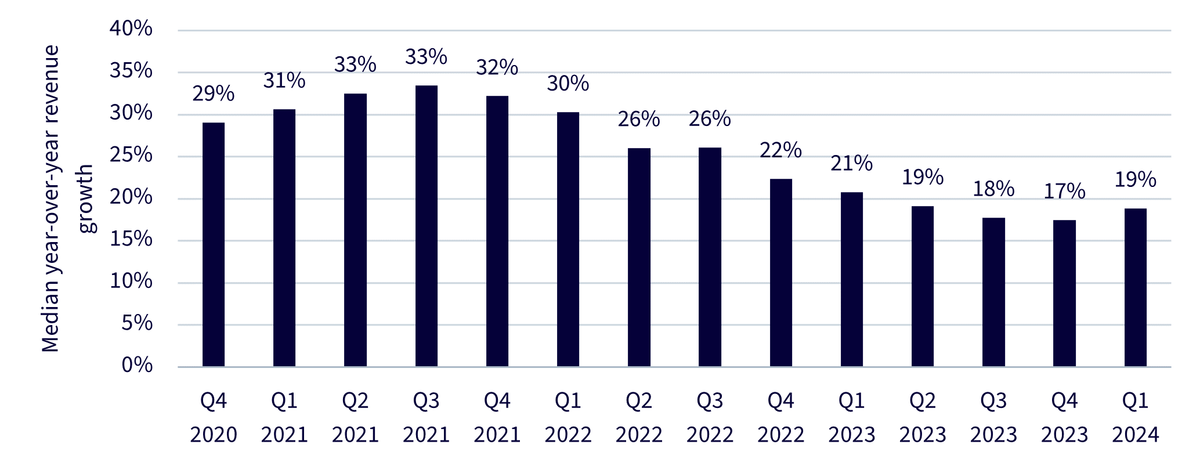
Source: WisdomTree, Bloomberg. To note, on 30 June 2024, the data for revenue growth based on the period that ended 30 June 2024 had not yet become public. It typically begins to become public about one month into the future as companies report their results for the period ended 30 June 2024. Historical performance is not an indication of future results and any investments may go down in value.
To prioritise ‘growth’ or ‘profitability’—at times, it feels like this is one of the primary questions in evaluating the performance of SaaS companies. When interest rates were at or near zero, and the government was printing more money than it ever had, it was clear that profitability was less important. However, currently, in an environment where money market interest rates are hovering around 5%, profitability is more important.
As we look at Figure 2, the median Free Cash Flow margin has gone from 0.9% in the third quarter of 2021 (the peak period in median revenue growth observed in Figure 1) to a level of 21.7% in the first quarter of 2024.
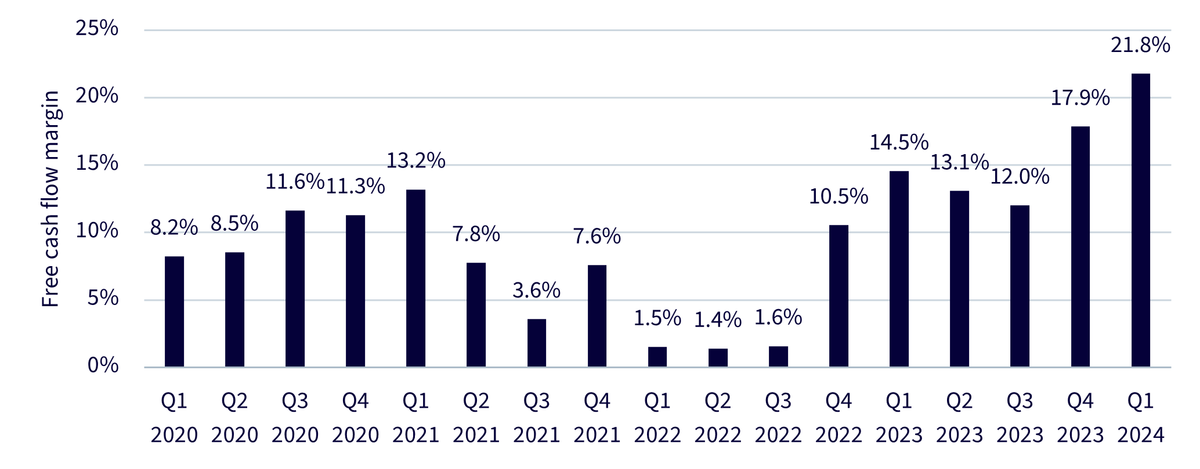
Source: WisdomTree, Bloomberg. To note, on 30 June 2024, the data for free cash flow margin based on the period of time that ended 30 June 2024 has not yet become public and typically begins to become public about one month into the future as companies report their results for the period ended 30 June 2024. Historical performance is not an indication of future results and any investments may go down in value.
Much has been written about revenue guidance being a bit of a ‘game.’ Is the goal genuinely to deliver as strong business results as possible, or is the game simply to manage revenue guidance so that it’s possible to say ‘guidance was beaten’? The reality is probably somewhere on a spectrum.
When we look at the percentage of companies that have beaten guidance, quarter by quarter, in Figure 3a, we see that the figure doesn’t change much. Most firms within the BVP Nasdaq Emerging Cloud Index have been beating guidance.
Possibly more interesting is the trend in the ‘median beat’, meaning that a higher number means that the guidance is being beaten by a greater percentage, and a lower number means that the guidance is being beaten by a lower percentage.
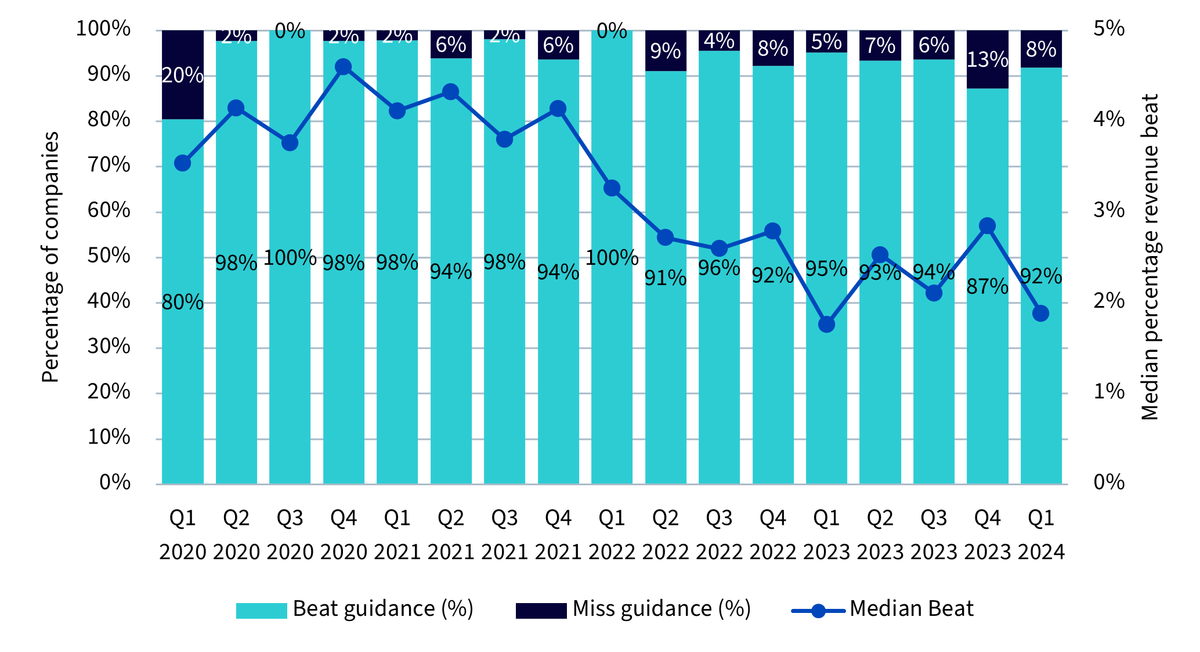
Source: WisdomTree, Bloomberg. The median beat denotes the median of volume by which reported sales exceed guided sales. To note, on 30 June 2024, the data is based on the period of time that ended 30 June 2024 has not yet become public and typically begins to become public about one month into the future as companies report their results for the period ended 30 June 2024. Historical performance is not an indication of future results and any investments may go down in value.
Figure 3b, however, may be more interesting as it relates to companies themselves shifting their guidance. In a sense, we can assume that companies want to provide guidance that they can beat, however slightly, so that the quarterly earnings press release can indicate ‘beating guidance’ instead of ‘missing guidance.’ If companies are doing this, however, once they know that conditions have changed, they would have to lower guidance to be able to turn around a ‘beat’ in the coming quarter.
The figures indicate a bit more movement—for instance, in the fourth quarter of 2023, we saw the raise guidance percentage go from 92% to 75%. We also see how the median revenue guidance raise has shifted from the 7-8% range to something closer to the 4-5% level.
Conditions may not be as positive as they were in late 2020 and 2021, but the true question is whether the fourth quarter of 2023 will be the toughest or if the rest of 2024 will be even more challenging.
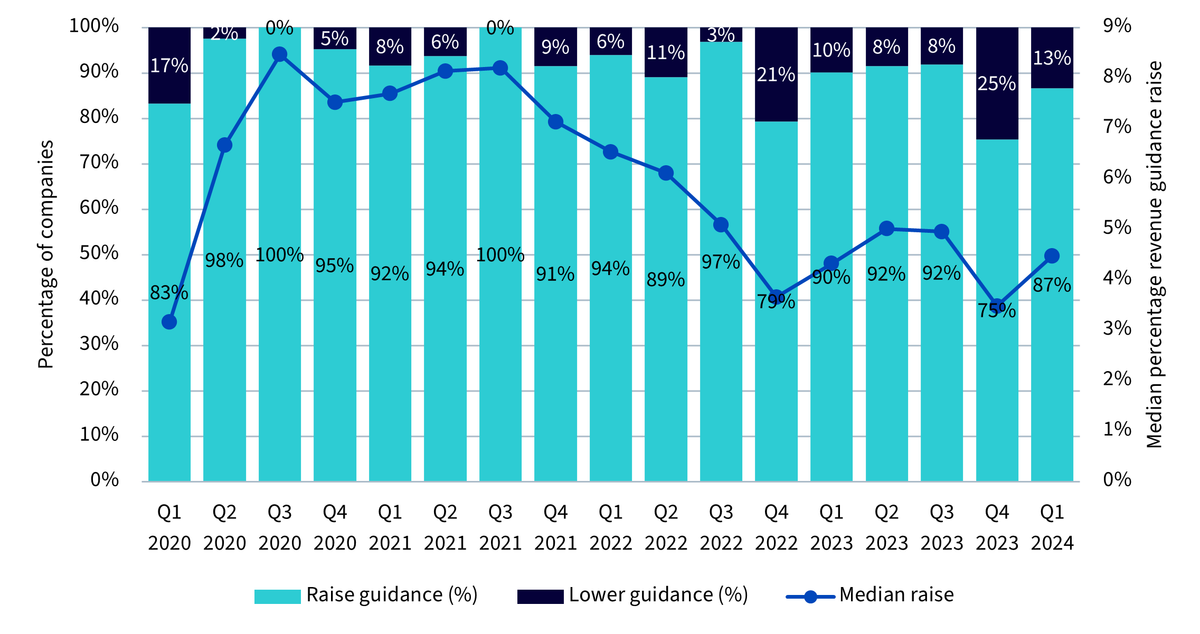
Source: WisdomTree, Bloomberg. To note, on 30 June 2024, the data is based on the period of time that ended 30 June 2024 has not yet become public and typically begins to become public about one month into the future as companies report their results for the period ended 30 June 2024. Historical performance is not an indication of future results and any investments may go down in value.
Sometimes, it makes sense to follow the momentum, which would mean, at least in July 2024, following the trend of some of the world’s largest technology companies seemingly ever higher. To be truthful, looking at Nvidia, Apple, Amazon, Microsoft, Meta, and Alphabet—it’s difficult to know if or when the trend will end. People cite the difference in return between the S&P 500 Index and the S&P 500 Equal-Weight Index as one measure of the lack of breadth in the market.
Emerging SaaS companies delivered strongly in terms of returns in 2023, but really only when it was assumed that US policy rates were about to be cut. As these cuts did not materialise during the first half of 2024, we saw a very tough performance environment. If it is expected that the US Federal Reserve may move in the second half of 2024, it may be that the trend of the largest companies outperforming shifts and opens up some room for emerging SaaS to exhibit a bit of recovery.
1 Source: Board of Governors of the Federal Reserve System (US), Market Yield on US Treasury Securities at 10-Year Constant Maturity, Quoted on an Investment Basis [DGS10], retrieved from FRED, Federal Reserve Bank of St. Louis; https://fred.stlouisfed.org/series/DGS10, June 27, 2024.
2 Source: Bloomberg.
3 Source: Bloomberg, with first six months of 2024 referencing December 31, 2023 to June 30, 2024.
WisdomTree Cloud Computing UCITS ETF - USD Acc

Global Head of Research
Christopher Gannatti began at WisdomTree as a Research Analyst in December 2010, working directly with Jeremy Schwartz, CFA®, Director of Research. In January of 2014, he was promoted to Associate Director of Research where he was responsible to lead different groups of analysts and strategists within the broader Research team at WisdomTree. In February of 2018, Christopher was promoted to Head of Research, Europe, where he was based out of WisdomTree’s London office and was responsible for the full WisdomTree research effort within the European market, as well as supporting the UCITs platform globally. In November 2021, Christopher was promoted to Global Head of Research, now responsible for numerous communications on investment strategy globally, particularly in the thematic equity space. Christopher came to WisdomTree from Lord Abbett, where he worked for four and a half years as a Regional Consultant. He received his MBA in Quantitative Finance, Accounting, and Economics from NYU’s Stern School of Business in 2010, and he received his bachelor’s degree from Colgate University in Economics in 2006. Christopher is a holder of the Chartered Financial Analyst Designation.
