

What’s Hot: A volatile week in oil as security-driven supply concerns counter demand concerns
Publié le 12 janvier 2024

What’s Hot: A volatile week in oil as security-driven supply concerns counter demand concerns
While the International Energy Agency (IEA) and Energy Information Administration (EIA) have been revising downward their oil demand forecasts for a number of months, the Organisation of Petroleum Exporting Countries (OPEC) has kept its forecasts at a rather optimistic level for some time (see Table 1).
Oil demand growth forecasts (million barrels per day)

Reduction in Saudi OSPs
However, last Sunday (January 7th 2024), Saudi Arabia, the largest and most influential OPEC member, cut its selling prices across most regions. The Official Selling Price (OSP, as a spread above the Oman and Dubai benchmarks) of the flagship Arab Light Crude to East Asia for example fell to the lowest level since November 2021. Markets interpreted this as Saudi conceding that oil demand is indeed soft, and the price of Brent crude oil fell 4.5% between the open and late afternoon on Monday 8th January.
Source: WisdomTree, Bloomberg. Relates to prices in February 2024, expressed in US$/barrel above the relevant benchmark. Relevant benchmarks: East Asia - Oman and Dubai; West Europe and Mediterranean Europe – Brent; North America - Argus Sour Crude Index. Historical performance is not an indication of future performance and any investments may go down in value.
Middle East export disruption in focus
The price weakness in Brent was not sustained for long and by Wednesday 10th January, most of the losses were recovered. The chief driver has been market concern about oil export supply disruptions in the Middle East. Attacks on ships passing through the Red Sea by Houthi rebels had gathered pace in December 2023 and escalated into January 2024. On 10th January, a British warship in an operation with US forces, shot down seven drones launched by Houthis in the Red Sea to repel the largest drone and missile attack to date. Further US air strikes against Houthis on 12th January lifted oil prices to erase all loses from earlier in the week.
Around the Red Sea are the Suez Canal and Bab el-Mandeb Strait choke points. According to EIA analysis, in H1 2023, 9.2 million barrels per day of oil and petroleum products passed through the Suez Canal and SUMED pipeline and 8.8 million barrels per day of oil and petroleum products passed through the Bab el-Mandeb Strait.
Suez Canal, SUMED pipeline and Bab el-Mandeb Strait chokepoints
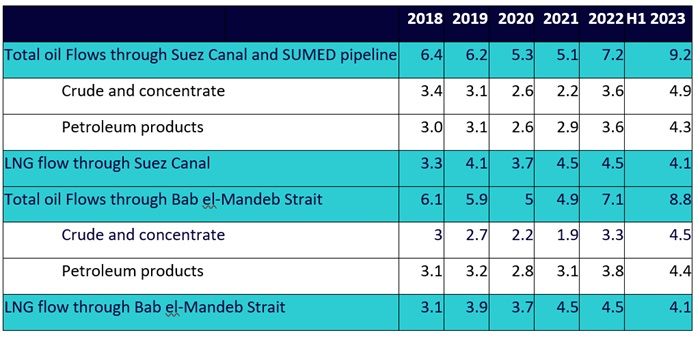
Source: EIA analysis based on Vortexa tanker tracking, December 2023. LNG=liquefied natural gas. Oil flows measured in millions of barrels per day and LNG measured in billion cubic feet per day. Historical performance is not an indication of future performance and any investments may go down in value.
The region is critical for global oil transportation. Oil and fuel tanker traffic through the Red Sea has not fallen significantly yet, unlike Asia-Europe container ships, which have chosen to divert around the Cape of Good Hope in South Africa (adding an extra 14 days to shipments according to S&P Global). However, the few that have paused their Red Sea shipments, could become more numerous the longer the security concern in the area remains.
Could the Strait of Hormuz be next?
On Thursday 11th January security concerns in the Middle East were further escalated when Iranian state media reported that Iran’s elite Revolutionary Guards seized a tanker with Iraqi crude destined for Turkey. The seizure was in retaliation for the confiscation last year of the same vessel and its oil by the US. Last year the US stopped the vessel as part of its enforcement of Iranian sanctions. Markets are getting fearful that Iran and it proxies could disrupt oil moving out of the Strait of Hormuz, which is the world’s most important oil chokepoint. The Strait of Hormuz lies to the north of point where the tanker was taken. More than 20 million barrels of oil per day move through the Strait of Hormuz, which could be more than a third of all seaborn oil , eclipsing both the Bab el-Mandeb Strait and Suez Canal.
Will OPEC adjust its forecasts?
At the end of a volatile week, it appears security related supply concerns overwhelmed demand concerns to drive oil prices higher. However, should supply issues be resolved, market focus could return to the demand side of the equation. Crude oil is an unusual market in that OPEC and partners control more than 50% of production. Their supply decisions can drive market balance and ultimately price. OPEC will publish its next Monthly Report on 17th January. OPEC and its partner countries are restraining production with voluntary cuts of 2.2 million barrels per day until March 2024. Should demand forecasts be revised lower in the January report, that could build the groundwork for a deeper cut.
+ What's Hot: Policy meetings to drive oil's path as we close the year
+ Commodities: an immaculate asset for an immaculate disinflation?
Catégories
À propos du contributeur

Head of Commodities and Macroeconomic Research, WisdomTree Europe
@NiteshShahWTNitesh Shah est un expert confirmé de la finance, qui possède plus de 24 années d’expérience dans la recherche et la stratégie d’investissement. Chez WisdomTree, en tant que Directeur de la recherche sur les matières premières et la macroéconomie pour l’Europe, il supervise l’analyse des marchés et les renseignements sur les catégories d’actifs, en plaçant l’accent sur les matières premières et les produits indiciels cotés en bourse. Il a précédemment occupé différents postes chez Moody’s, HSBC Investment Bank, Pension Protection Fund et Decision Economics, fonctions dans lesquelles il a acquis une expertise approfondie en stratégie et en analyse de marché. Nitesh est titulaire d’une maîtrise en économie internationale et finance de l’université Brandeis, ainsi que d’une licence en économie de la London School of Economics. Ses analyses sont régulièrement relayées dans les médias financiers. Il est également un intervenant très sollicité lors des événements de ce secteur. Il anime le podcast « Commodity Exchange », dans lequel il aborde les tendances qui façonnent les marchés mondiaux. Animé par sa volonté d’accompagner les investisseurs, Nitesh fournit des analyses concrètes qui leur permettent d’évoluer dans des environnements financiers complexes.