

What makes WisdomTree different? A Eurozone case study
Publié le 25 juillet 2018

Global Head of Research
Throughout Europe, many clients are curious about WisdomTree’s wide variety of exchange traded funds (ETFs). When we talk about ETFs, the basic premise is that we must be tracking the returns of standard, well-known and widely followed market capitalization-weighted benchmark indexes. The critical assumption: to be an ETF, one must track a standard, passive index.
Is WisdomTree active or passive?
To help solving this fundamental question, we will break those strategies down and propose our framework for thinking about the answer:
- Active strategies: these attempt to employ a process aimed at outperforming a standard, market capitalization-weighted benchmark index.
- Passive strategies: these attempt to provide market access, aimed at matching the performance of a standard market capitalization-weighted benchmark index.
WisdomTree creates indexes to define exposures to markets around the world. These indexes aim to outperform standard market capitalization-weighted benchmarks, and ultimately are very similar to quantitative, rules-based active strategies that depend on the regular application of a methodology instead of human judgement.
It is our view, therefore, that most WisdomTree strategies are best viewed as rules-based, quantitatively driven active managers, which are very different in focus from simply providing access to match the returns of a given market.
Quality in the Eurozone—a great strategy for H1 2018
To this end, we are constantly analysing our strategies to see where these fundamentally-focused approaches are adding the most value relative to standard indexes. We always want to understand:
- Why value is (or isn’t) being added.
- What types of catalysts would be needed to potentially cause a change in the current trend of either out or under performance.
Many clients that we speak to are very familiar with the Euro STOXX 50 and MSCI EMU Index benchmarks. In relation to 2017, 2018 has seen a higher degree of variability in returns as different events—like the delay in figuring out Italy’s ultimate election results—have caused a higher overall perception of risk.
Clients are far less familiar with the WisdomTree Eurozone Quality Dividend Growth Index, which is running an annual, quantitatively-driven rules-based process that is attempting to add value over standard market capitalization-weighted approaches. As it can be seen of figure 1, a quality tilted strategy delivered more value over the first half of 2018.
Figure 1: During a challenging environment, quality added value
Source: Bloomberg. Period is from 29 June 2017 to 29 June 2018.
You cannot invest directly within an Index. Historical performance is not an indication of future performance and any investments may go down in value.
Next, we look at factors at the core of its outperformance this year.
Financials: a tough sector for the Eurozone
Financials have been challenged this year in the Eurozone. One reason is that many of the players in the sector hold a lot of Italy’s government debt, and there were some serious questions about the potential value of this debt as we faced peak uncertainty regarding Italy’s recent election outcomes. For the moment, that concern has waned.
A secondary issue that may hinder profitability in this sector in the second half of 2018 is that the European Central Bank is unlikely to raise interest rates for approximately 12-months, until mid-year 2019. Extending the ultra-low interest rate environment in the near-term can hurt the net interest margins of financials, and therefore constrain performance in the sector.
Figure 2: Eurozone quality dividend growth: large underweight in the worst-performing sector
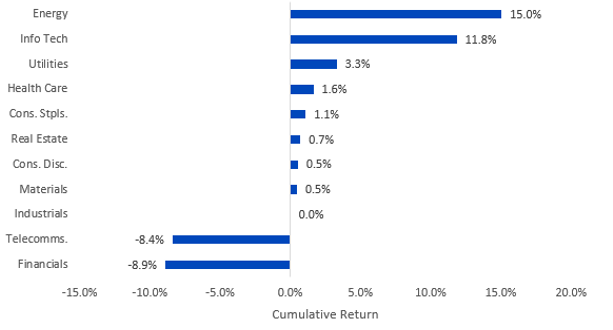
Source: Bloomberg. Top figure sector relative positioning data is for the WisdomTree Eurozone Quality Dividend Growth Index vs. MSCI EMU Index as of 29 June 2018. Bottom figure is for the cumulative sector returns of the MSCI EMU Index from 29 December 2017 to 29 June 2018. You cannot invest directly within an Index.
Historical performance is not an indication of future performance and any investments may go down in value
How can we best understand the ongoing focus of the strategy?
Now, we must be careful not to focus too much on the results—just like any active manager, this approach will ebb and flow through periods of both out and underperformance as conditions change. It is more important to understand the core focus of WisdomTree’s annual rebalancing process:
- As of 31 May each year, WisdomTree screens the fundamentals of all Eurozone dividend payers. Companies must have dividend coverage ratios greater than 1.0x to progress through the first stage.
- Quality is a term that can mean many different things, but at WisdomTree it is exemplified through a focus on three-year average return on equity and on assets. By focusing on both, firms with higher leverage—like Eurozone Financials—have a much tougher time qualifying for inclusion. This is what accounts for the underweight to the sector and why we’d expect it to continue.
- Growth can also mean many different things, but in this case, it encapsulates forward-looking earnings estimates, which is quite different from the backward-looking historical dividend growth screens that many Indexes use.
Figure 3: Refreshing quality metrics at the 2018 Annual Rebalance
Top figure relative to before WisdomTree’s Rebalance Data as of 31 May 2018. Bottom figure relative to after WisdomTree’s Rebalance Data as of 29 June 2018. Source: Bloomberg. You cannot invest directly within an Index.
Historical performance is not an indication of future performance and any investments may go down in value.
While neither the MSCI EMU nor Euro STOXX 50 Indices saw much change in their return on equity (ROE) and return on assets (ROA) figures in single months, WisdomTree’s rebalance refreshed and raised these metrics for the WisdomTree Eurozone Quality Dividend Growth Index.
Conclusion: who should look at this index?
It is rare that we speak to investors in Europe who don’t already have a strong view on what they think of the banks. Many can even name stronger, average and weaker institutions off the top of their heads. To that end, this strategy represents a quantitative, rules-based approach that will tend to avoid highly leverage firms and may complement positions in individual banks much more strongly than market capitalisation-weighted Indexes that typically place one fifth of their weight in this sector.
Related blogs
À propos du contributeur

Global Head of Research
Christopher Gannatti dirige l’équipe de recherche mondiale de WisdomTree, apportant sa riche expérience à l’entreprise. Depuis son arrivée en décembre 2010, Chris a progressé dans l’organisation avant d’en assumer la direction en 2021. Dans le cadre de sa mission mondiale, Chris joue un rôle crucial dans la conception des initiatives de WisdomTree aux États-Unis et en Europe. Son expertise repose sur les actions et les thématiques technologiques, en accordant une attention particulière à la mise en récit et aux analyses stratégiques. Basé aux États-Unis, il travaille en étroite collaboration avec Jeremy Schwartz, Directeur mondial des investissements. Avant de rejoindre WisdomTree, Chris a travaillé chez Lord Abbett en tant que consultant régional, en collaboration avec des conseillers financiers basés dans la région du Midwest. Il est titulaire d’un diplôme en économie de l’université Colgate et d’un MBA de la NYU Stern School of Business, avec des spécialisations en finance quantitative, comptabilité et économie. Il possède également la certification CFA. Chris est un véritable visionnaire, reconnu pour son leadership éclairé et sa capacité à expliquer efficacement des stratégies complexes.