
WTVE LN
WisdomTree Europe Value UCITS ETF - EUR Acc

Publié le 27 mars 2026

Director, Quantitative Research
European equities are once again moving into focus for global investors. Rising geopolitical tensions in the Middle East have introduced a new layer of uncertainty for global markets, particularly through the potential impact on energy prices and global supply chains. While Europe is not directly involved in the conflict, the region remains sensitive to energy market disruptions given its reliance on imported energy.
In this environment, investors may increasingly focus on defensive equity exposure: companies with strong fundamentals, disciplined capital allocation and the ability to return capital to shareholders.
Europe offers a particularly compelling opportunity set in this regard. The region has long maintained a strong culture of returning capital to shareholders through dividends, and companies are increasingly complementing these payments with share buybacks.
Against this backdrop, investors may benefit from two differentiated approaches to accessing European equities:
These strategies provide exposure to different drivers of equity returns while maintaining a disciplined and systematic investment framework.
For many investors, Europe is particularly attractive because of its strong dividend culture. Dividend payments have historically been an important component of total returns in European equities, reflecting the region’s emphasis on shareholder distributions.
The WisdomTree Europe Equity Income UCITS ETF focuses on companies capable of delivering sustainable and attractive dividend payouts. These are typically businesses with:
By emphasising companies with the ability to maintain and grow their dividend payments, this strategy seeks to provide investors with consistent income alongside equity market exposure.
In a more uncertain macroeconomic environment, such companies may also offer greater resilience than firms with weaker profitability or less predictable cash flows.
The WisdomTree Europe Equity Income strategy captures these companies and provides exposure to compelling valuations with a consistently high dividend yield (see Figure 1).
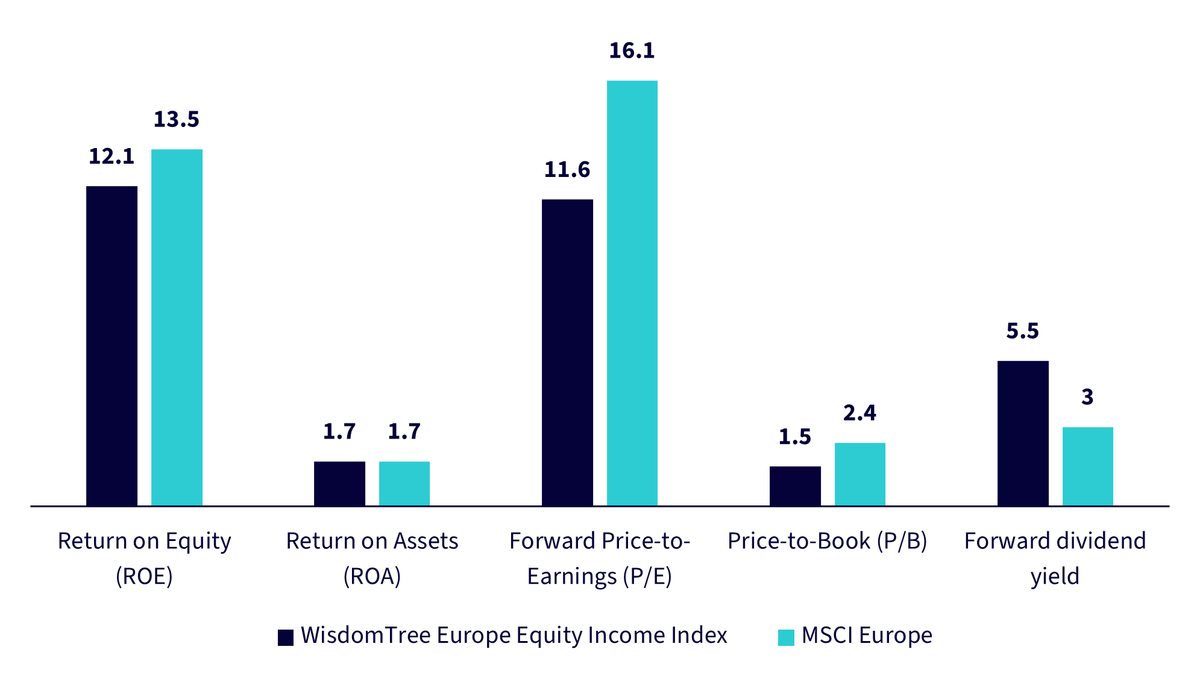
Source: WisdomTree, FactSet, MSCI. Data as of 31 December 2025. You can not invest in an index. Historical performance is not an indication of future performance and any investments may go down in value.
While dividends remain a cornerstone of shareholder returns in Europe, they represent only one part of the picture.
Companies are increasingly returning capital through share buybacks, which provide another mechanism for distributing excess cash to investors. Buybacks can signal management confidence in the company’s fundamentals and belief that the stock is trading below its intrinsic value. By reducing the number of shares outstanding, buybacks can also improve per-share metrics such as earnings per share and cash flow per share.
For this reason, the WisdomTree Europe Value UCITS ETF focuses on total shareholder yield, defined as the combination of dividend yield and net buyback yield.
This broader definition of value reflects the different ways companies return capital to shareholders. Research has shown that value strategies defined by shareholder yield have historically delivered stronger outcomes than traditional approaches that rely solely on valuation multiples, such as price-to-book ratios.
By focusing on companies with high shareholder yield, the strategy aims to capture firms that are not only attractively valued but also actively returning capital to investors.
Below is a representation of how shareholder yield has historically performed relative to traditional value metrics, such as the price-to-book ratio, in European equity markets.
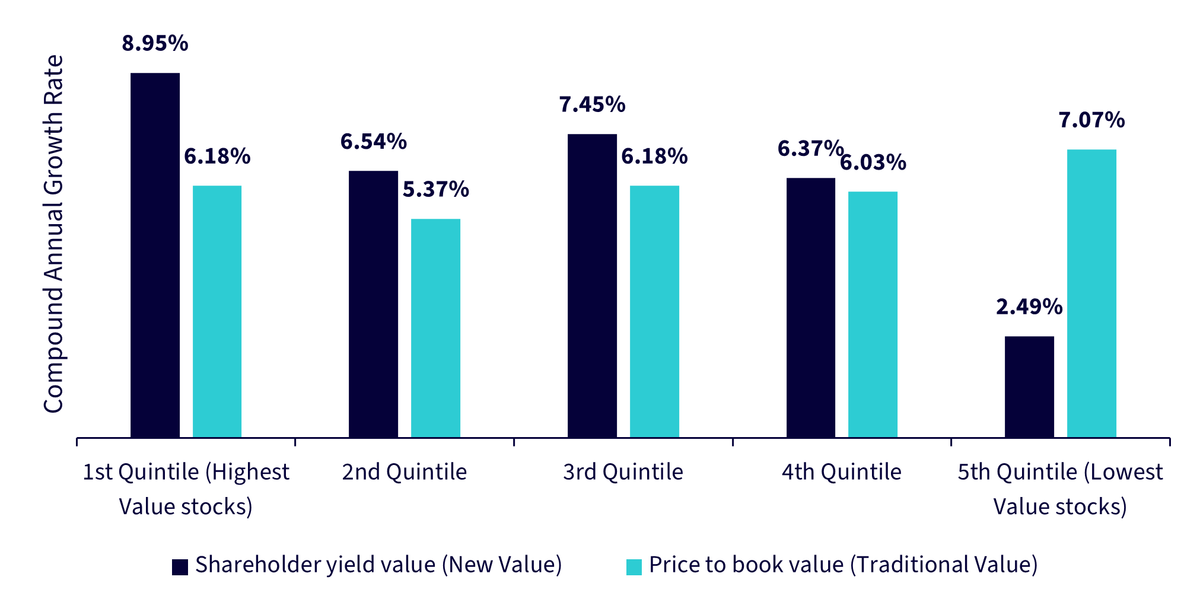
Sources: WisdomTree, MSCI, 12/31/2007–31/1/2026. Quintile portfolios created using end of December data each year and constituents are equally weighted. Shareholder yield = 1st quintile (highest shareholder yield) within the MSCI Europe Index. Price-to-Book = 1st quintile (lowest P/B) within the MSCI Europe Index. You cannot invest directly in an index. Historical performance is not an indication of future performance and any investment may go down in value.
Whether focusing on income or value, one of the key risks in equity investing is the value traps, companies that appear attractive based on yield or valuation but are facing deteriorating fundamentals.
To address this challenge, WisdomTree incorporates a Composite Risk Score (CRS) framework designed to identify companies with stronger underlying characteristics.
The Composite Risk Score combines quality and momentum signals, evaluating factors such as profitability, cash flow strength and risk-adjusted price trends.
Companies that rank poorly on this framework are excluded from the strategies, helping remove potentially higher-risk stocks while maintaining exposure to companies with attractive shareholder return characteristics.
This disciplined screening process helps ensure that both the WisdomTree Europe Equity Income UCITS ETF and the WisdomTree Europe Value UCITS ETF emphasise shareholder returns alongside strong fundamentals.
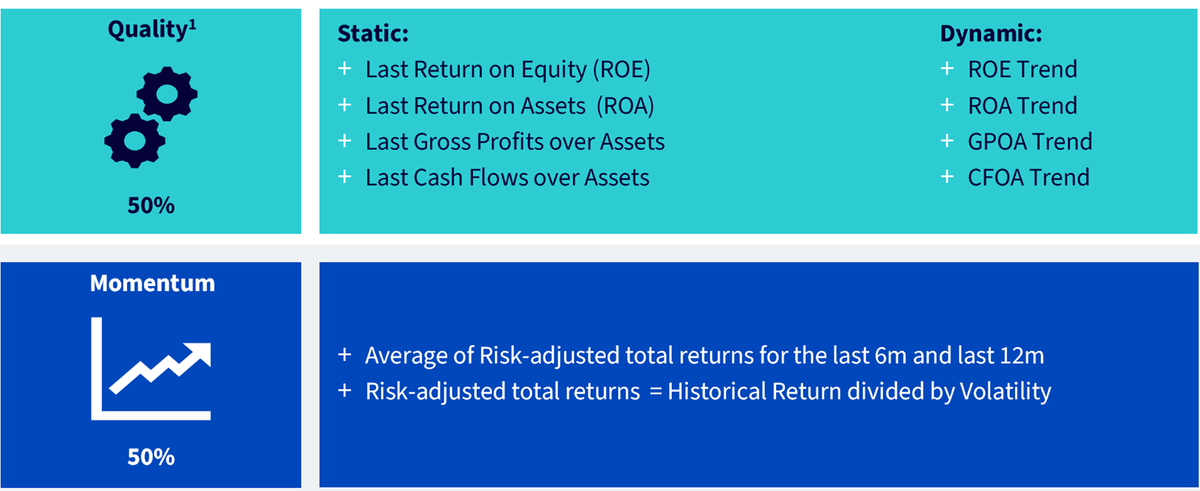
Source: WisdomTree. 1. The Quality score is an equal weight of the 8 scores (at least 6 data points (3 and 3) are needed per stock to be included). Data is normalised using a cross-sectoral Z-score for each industry group. Trends are calculated as 12-quarter historical Z-scores for each industry group.
While both strategies focus on companies that return capital to shareholders, they target different return drivers within the European equity market.
Strategy | Primary Objective | Key Return Driver |
|---|---|---|
WisdomTree Europe Equity Income UCITS ETF | Generate sustainable income | High dividend-paying companies with quality control |
WisdomTree Europe Value UCITS ETF | Capture undervalued opportunities | Total shareholder yield (dividends + buybacks) |
European equities offer a unique opportunity set for investors seeking diversification and defensive investments in the current geopolitical climate.
With the region’s strong dividend culture, combined with the increasing use of share buybacks, creating multiple ways for companies to return capital to investors, the European story is compelling, but targeted exposure remains the key.
Through the WisdomTree Europe Equity Income UCITS ETF and the WisdomTree Europe Value UCITS ETF, investors can access two differentiated approaches to the European equity market, one focused on sustainable dividends for stable income and the other on total shareholder yield targeting value exposure optimised for long-term risk-adjusted returns.
In an environment characterised by geopolitical uncertainty and shifting market leadership, these complementary strategies could offer investors a more balanced approach to capturing long-term opportunities in European equities.

Director, Quantitative Research
Ayush Babel is the Director of Quantitative Research in WisdomTree's multi-asset quantitative research and index teams. In this role, he focuses on developing innovative quantitative strategies across various asset classes while supporting WisdomTree's diverse range of products. His expertise spans factor exploration, portfolio construction and optimization, quantitative investment research, and product development.
With over a decade of experience in the financial services industry, Ayush has held investment research roles at J.P. Morgan and Franklin Templeton. At these institutions, he was responsible for developing and managing equity and fixed income smart beta products, as well as cross-asset risk premia solutions for global institutional and retail clients. His experience covers a broad spectrum of asset classes and investment styles.
Ayush holds a bachelor's in Engineering Physics and a master’s degree in Nanoscience from the Indian Institute of Technology, Bombay.
