
WDEF LN
WisdomTree Europe Defence UCITS ETF - EUR Acc

Veröffentlicht am 2. Juli 2025

When the NATO leaders’ motorcades pulled away from The Hague’s World Forum last week, the mood was somewhere between relief and quiet astonishment. Relief, because the alliance had avoided the public rows many feared; astonishment, because – helped by a mixture of red-carpet diplomacy and transatlantic arm-twisting – the allies had signed off on the most ambitious re-armament target in their 75-year history: to spend 5% of national GDP on defence by 2035.
Unlike the bold goals set at earlier summits, this one lands with a timetable, mid-course audits in 2029, and a rulebook that breaks the 5% target into three hard numbers as discussed here: 3.5% for core defence budgets, 1.5% for infrastructure, cyber and resilience, and the existing 2% floor that every ally must reach by 2026. A fifth metric – at least 20% of every defence budget on new equipment and R&D – was quietly reaffirmed in the communiqué.
Europe’s free ride on defence is over
The Dutch prime minister and freshly minted NATO secretary-general Mark Rutte called it a “quantum leap in our collective defence”. In reality, the upshift will not be uniform: each ally is starting from a different baseline and will follow its own timetable toward 5% – as the chart makes clear, the journey is a patchwork of speeds rather than a single leap.
Figure 1: Planned defence spending as a percentage of GDP
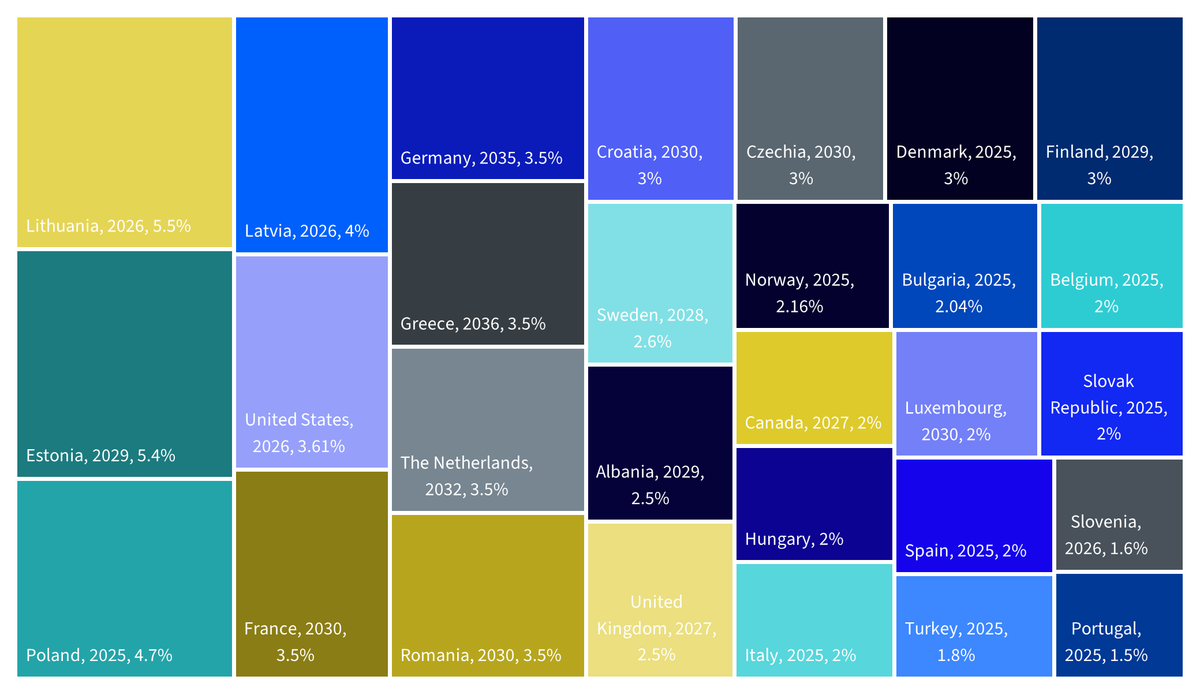
Source: NATO, WisdomTree as of 26 June 2025, Please note: Montenegro and North Macedonia have not added any new pledge.
Germany’s new Basic-Law amendment lets Berlin borrow more freely and lift defence spending above 3% of GDP by 2027 on the way to 3.5% two years later. France, Italy and Spain, by contrast, confront tight fiscal corsets and tepid public support – Madrid even secured a face-saving waiver that lets it stay close to 2% so long as it meets capability targets. In a hypothetical base case scenario, in which Europe ramps up spending to achieve 3.5% of GDP, we estimate the incremental spend to rise to US$2.3trn by 2025. In which case, Germany is likely to account for US$700Bn of that.
Figure 2: Funding scenarios: Price tag to 2035
Scenario | Spend target % of GDP | 2025-35 incremental outlay | Germany's slice |
|---|---|---|---|
Bull | 5.0% | US$4.6 tn | US$1.4 tn |
Base | 3.5% | US$2.3 tn | US$0.7 tn |
Bear | 2.5% | US$1.1 tn | US$0.3 tn |
Source: European Commission, WisdomTree as of 26 June 2025. Please note: The calculations assume front loaded capital projects for Germany in the Bull base.
Ukraine support must be “Europe-proof”
The communiqué’s wording on Kyiv was, by past standards, anaemic; membership was not mentioned at all. The declaration affirms NATO’s support for Ukraine, while omitting last year’s statement that the country’s future is in the alliance, reflecting the Trump administration’s growing reluctance to provide more military assistance to Kyiv. Yet on the sidelines President Trump floated the idea of selling Patriot batteries to Ukraine – something Washington has so far avoided – while European leaders openly discussed a Danish-style fund that would channel a slice of every national budget directly into Ukrainian factories. If, as many in The Hague quietly assume, US military aid stalls once the Biden allotments are delivered, Europe will have to keep Ukraine’s war machine running, or risk seeing the frontline shift west.
Figure 3: Military Aid to Ukraine
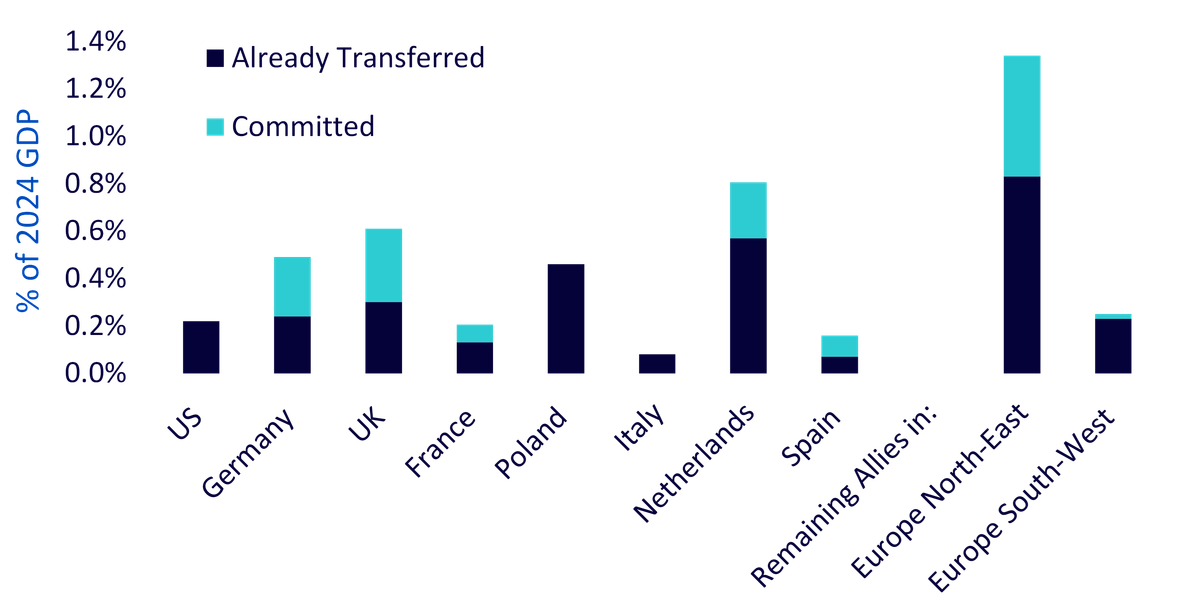
Source: IfW Kiel, NATO, WisdomTree from 24 January 2022 to 28 February 2025. Military aid includes equipment donated directly and financial assistance tied to military purposes.
A once-in-a-generation industrial build-out
Europe’s defence supply-chain is already straining. The sector has announced 113 new production lines since 20221, from Rheinmetall’s powder plants in Bavaria to drone factories in the Baltics. Brussels is pitching in: the €150 billion Security for Action Europe (SAFE) loan facility will follow NextGenerationEU once that programme tapers in 2027, and the European Investment Bank’s defence-lending headroom has just been lifted to €100 billion. Add the mooted Defence, Security & Resilience Bank and a proposed EU-level green-light for “Defence Bonds”, and Europe’s arsenal build-out will be financed on terms that would have been unthinkable three years ago.
Strategic attention drifts east and south-east
Only one line of the communiqué mentioned Russia, a rhetorical shift that tracks with President Trump’s milder view of Moscow. However, the Indo-Pacific also made barely a dent in the final text after three of the so-called IP4 Japan, New Zealand and South Korea leaders cancelled their trip. Australia sent its Deputy Prime Minister instead of the Prime Minister. Their absence meant Indo-Pacific security received little airtime in the communiqué. For Europe, this means a double posture: bulk up against Russia on land, while investing in maritime domain awareness and joint under-sea monitoring with Japan and Australia – tasks that blend traditional steel with AI, edge computing and satellite connectivity.
NATO requires that at least 20% of every defence budget go to new equipment and R&D each year. The 20% equipment-and-R&D rule will push capital toward exactly those technology layers – AI onboard drones, edge-computing nodes that process sensor data at sea, LEO satellites for resilient comms – rather than into slow-burn personnel budgets. EU firms like Hensoldt (sensors), Airbus Space (LEO payloads) and Saab (surface-picture fusion software) sit right in that funding stream.
Conclusion
The Hague summit may have aimed low on drama, but it has reset the fiscal and strategic baseline for an entire continent. Europe must spend more, borrow more and think in decades, not years, about its own security. For policymakers, that is a daunting to-do list.
1 WisdomTree aggregates verified green-field plants, dormant-line restarts and major capacity upgrades (≥ €25 m capex or ≥ 50 new FTEs). Roughly two-thirds are ammunition or energetics, the rest cover missiles, drones, naval hulls, radars and satellite payloads.


Director, Macroeconomic Research, WisdomTree Europe
@AneekaGuptaWTAneeka Gupta ist Director im europäischen Researchteam von WisdomTree und konzentriert sich auf Aktien und Rohstoffe. Sie verfügt über 20 Jahre Erfahrung in unterschiedlichen Anlageklassen und schreibt regelmäßig Branchenkommentare in Finanzmedien. In ihrer derzeitigen Position ist sie für die Durchführung von Analysen für alle internen Aktien-, Rohstoff- und Makro-Publikationen verantwortlich und unterstützt das Vertriebsteam bei Kundenanfragen zu Produkten und Märkten. Aneeka Gupta hat einen Master-Abschluss in Mathematik von der Oxford University und einen Bachelor-Abschluss in Mathematik von der University of Delhi in Indien. Außerdem ist sie CFA-Charterholder.