

What Cisco teaches us for today’s ‘AI star’, Nvidia
Published 7 September 2023

Global Chief Investment Officer

Research Analyst
Nvidia's recent meteoric rise evokes memories of Cisco's ascent during the dot-com era. Both were tech behemoths powering significant technological shifts and both companies represented the heartbeats of transformative technological revolutions.
In the late 90s and early 2000s, Cisco was more than just a tech giant; it was the backbone of the burgeoning internet. As the world began to realise the internet’s potential, Cisco's routers and switches became indispensable, turning digital dreams into tangible realities. Their hardware served as critical infrastructure in the foundation of the modern internet.
Similarly, Nvidia, initially renowned for its prowess in graphics processing units (GPUs), has positioned itself at the forefront of another digital paradigm shift: artificial intelligence (AI).
AI, with its vast applications ranging from data analysis to autonomous vehicles, requires intense computational power. Nvidia’s GPUs have been repurposed beyond mere gaming and now power the computations behind the most advanced AI applications.
Figure 1: Price-to-sales (P/S) ratios of NVDA and CSCO reaching similar levels at their peaks
Source: Jeremy Siegel with Jeremy Schwartz, research for Stocks for the Long Run, 6th ed., 2022. Historical performance is not an indication of future performance and any investments may go down in value.
At their peaks, both companies commanded towering valuations, captivating investors with seemingly boundless growth potential. However, as the tech landscape evolved, Cisco had to face competitors like Arista, Brocade, and Juniper as they emerged. These ‘up-and-comers’ demonstrated rapid sales growth, often outpacing Cisco post the dot-com bubble. While Cisco's sales growth since 2003 has been 5.15% per year, Juniper and Brocade have grown at 12.08% and 10.15% respectively. Arista, since 2015, has reported an impressive 28.34% annual sales growth1.
For Nvidia investors today, recent news might bring some doubts that it can keep its dominating market share and sustain its sales growth long term. AMD plans to release its MI300X chip later this year, a direct competitor to Nvidia’s chips. Whilst this is unlikely to eat into much of Nvidia’s market share, it still signifies increasing competition and an adapting landscape. AMD also plans to invest around $400 million in India over the next five years, building its largest design centre in the tech hub of Bengaluru2.
Intel, another formidable player in the chip industry, recently announced a massive €80 billion across Europe over the next decade, with a significant portion dedicated to building semiconductor manufacturing facilities in Germany3. These moves are expected to bolster AMD and Intel’s presence in the AI chip market, directly challenging whether Nvidia's dominance can translate to other parts of the globe.
While Nvidia currently holds a dominant position in the AI GPU market, its competitors are strategically positioning themselves to challenge this dominance, especially in regions where Nvidia's influence is still growing. Just as Cisco faced stiff competition from emerging players in the early 2000s, Nvidia must now navigate a landscape where its competitors are making significant inroads in new markets.
Figure 2: Sales growth of the S&P 500, tech sector, and Cisco since March 2000
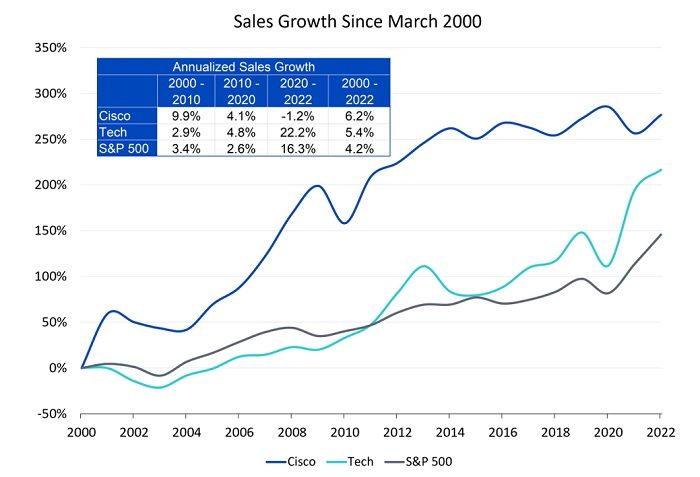
Even against the competition, Cisco's status as a tech titan was undeniable and the company was even able to maintain an annual sales growth rate of 9.9% for the decade after it reached its peak P/S valuation in March 2000, almost triple the market’s 3.4%. Over the next 22 years, Cisco’s sales growth slowed and currently stands at about 6.2% annually, which is still much higher than the market’s 4.2% and the tech sector’s 5.4% annual sales growth. However, despite strong growth and continued (albeit shrinking) market dominance, its stock has still not recovered to its early-2000 highs.
Another factor that contributed to Cisco's downfall was its misjudgement of demand and supply dynamics. In the early 2000s, Cisco was overly optimistic about the continued growth of the internet and its role in it, even when competitors and suppliers started to lower their growth estimates. This optimism led them to place large orders with their Contract Electronics Manufacturers (CEMs) since, at the time, they had more orders coming in than they could fulfil, expecting that the future demand would hold. However, as the dot-com bubble burst, and the industry's growth forecasts started to decline, Cisco found itself in a precarious position.
Its CEMs, who benefitted from extra production regardless of the demand, had ramped up production. But, with the slowing demand, Cisco was left with an excess supply. This miscalculation culminated in a massive $2.25 billion inventory write-down in 20014.
Fast forward to today, and Nvidia is echoing a similar sentiment, claiming that chip manufacturers can't keep up with the soaring demand for their products. The August 2023 UBS Nvidia report stated that the demand for these chips is outpacing supply by “at least 5-10x”. While the AI boom is undeniable, the tech landscape is rife with uncertainties, and extra concerns arise regarding the uncertain future economic environment, as well as new competition. If Nvidia’s forecasts fail to account for all these factors in this volatile environment, it could find itself in a similar situation as Cisco. As history has shown, even tech giants aren't immune to the repercussions of such miscalculations.
Figure 3: Return for S&P 500, tech sector, and Cisco from February 1990, normalised at vertical line or March 2000 (maximum P/S valuation for Cisco)
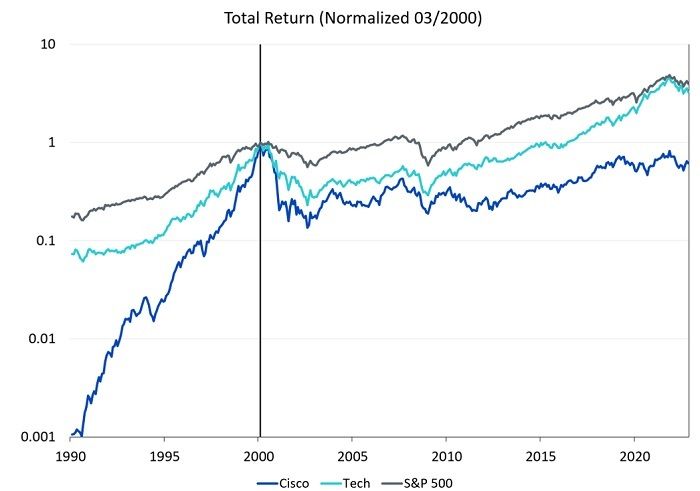
Source: Jeremy Siegel with Jeremy Schwartz, research for Stocks for the Long Run, 6th ed., 2022. Historical performance is not an indication of future performance and any investments may go down in value.
The aftermath of Cisco's dot-com era peak is a testament to the fact that, in the tech world, groundbreaking innovation isn't the only key to sustained success. Beyond the products and services, it's also important to accurately gauge market demand, navigate shifting dynamics, and anticipating competition. While Cisco was a staple company in the internet's early days, its difficulty to approach its all-time high more than 20 years ago proves the importance of these market nuances.
The tech titans of March 2000
While Nvidia mirrors Cisco in various facets, broadening our lens to encompass the top tech stars of March 2000 might offer further insights. These were the businesses at the epicentre of the dot-com frenzy, bearing valuations that mirrored the unbridled optimism of the age. What became of them, and what does that spell for Nvidia?
Figure 4: Subsequent returns and sales growth for largest 20 tech stocks + Amazon on 03/2000
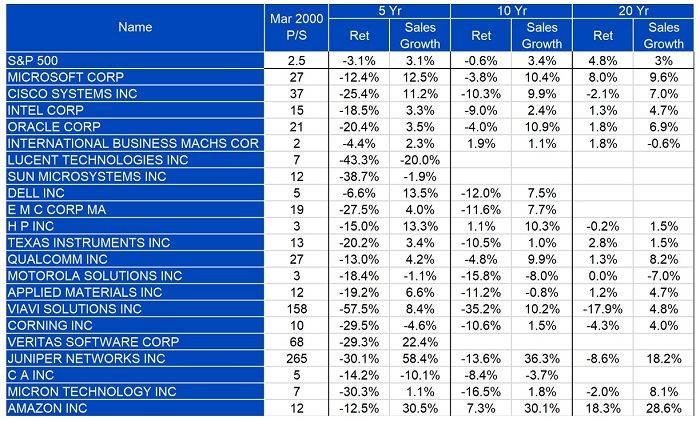
Source: Jeremy Siegel with Jeremy Schwartz, research for Stocks for the Long Run, 6th ed., 2022. Historical performance is not an indication of future performance and any investments may go down in value.
Only two companies from the largest 20 tech stocks in 2000 out-performed over the next 20-years: Microsoft and Amazon. Microsoft delivered nearly 10% sales growth a year for two decades, while Amazon delivered nearly 30% a year. One potential explanation for this is that these companies are so large, and their income is well diversified, protecting it from sudden shifts in competitive landscapes destroying its value. They are also the two leaders in public cloud computing infrastructure.
While Microsoft and Amazon's diversified income streams have made them more resilient, Nvidia appears to be navigating on narrower straits. Nvidia’s most recent income statement shows that its $26 billion income comes mainly from two product segments: around $15 billion from computing and networking, and $11 billion from graphics5.
Figure 5: Nvidia sales by country
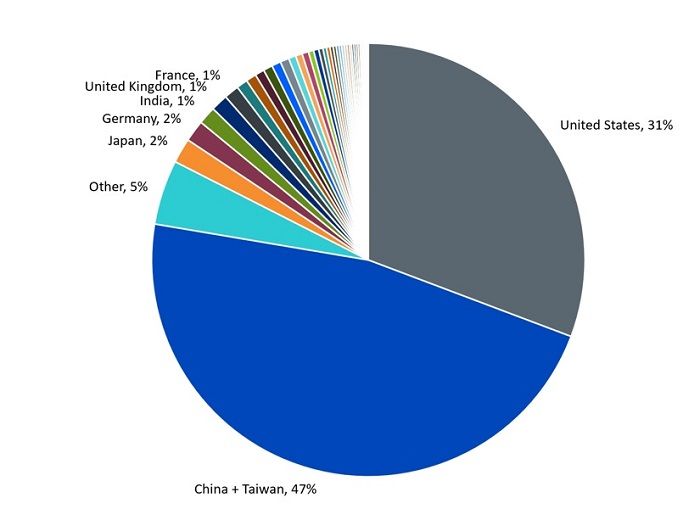
Source: WisdomTree, FactSet. Historical performance is not an indication of future performance and any investments may go down in value.
This dependence on a few main drivers becomes more apparent in Figure 5, which shows that a significant chunk (almost half) of its revenue is rooted in China and Taiwan. Such a concentrated revenue stream, especially from regions embroiled in intensifying geopolitical tensions, brings into sharp focus the potential geopolitical risks and exposure to China that is intrinsic to an Nvidia investment.
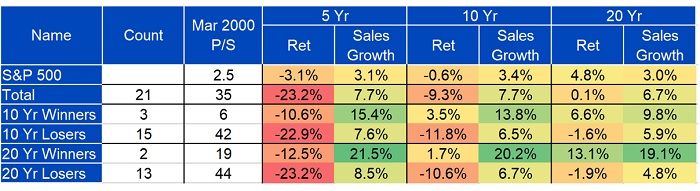
Even the losers on this list more than doubled the sales growth of the S&P 500 over the coming 10 and 20-year periods. But the high starting valuation was an anchor and dragged down their future returns.
Figure 6: Averages for largest 20 tech stocks + Amazon on 03/2000 bucketed by relative performance to market
Source: Jeremy Siegel with Jeremy Schwartz, research for Stocks for the Long Run, 6th ed., 2022. Historical performance is not an indication of future performance and any investments may go down in value.
These narratives remind us that leading in innovation doesn't guarantee perpetual success. For Nvidia, the task ahead is twofold: to fend off rising competitors and to accurately anticipate the evolving market landscape. Remember, competitors can be other chip players like AMD, or they can be large companies venturing into designing their own customized chips. The market in general is not in favour of a single supplier of AI computational power.
For investors, it's a reminder to stay grounded and look beyond the present hype to consider the long-term viability of success for a stock at such high valuations.
Related products
+ WisdomTree Artificial Intelligence UCITS ETF – USD Acc
Related blogs
+ Performance after peak valuation: navigating the tech sector’s high multiples
1 Source Jeremy Siegel with Jeremy Schwartz, research for Stocks for the Long Run, 6th ed., 2022.
2 Source TechCrunch. (28 July 2023). AMD plans to invest $400 million in India by 2028.
3 Source TechCrunch. (15 March 2022). Intel plans to build a $19 billion chip plant in Germany.
4 Source CNET. (2 January 2000). Cisco’s $2.25 billion mea culpa.
5 Source Statista Intelligence. (2023). Nvidia Revenue by Segment Report.
About the contributors

Global Chief Investment Officer
Jeremy Schwartz has served as Global Chief Investment Officer since November 2021 and leads WisdomTree’s investment strategy team in the construction of WisdomTree’s equity Indexes, quantitative active strategies and multi-asset Model Portfolios. Jeremy joined WisdomTree in May 2005 as a Senior Analyst, adding Deputy Director of Research to his responsibilities in February 2007. He served as Director of Research from October 2008 to October 2018 and as Global Head of Research from November 2018 to November 2021. Before joining WisdomTree, he was a head research assistant for Professor Jeremy Siegel and, in 2022, became his co-author on the sixth edition of the book Stocks for the Long Run. Jeremy is also co-author of the Financial Analysts Journal paper “What Happened to the Original Stocks in the S&P 500?” He received his B.S. in economics from The Wharton School of the University of Pennsylvania and hosts the Behind the Markets podcast. Jeremy is a member of the CFA Society of Philadelphia.
