
WTAI LN
WisdomTree Artificial Intelligence UCITS ETF - USD Acc

Published 29 April 2025

Senior Associate, Quantitative Research and Multi Asset Solutions
Since the release of ChatGPT in 2022, artificial intelligence (AI) has dominated marketing headlines and remained one of the hottest themes for thematic investors. According to our data, the "AI & Big Data" themed exchange-traded funds (ETFs) in Europe attracted approximately $1.9 billion1 in inflows in 2024, making it the most popular theme of the year. In recent months, we have also seen significant developments across the AI space. We believe the recent rebalancing of the WisdomTree Artificial Intelligence UCITS ETF (WTAI) in March 2025 remains closely aligned with this megatrend and reflects the latest advancements in the AI landscape.
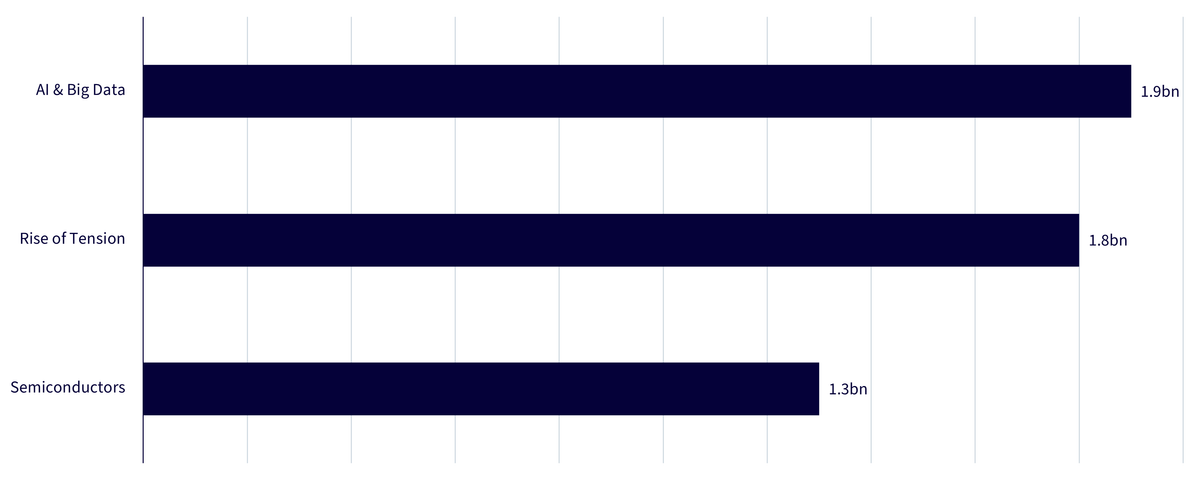
Source: WisdomTree, Morningstar, Bloomberg. All data as of 31/12/2024 and based on WisdomTree's internal classification of thematic funds. Performance is based on monthly returns from Bloomberg and Morningstar. More information on the WisdomTree Thematic classification can be found in the WisdomTree Thematic Classification. Historical performance is not an indication of future performance, and any investments may go down in value.
The AI landscape continues to evolve rapidly, driven by fierce competition among leading AI model providers. In recent months, significant model releases underscored this intense rivalry.
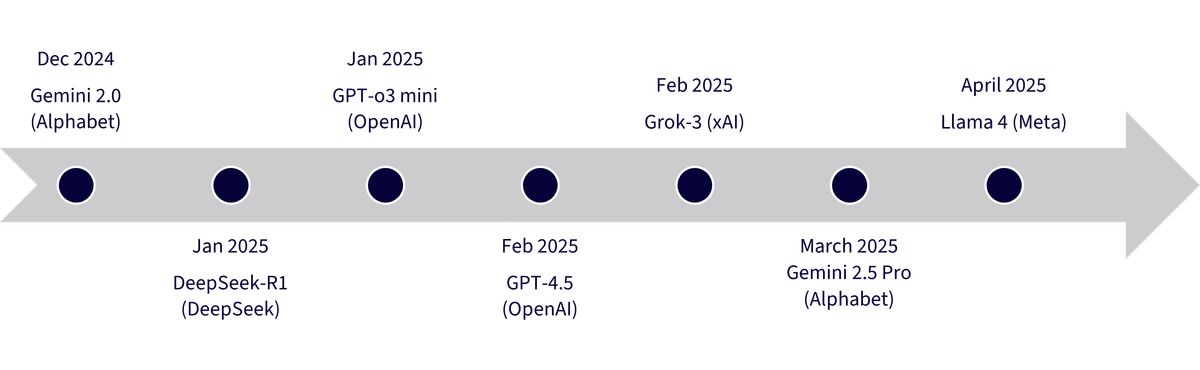
Source: Alphabet, DeepSeek, OpenAI, Meta.
The DeepSeek’s cost-efficient models shocked the markets in January because the open sourced high performing models can be trained and operated at a much more affordable price. This competitive environment has driven substantial cost reductions in AI model pricing. For instance, OpenAI significantly lowered the prices for its GPT models, promoting wider adoption and fuelling growth in AI applications. Agentic AI (autonomous agents capable of proactive, context-aware task execution), in particular, has benefited from these reduced costs, enabling broader deployment across customer service, sales automation, and content generation industries.
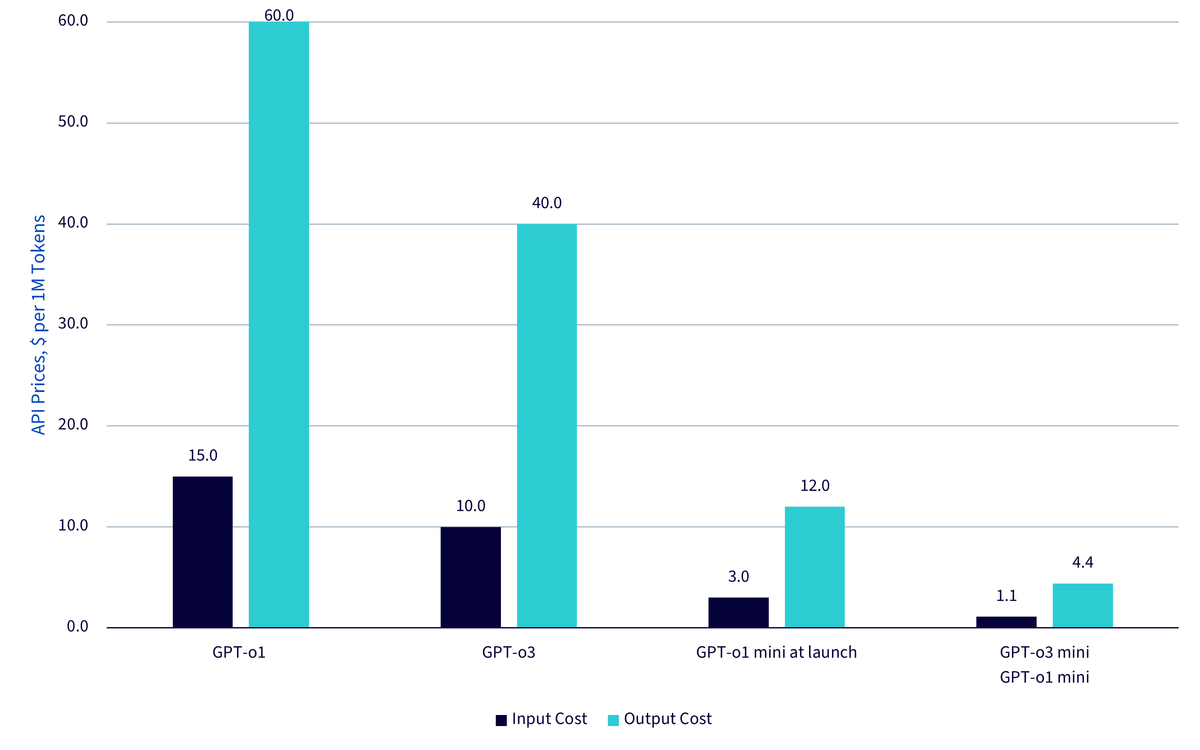
Source: OpenAI, as of 22 April 2025. Historical performance is not an indication of future performance and any investments may go down in value.
In addition, significant developments have emerged in edge AI and robotics, further expanding AI’s practical applications. Companies such as Qualcomm and Apple introduced powerful AI processing capabilities in their mobile chipsets, reducing dependency on cloud-based solutions and facilitating more secure and responsive local AI processing. Robotics also advanced, led notably by Tesla’s Optimus, which demonstrated enhanced real-time learning and improved autonomous operations.
In our strategy, AI companies within the AI value chain are classified into three categories:
Enabler: a company that develops the building block components for artificial intelligence, such as advanced machinery, autonomous systems/self-driving vehicles, semiconductors, or databases used for machine learning.
Engager: a company that designs, creates, integrates, or delivers artificial intelligence in the form of products, software, or systems.
Enhancer: a company that provides its own value-added services within the AI ecosystem that are not core to their product or service offering.
Kakao (Enhancer): Kakao has significantly improved conversational AI capabilities within its KakaoTalk app. Its assistant "Kanana" now delivers advanced chat summaries, schedule management, and personalised recommendations, leveraging localised language models and global AI partnerships. These developments significantly enhance user interaction, positioning Kakao prominently within Korea’s highly competitive mobile ecosystem.
Oracle (Enabler): Oracle’s strategic deployment of a zettascale supercomputer cluster with over 130,000 Nvidia GPUs2 substantially upgrades its infrastructure capabilities, significantly boosting its competitiveness in enterprise AI. Enhanced scalability, combined with strengthened regulatory compliance and deepening partnerships with Nvidia, solidifies Oracle’s ability to support complex AI workloads at scale across diverse industries.
Recursion pharmaceuticals (Engager): Recursion accelerated its AI-powered drug discovery capabilities with the introduction of its BioHive-2 supercomputer platform. Recent acquisitions and technological enhancements have substantially increased its experimental throughput, evidenced by promising Phase II clinical results on AI-identified therapeutics. These advances highlight Recursion's continued leadership in technology-driven pharmaceutical innovation.
Siemens (Engager): Siemens expanded its digital twin and simulation technology offerings by acquiring Altair Engineering and launching advanced Industrial Copilot tools. These enhancements, coupled with improved real-time 3D visualisation capabilities through strategic partnerships, reinforce Siemens' position as a pioneer in industrial process optimisation and efficiency.
Tempus AI (Engager): Tempus AI significantly bolstered its precision medicine capabilities by acquiring Ambry Genetics, enriching its genomic datasets and diagnostic expertise. The introduction of generative AI capabilities in the Tempus One clinical assistant further enables rapid analysis of complex medical data, facilitating personalised treatment decisions and clinical trial matching, significantly advancing precision healthcare.
Tesla (Enhancer): Tesla continued to make notable advancements in autonomous vehicle technology with the rollout of Full Self-Driving (FSD) Beta v12, increasingly leveraging end-to-end neural network solutions. Additionally, Tesla's ongoing development of its humanoid robot, Optimus, demonstrated considerable progress through reinforcement learning, underscoring Tesla's dual leadership in automotive and robotic AI applications.
IBM (from Enhancer to Engager): IBM expanded its Watsonx AI platform, integrating new AI assistants and agents directly into its enterprise consulting workflows. The proactive deployment of AI-driven solutions across consulting projects, combined with the open-sourcing of new language models, signifies IBM’s strengthened role in directly engaging clients with bespoke AI tools tailored for security, compliance, and operational efficiency.
Salesforce (from Enhancer to Engager): Salesforce deepened AI integration within its ecosystem through Einstein Copilot, evolving into Agentforce, an advanced AI assistant embedded across Salesforce and Slack. This move streamlines CRM3 tasks, boosts productivity, and introduces additional revenue opportunities through innovative AI-enabled applications, marking Salesforce's expanded role as a direct AI service provider.
Deletion:
ANSYS Inc (Engager): Removed due to a pending acquisition by Synopsys.
The recent rebalance of WisdomTree's AI strategy reflects proactive adaptation to dynamic industry shifts, maintaining exposure to leaders capitalising on AI’s increasing affordability, technological advancements, and expanding use-cases. We remain optimistic about AI's transformative potential and believe companies positioned effectively within this rapidly evolving landscape will continue to drive strong growth and innovation.
1 Source: WisdomTree, Morningstar, Bloomberg.
2 GPU = graphics processing unit.
3 CRM = Customer Relationship Management.
WisdomTree Artificial Intelligence UCITS ETF - USD Acc

Senior Associate, Quantitative Research and Multi Asset Solutions
Baoqi Zhu joined WisdomTree in 2023 as a Senior Associate on the Research team. Baoqi focuses on quantitative research on thematic equity indices and portfolio solutions. Prior to WisdomTree, Baoqi spent over two years at Ernst & Young (EY) in their Quantitative Advisory Services, where he was involved in the research and development of quantitative risk models. Earlier in his career, Baoqi served as a quantitative analyst within a multi-asset structuring team at Maven Global for more than three years. His responsibilities included designing and optimising bespoke hedging strategies based on derivatives. Baoqi holds a MSc in Financial Engineering & Risk Management from Imperial College London and a BSc in Actuarial Science from Nankai University, China. He is also a certified Financial Risk Manager (FRM).
