
WXRP IM
WisdomTree Physical XRP

Published 9 December 2024

Director, Digital Assets Research
Back in 2009, bitcoin burst onto the scene, introduced by the mysterious Satoshi Nakamoto. Through its now-iconic whitepaper, bitcoin pioneered the idea of a decentralised digital currency operating on a secure and immutable blockchain.
Since then, bitcoin has cemented its status as the dominant cryptocurrency, and it continues to represent over 50%1 of the total crypto market capitalisation. Nowadays, bitcoin is hailed as a ‘store of value’, often compared to digital gold, and institutions are increasingly incorporating it into their multi-asset portfolios to enhance their risk-return metrics.
XRP followed shortly after bitcoin, and it aimed to revolutionise cross-border payments with speed and efficiency. By way of example, Tranglo, a leading cross-border payment hub, has integrated Ripple’s On-Demand Liquidity service that leverages XRP to facilitate instant cross-border transactions without any need for pre-funding accounts2.
WisdomTree’s digital asset taxonomy classifies both bitcoin and XRP as Layer-1 payments but, despite its utility, XRP’s market capitalisation is significantly smaller than bitcoin’s:
The stark market cap difference raises a question: could XRP ever catch up with bitcoin?
Bitcoin and XRP are perceived through vastly different lenses.
The re-election of Donald Trump, known for his pro-crypto stance, has injected fresh optimism into the market, with expectations of favourable regulatory policies giving both bitcoin and XRP a price lift.
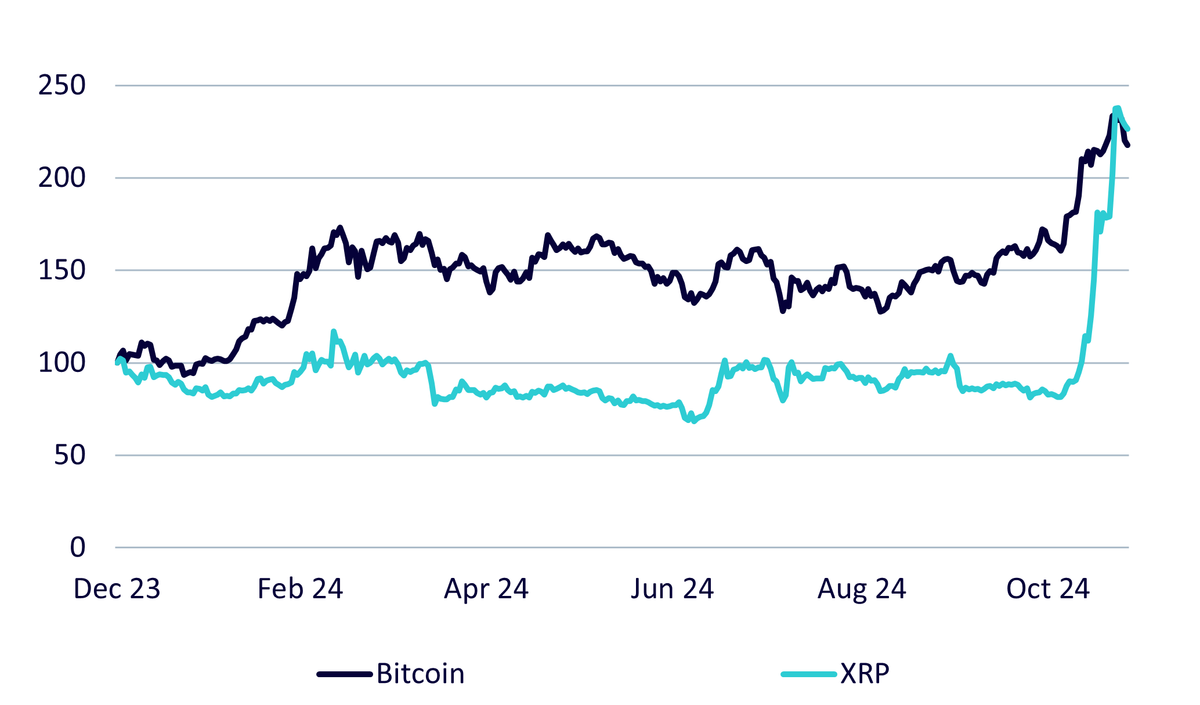
Source: GlassNode. 26 November 2024. Prices set to 100 on 31 December 2023. You cannot invest directly in an index. Historical performance is not an indication of future performance and any investment may go down in value.
Figure 1 clearly reflects the market’s optimism, with bitcoin price reaching its all-time high of more than $99k in November and XRP climbing to the levels it was at back in 2021.
As shown in Figure 2, both bitcoin and XRP have limited supply, which contributes to their scarcity and value proposition. To clarify the terms used:
| Bitcoin | XRP |
|---|---|---|
Circulating supply | 19.8 million | 57 billion |
Maximum supply | 21.0 million | 100 billion |
Total supply | 21.0 million | <100 billion (just over 13m XRP burned) |
Source: CoinGecko. 27 November 2024.
One of the primary distinctions between bitcoin and XRP lies in their total supply. While bitcoin’s total supply remains static at 21 million coins, XRP’s total supply is deflationary due to transaction fee burning.
Whenever a transaction occurs on the XRP Ledger, a small amount of XRP is permanently removed from circulation as a transaction fee. This burn mechanism ensures a gradual reduction in XRP’s total supply over time. To date, just over 13 million of XRP have been burned, resulting in a total supply that is slightly under the original 100 billion XRP coins.
By contrast, bitcoin’s total supply is fixed and does not decrease over time. While coins may be lost due to forgotten private keys or mishandling, this is not a deliberate feature of the system.
The deflationary nature of XRP’s total supply sets it apart and adds a unique dimension to its long-term economic model. Conversely, bitcoin’s capped and unchanging supply solidifies its position as a digital asset with absolute scarcity, akin to ‘digital gold’.
Bitcoin and XRP cater to distinct user groups, with bitcoin predominantly serving retail users and XRP designed for institutional use.
Bitcoin primarily appeals to retail users due to its accessibility and decentralised nature. Key aspects of bitcoin’s retail use include:
While bitcoin is increasingly attracting institutional interest, its retail adoption remains its cornerstone. This is driven by its widespread accessibility, its established reputation as the first cryptocurrency, and its large and active community.
XRP, by contrast, in designed with institutional users in mind, particularly in the realm of international finance and cross-border payments. Its primary focus is on providing fast, cost-effective, and reliable solutions for financial institutions.
Through its scalability, speed, and institutional-grade reliability, XRP provides a tailored solution for optimising cross-border payment systems, making it a key asset for the financial sector.
When it comes to transaction speed, XRP outpaces bitcoin by a wide margin:
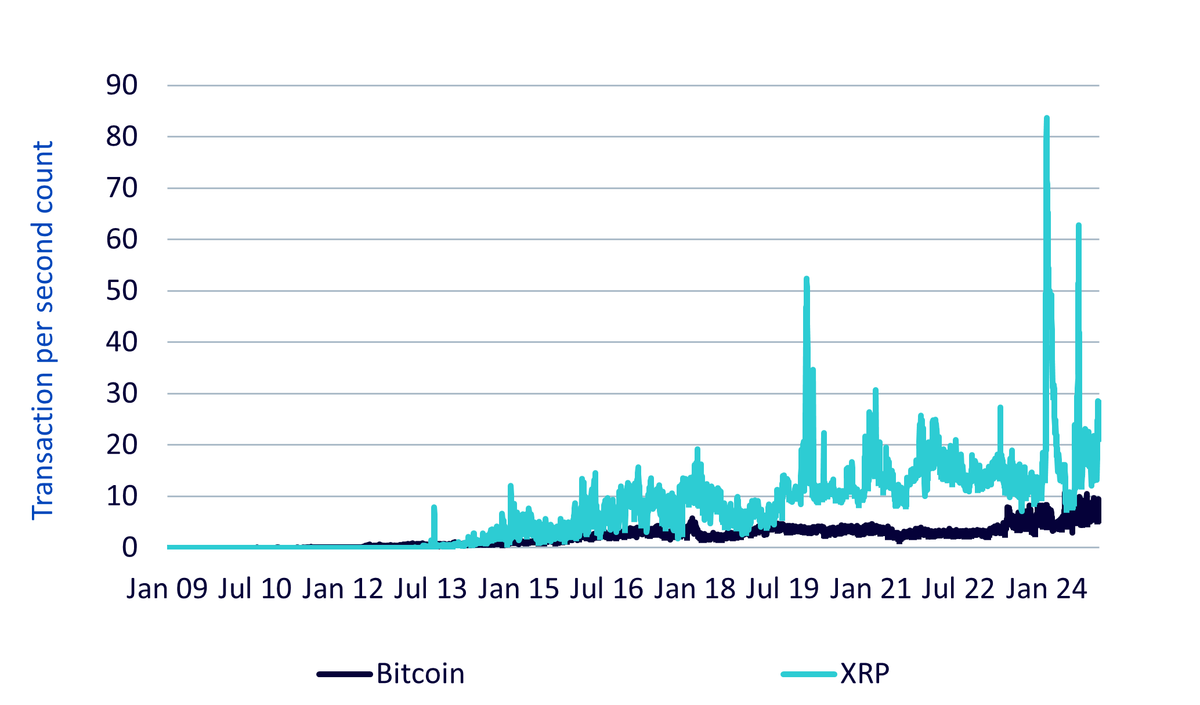
Source: CoinMetrics. 24 November 2024. Historical performance is not an indication of future performance and any investment may go down in value.
XRP’s efficiency makes it a strong contender for real-time payments, while bitcoin’s slower pace emphasises security and decentralisation.
For XRP to rival bitcoin’s $1.9 trillion market cap, transformative shifts would be essential:
To match bitcoin’s market capitalisation, XRP’s price would need to increase more than 20x from its current levels. This monumental challenge underscores bitcoin’s entrenched dominance and unique value.
Bitcoin and XRP each play vital roles in the cryptocurrency ecosystem. Bitcoin’s appeal as a decentralised store of value continues to attract investors, while XRP’s utility in transforming cross-border payments positions it as a leader in blockchain-based finance.
Though surpassing bitcoin’s market cap remains an ambitious goal, XRP’s deflationary supply, institutional focus, and scalability mean it will likely remain a crucial player in the evolving crypto space.
WisdomTree offers a curated range of nine physical crypto exchange-traded products (ETPs) that have institutional-grade structure and provide spot price exposure to single coins and diversified crypto baskets. Please see the WisdomTree Crypto ETP centre for further detail.
1 Coin360. 27 November 2024.
2 Please see https://www.tranglo.com/odl/ for further detail.
3 Messari. 27 November 2024.
4 Messari. 27 November 2024.
WisdomTree Physical XRP

Director, Digital Assets Research
Dovile Silenskyte is a director of digital assets research at WisdomTree. Before joining WisdomTree in May 2024, Dovile worked as an index equity product strategist at BlackRock. Currently, she is responsible for conducting analyses for in-house digital assets publications and assisting the sales team with client queries about products and markets. Dovile holds an MSc in Finance from Texas A&M University – Commerce, and she is also a chartered financial analyst (CFA).


