
WXRP IM
WisdomTree Physical XRP

Published 21 November 2024

Director, Digital Assets Research
As investors start to recognise the potential benefits of adding crypto to their multi-asset portfolios, they are also looking for ways to diversify their crypto exposures. That is, some investors no longer want to be overexposed to a single mega cap cryptocurrency and are actively looking for a suitable altcoin to sit alongside it.
The WisdomTree Digital Asset Taxonomy categorises cryptocurrencies into:
This taxonomy helped us identify XRP as an altcoin that could sit alongside bitcoin, given that both are classified as Layer-1 payments. There are parallels between Ethereum and Solana, which are classified as Layer-1 smart contracts networks, with Solana being an altcoin to Ethereum.
Layer-1 payments | Layer-1 smart contracts | |
|---|---|---|
Mega cap | Bitcoin | Ethereum |
Altcoin | XRP | Solana |
Source: WisdomTree. October 2024.
XRP is a digital asset native to the XRP Ledger (XRPL), an open-source, permissionless, and decentralised blockchain. Built in 2012, specifically for payments, XRP can settle transactions on the ledger in 3-5 seconds and was designed to be a faster and more sustainable alternative to Bitcoin. This is possible because XRPL and Bitcoin use two different consensus mechanisms:
PoA is operated by universities, exchanges, businesses, and individuals to validate transactions. It is more efficient to run than PoW as it requires fewer hardware resources and consumes less energy.
XRP can be sent directly without a central intermediary, making it a convenient instrument for bridging two different currencies quickly and efficiently. It is freely exchanged on the open market and used in the real world to enable cross-border payments and microtransactions.
As of now, cryptocurrencies have a significant track record of 15+ years. Per Figure 2 (below), they also represent a portion of investable market portfolio.
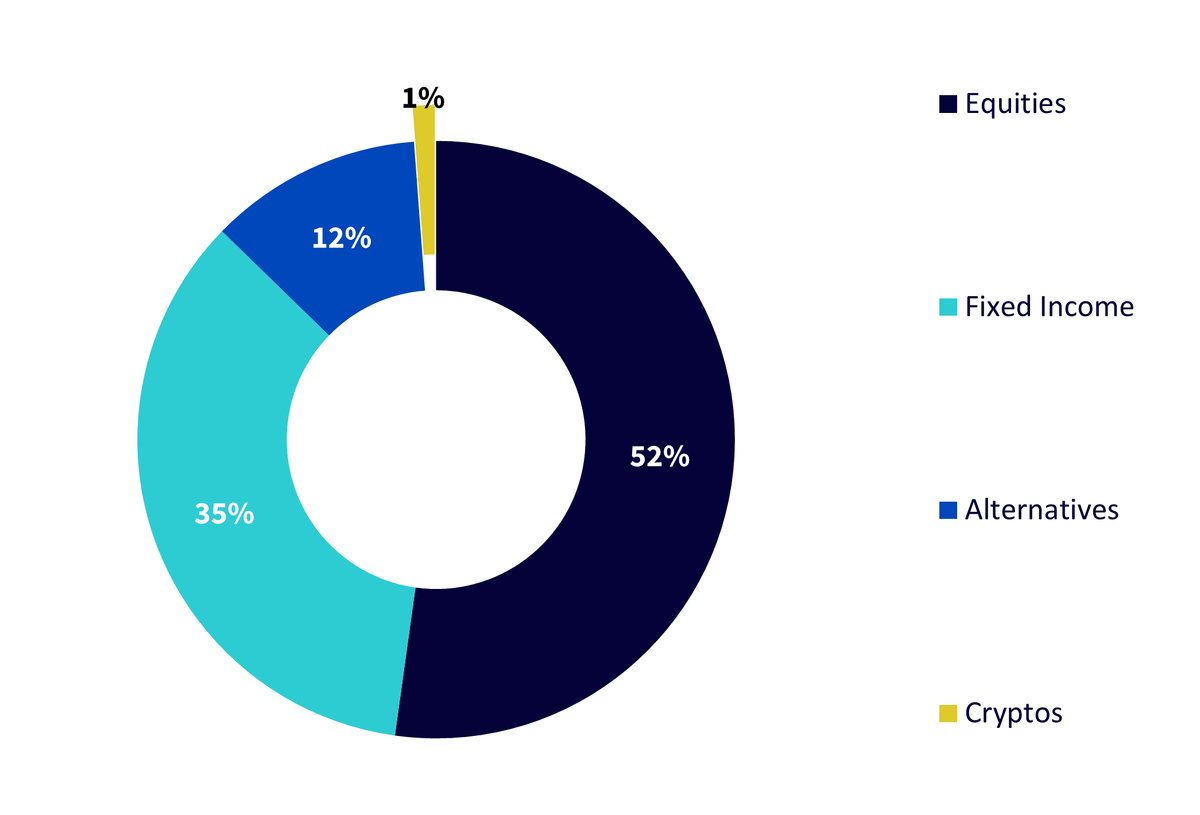
Source: Bloomberg, WisdomTree. 30 September 2024. In USD. You cannot invest directly in an index. Historical performance is not an indication of future performance and any investment may go down in value.
Figure 2 (above) shows the market portfolio of all listed, investable assets accessible to investors. With a market cap of over $2 trillion1, cryptocurrencies represent approximately 1% of the market portfolio that has a total market cap of just over $200 trillion2. XRP itself has a market cap of $31 billion3 which places it as number 54 by market cap among all cryptocurrencies.
Since cryptocurrencies have a low correlation to traditional asset classes, they can help enhance the diversification of multi-asset portfolios and potentially improve the risk/return profiles of those portfolios. As an altcoin to bitcoin, XRP could sit alongside it in a multi-asset portfolio and reduce investors’ exposure to and reliance on a single cryptocurrency.
XRP | Bitcoin | Ether | |
|---|---|---|---|
XRP | 1.00 | ||
Bitcoin | 0.4 | 1.00 | |
Ether | 0.4 | 0.9 | 1.00 |
Source: WisdomTree, Glassnode. 21 October 2024. Correlation is calculated using 3-month daily USD returns and is annualised. Historical performance is not an indication of future performance and any investment may go down in value.
Interesting to note, and as seen in Figure 3 (above), bitcoin and ether are strongly correlated with each other, while XRP has low correlation with both of them.
Transaction fees on the XRPL are systematically burned, applying deflationary pressure to XRP’s total supply of 100 billion units. Since its inception, approximately 12 million XRP units have been burned. While this burn rate may seem relatively low, it is directly linked to most transactions only costing fractions of a cent. Low transaction costs are important for real world adoption of XRP.
In addition, 1 billion XRP units are released from escrow to Ripple each month. This is due to Ripple originally locking 55 billion XRP units (i.e. 55% of the total possible supply) into a series of escrows in order to ensure predictability to the XRP supply5. Any XRP not spent or distributed by Ripple in that month is put into new escrow contracts. This will continue until the remaining ~45 billion XRP units become liquid. Afterwards, the burned fees will be the only supply variable.6
For investors, both bitcoin and XRP are scarce cryptocurrencies with different issuance schedules. Bitcoin should reach its max supply of 21 million units in approximately 2140, and XRP should reach its max supply in the next few years. Afterwards, the number of XRP units will only shrink due to the burning of transaction fees. As long as XRP demand grows or even remains the same, XRP scarcity should be positive for XRP price.
XRP offers a strong complement to bitcoin in a portfolio. With its focus on fast, low-cost transactions, XRP balances bitcoin’s strengths as a digital asset. By holding both, investors can spread out risk and enjoy the unique benefits each brings – bitcoin’s well-known store of value and XRP’s efficiency in payments – making the combination a versatile choice in today’s evolving market.
1 Source: Bloomberg, WisdomTree. 30 September 2024.
2 Source: Bloomberg, WisdomTree. 30 September 2024.
3 Source: Messari. 22 October 2024.
4 Source: Messari. Excluding stablecoins. 22 October 2024.
5 Please see further detail here: https://ripple.com/insights/explanation-ripples-xrp-escrow/
6 Sources: Messari’s State of XRP Ledger Q1 2024; Q2 2024 XRP Markets Report.

Director, Digital Assets Research
Dovile Silenskyte is a director of digital assets research at WisdomTree. Before joining WisdomTree in May 2024, Dovile worked as an index equity product strategist at BlackRock. Currently, she is responsible for conducting analyses for in-house digital assets publications and assisting the sales team with client queries about products and markets. Dovile holds an MSc in Finance from Texas A&M University – Commerce, and she is also a chartered financial analyst (CFA).


