
AIGA LN
WisdomTree Agriculture

Published 16 September 2024

The conclusion of the 2023/24 El Nino event is now giving way for the likely return of the climate phenomenon La Nina. The cooling of the sea’s surface in July and August now points to a shift towards more neutral conditions. The chances of a La Nina weather pattern forming this year are becoming more likely. According to NOAA, La Nina is favoured to emerge in September – November with a 71% chance and is expected to persist through January to March 20251.
During La Nina, the tropical Pacific Ocean is cooler than average, putting in motion a series of potential impacts, from stronger rains in Asia to drier conditions in South America. Increased rainfall in Southeast Asia is expected to improve the outlook for rice, sugar and food oils. In contrast, the transition may intensify dry conditions in Latin America, negatively affecting crops and yields for commodities such as soybeans, maize and sugar. Reduced rainfall in South America due to La Nina could delay plantings and further impact yields for the next season too.
In the US, La Nina can result in drought and winter heat to some southern states and heavy rains to the Pacific Northwest. La Nina is also known to intensify extreme weather events such as flooding, drought and heatwaves and hurricanes across key producing regions, adding a layer of uncertainty to the agricultural production and food security.
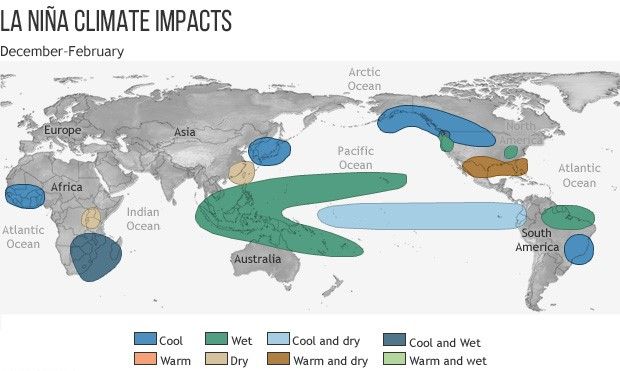
Source: National Oceanic and Atmospheric Administration, WisdomTree as of 30 August 2024.
Looking back at historical data since 1950, there have been a total of 14 La Nina weather phenomena. On analysing agricultural commodity prices during 13 of those La Nina episodes, we found that wheat traded higher in 12 cases, six months after the La Nina event started. While in 11 of the 13 cases corn traded higher, six months following the start of the La Nina event. In 9 of the 13 prior La Nina cycles, soybean and cotton traded higher six months after the event began. While for most other commodities the results were mixed.
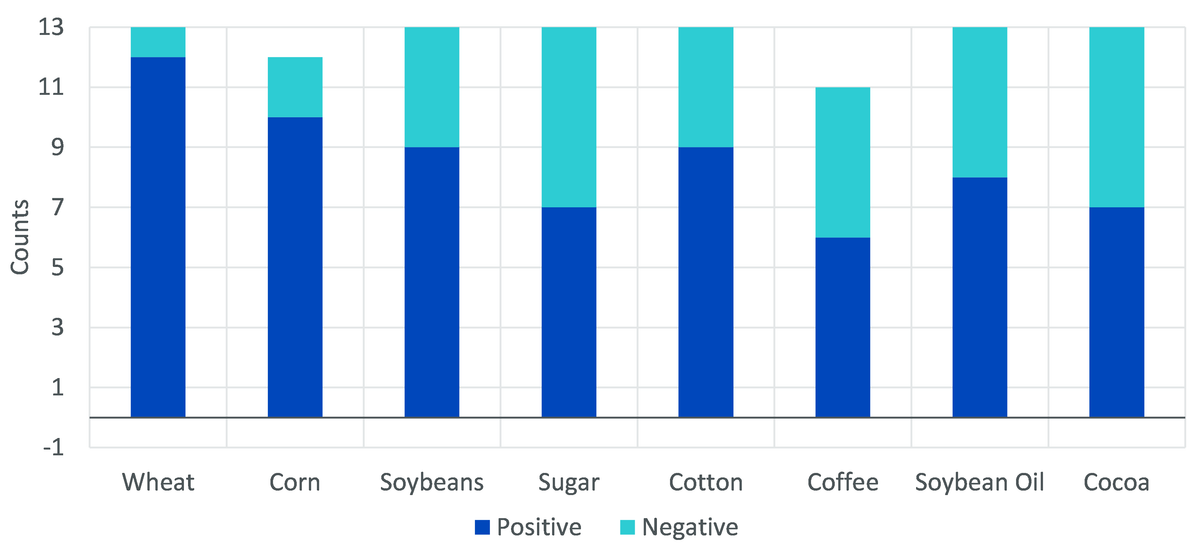
Source: National Oceanic and Atmospheric Organization, Bloomberg, WisdomTree, data from January 1950 to August 2024. Please note in the case of coffee, owing to data availability, we have analysed price performance in 11 prior La Nina episodes compared to 13 for the remaining commodities. Historical performance is not an indication of future performance, and any investments may go down in value.
While the La Nina event is not guaranteed as it holds less than 100% probability, and meteorologists are expecting it to be a relatively weak event2, inventories of many crops remain below the long-term average. Inventories for wheat, corn, sugar and coffee are 9.8%, 2%, 20% and 30% below their five-year historical average3. And so, the ability to absorb a price shock is thinner for these commodities in particular. La Nina could therefore provide an upside price boost for these agricultural commodities.
In addition, sentiment across agricultural commodities remains low. Net speculative positioning across wheat, corn, soybeans, sugar, cotton and soybean oil are well below their respective five-year average.
1 Climate Prediction Center as of 12 September 2024
2 https://www.climate.gov/news-features/blogs/enso
3 United States Department of Agriculture (USDA) as of 3 August 2024


Director, Macroeconomic Research, WisdomTree Europe
@AneekaGuptaWTAneeka Gupta is Director of Research at WisdomTree. Prior to the acquisition of ETF Securities in April 2018, Aneeka worked as an Equity & Commodities Strategist at the company. Aneeka has 17 years of experience working as a Research Analyst across a wide range of asset classes. In her current role she is responsible for conducting analysis for all in-house equity, commodity and macro publications and assisting the sales team with client queries around products and markets. Prior to WisdomTree, Aneeka began her career as an equity analyst at Bear Stearns International Ltd in London. She also worked as an Equity Sales Trader at Sunrise Brokers across US and Pan European Exchanges. Before that she worked as an Equity Derivatives Sales Manager at Mashreq Bank in Dubai. Aneeka holds a Masters in Mathematics from Oxford University and a BSc in Mathematics from the University of Delhi, India. She is also a CFA Charterholder.