

WisdomTree’s Japan Equity Toolkit for 2015
Published July 16, 2015

Global Head of Research
Japan has been among the world’s best performing equity markets thus far this year.1 WisdomTree has an extensive Japanese toolkit, with 10 distinct Indexes tracked by exchange-traded funds (ETFs). In this article we aim to answer two key questions.
1. Which Indexes have performed the strongest during the first half of 2015?2. Which Indexes represent interesting potential for the second half of 2015?Showcasing the Performance of Japanese Equities
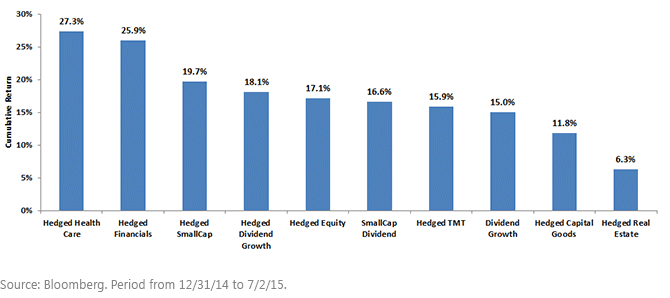
“Hedged Health Care” refers to the WisdomTree Japan Hedged Health Care Index. “Hedged Financials” refers to the WisdomTree Japan Hedged Financials Index. “Hedged SmallCap” refers to the WisdomTree Japan Hedged SmallCap Equity Index. “Hedged Dividend Growth” refers to the WisdomTree Japan Hedged Dividend Growth Index. “Hedged Equity” refers to the WisdomTree Japan Hedged Equity Index. “SmallCap Dividend” refers to the WisdomTree Japan SmallCap Dividend Index. “Hedged TMT” refers to the WisdomTree Japan Hedged Tech, Media and Telecom Index. “Dividend Growth” refers to the WisdomTree Japan Dividend Growth Index. “Hedged Capital Goods” refers to the WisdomTree Japan Hedged Capital Goods Index. “Hedged Real Estate” refers to the WisdomTree Japan Hedged Real Estate Index.
• Health Care and Financials Stand Out: WisdomTree’s Japan Hedged Health Care Index has been a consistently strong performer since its December 2, 2013, inception, exhibiting average annual returns of 29.7%.2 WisdomTree’s Japan Hedged Financials Index, on the other hand, had a much weaker 2014, but has been gaining momentum recently.• Real Estate Notably Weak: For a more contrarian play on Japan, judging by recent performance, WisdomTree’s Japan Hedged Real Estate Index may be of interest. Even though the Bank of Japan announced a tripling of its annual purchases of Japan real estate investment trusts (J-REITs) on October 31, 2014, performance has not really responded as strongly as some other parts of Japan’s equity markets.3Opportunities for the Second Half of 2015 Of course, while it’s nice to note recent performance, there is little it can tell us about future opportunities. An analysis of the fundamentals may be more appropriate. Which Index Has the Lowest Price-to-earnings (P/E) ratio? While the WisdomTree Japan Hedged Real Estate Index had the worst performance over the period shown, does this mean that it’s the least expensive? Not on a P/E ratio basis. In fact, it’s interesting that the WisdomTree Japan Hedged Financials Index had the lowest P/E ratio as of July 2, 2015, a level of 13.0x. The WisdomTree Japan Hedged Health Care Index, on the other hand, had a P/E ratio of nearly 28.0x, or more than twice as high. Which Index Has the Highest Dividend Yield? This is an interesting question, in that Japanese equities represent a generally lower-yielding equity market. However, as of July 2, 2015, two Indexes exhibited a dividend yield above 2.0%: the WisdomTree Japan Hedged Equity and the WisdomTree Japan Hedged Dividend Growth Indexes. These Indexes are weighted by cash dividends, which tends to increase their dividend yields compared to market capitalization-weighted approaches. Of the Japan sector Indexes not weighted by cash dividends, the WisdomTree Japan Hedged Financials Index had a dividend yield of about 1.9%, which was the highest value exhibited among the market capitalization-weighted approaches. Which Index Has the Highest Buyback Yield? We’ve seen the evolution of Abenomics, and the 2015 manifestation has been a greater focus on returning cash to shareholders. Share buybacks have been an important avenue through which this has been accomplished. The WisdomTree Japan Hedged Dividend Growth Index had the highest buyback yield, 0.79%, as of July 2, 2015. The second highest was the WisdomTree Japan Hedged Financials Index, at 0.77%. The Index with the lowest share buyback yield was actually the WisdomTree Japan Hedged Real Estate Index, at about 0.14%. Financials: A Strong Combination So, even though the performance momentum has been so strong during the first half of 2015, the WisdomTree Japan Hedged Financials Index had the lowest P/E ratio, a competitive dividend yield even without being cash dividend weighted and the second highest buyback yield. As opportunities go for the second half of 2015, we think that the Japanese financials could still be of particular interest. 1Source: Bloomberg, for period 12/31/14–7/2/15. 2Source: Bloomberg, for period 12/2/13–7/2/15. 3Source: “Expansion of the Quantitative & Qualitative Monetary Easing,” Bank of Japan, 10/31/14.
Important Risks Related to this Article
Foreign investing involves special risks, such as risk of loss from currency fluctuation or political or economic uncertainty. Investments focused in Japan increase the impact of events and developments associated with the region, which can adversely affect performance.
About the contributor

Global Head of Research
Christopher Gannatti began at WisdomTree as a Research Analyst in December 2010, working directly with Jeremy Schwartz, CFA®, Director of Research. In January of 2014, he was promoted to Associate Director of Research where he was responsible to lead different groups of analysts and strategists within the broader Research team at WisdomTree. In February of 2018, Christopher was promoted to Head of Research, Europe, where he was based out of WisdomTree’s London office and was responsible for the full WisdomTree research effort within the European market, as well as supporting the UCITs platform globally. In November 2021, Christopher was promoted to Global Head of Research, now responsible for numerous communications on investment strategy globally, particularly in the thematic equity space. Christopher came to WisdomTree from Lord Abbett, where he worked for four and a half years as a Regional Consultant. He received his MBA in Quantitative Finance, Accounting, and Economics from NYU’s Stern School of Business in 2010, and he received his bachelor’s degree from Colgate University in Economics in 2006. Christopher is a holder of the Chartered Financial Analyst Designation.