

WisdomTree’s India Earnings Index: Annual Rebalance Screening
Published October 9, 2013

Global Chief Investment Officer
Both the Indian equity market and the Indian rupee have experienced strong bouts of volatility in recent years. Amid the noise of central bank actions and macro-related policy debates, WisdomTree rebalanced its India Earnings index on September 20—the same day the new governor of the Reserve Bank of India (RBI) made his first policy announcement. The timing of this Index rebalance and central bank meeting was a coincidence—the Index rebalance occurs at the same time every September. Each year, WisdomTree calculates the Earnings Stream of India’s equity market to identify firms that have generated positive cumulative profits. Qualifying companies are weighted by their proportionate contribution to the total Earnings Stream. • Firms whose price levels have declined but whose earnings have either remained constant or grown tend to see increases in their weights at the rebalance. This rules-based methodology applies a disciplined focus to firms’ fundamentals and relative valuations. Sector Weight Changes and Measures of Potential Rupee Sensitivity In the trailing 12 months prior to the rebalance date (September 20, 2013), India’s equities as measured by the WisdomTree India Earnings Index (WTIND) delivered returns of -13.2%. Given that the rupee declined more than 14% over this period, the currency move explains the Index decline. But there were big divergences among sectors that led to shifts in sector weights at the rebalance. One factor that was important in explaining the sector performance was each sector’s sensitivity to the currency, so in the below analysis we list those sector correlations. Analysis of Sector Changes in Weight and Rupee Sensitivity
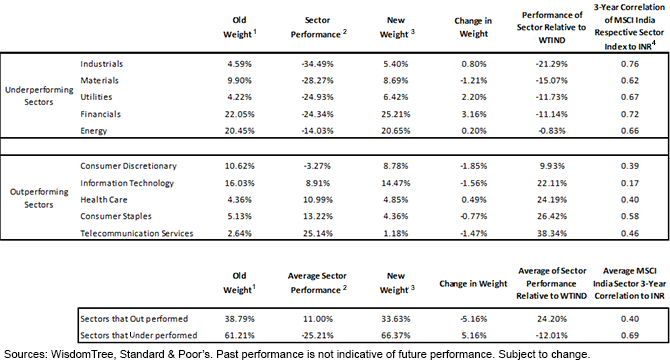
1 As of 9/20/2013, before rebalance weights went into effect. 2 Performance of specified sector from 9/21/2012 to 9/20/2013. 3 As of 9/20/2013, after rebalance weights went into effect. 4 From 8/31/2010 to 8/31/2013. For definitions of terms in the charts, please visit our Glossary. There were five sectors in this Index that underperformed and five sectors that outperformed. Some notable points: • The Underperformers: This group consisted of Industrials, Utilities, Materials, Financials and Energy. Their average return over the period was worse than -25%, about 12% worse than the performance of WTIND (-13.2%). These underperforming sectors received about 5% additional weight at this year’s annual rebalance screening. The greatest two weight increases were to Financials and Utilities, whereas Energy and Industrials were largely unchanged in weight. • The Outperformers: This group consisted of Consumer Discretionary, Health Care, Consumer Staples, Information Technology and Telecommunication Services. Their average return over the period was approximately 11%, about 24% better than the performance of WTIND as a whole. The outperformers saw their weight reduced by 5%. The greatest reduction in weight came from Information Technology and Consumer Discretionary. • Correlation to the Rupee—Results: The sectors that underperformed were the ones most correlated to the rupee, in particular Financials, Energy, Industrials and Utilities. One factor causing this high correlation could be these companies’ issuance of dollar-denominated debt . When the local currency declines, it causes their debt levels to rise because it costs more rupees to pay off their debt. o Companies that have revenue in U.S. dollars, for example the exporters, benefit from a weaker rupee; the Technology sector is one of most prominent sectors whose companies can be said to have benefited on a revenue basis from the weakening rupee and which also had little dollar-denominated debt. • The actions taken by the new head of the central bank to provide discounted loans to financials represented a large change in sentiment and helped alleviate the pressures they faced from the declining rupee on their dollar-denominated debt—it may mark a turning point for these companies. • Rebalance Results: By shifting weight toward the Financials sector and away from the Technology sector, the correlation of the India Earnings Index to the currency change has the potential to become a bit more sensitive by adding more weight to a sector that is highly correlated to the rupee and taking weight away from the Tech sector, which is less correlated to the rupee. Conclusion Volatility in the markets creates the potential for opportunity to take stock of fundamentals and identify when stock prices have moved more than is justified by changes in the relative value of companies or markets. This year’s annual rebalance in India was such a time when there were large changes in many asset prices. We took this opportunity to add weight to Financials and Utilities, two sectors that underperformed, while taking weight away from sectors that performed relatively well: Technology. We believe this disciplined, rules-based rebalance is a key way to add value to our indexing approach.
Important Risks Related to this Article
There are risks associated with investing, including possible loss of principal. Foreign investing involves special risks, such as risk of loss from currency fluctuation or political or economic uncertainty. Investments in emerging, offshore or frontier markets such as India are generally less liquid and less efficient than investments in developed markets and are subject to additional risks, such as risks of adverse governmental regulation and intervention or political developments. You cannot invest directly in an index.
Categories
About the contributor

Global Chief Investment Officer
Jeremy Schwartz has served as Global Chief Investment Officer since November 2021 and leads WisdomTree’s investment strategy team in the construction of WisdomTree’s equity Indexes, quantitative active strategies and multi-asset Model Portfolios. Jeremy joined WisdomTree in May 2005 as a Senior Analyst, adding Deputy Director of Research to his responsibilities in February 2007. He served as Director of Research from October 2008 to October 2018 and as Global Head of Research from November 2018 to November 2021. Before joining WisdomTree, he was a head research assistant for Professor Jeremy Siegel and, in 2022, became his co-author on the sixth edition of the book Stocks for the Long Run. Jeremy is also co-author of the Financial Analysts Journal paper “What Happened to the Original Stocks in the S&P 500?” He received his B.S. in economics from The Wharton School of the University of Pennsylvania and hosts the Behind the Markets podcast. Jeremy is a member of the CFA Society of Philadelphia.