

Why Small Caps and Quality Can Be a Powerful Combination
Published March 27, 2017

Global Head of Research
In January 2015, Cliff Asness and his colleagues published a paper titled “Size Matters, if You Control Your Junk.”1 The big-picture concept of focusing on a fundamental attribute—in this case, quality—within small caps is something that we believe is quite powerful and something that WisdomTree has been doing when constructing its Indexes since 2006.
Quality: Long-Term Outperformance with Lower Risk
The “size effect” has been well documented, leading many investors to believe that holding shares of small companies for long periods of time could be a successful strategy. However, it’s important to question whether these greater returns over long periods are simply a function of greater risk.2
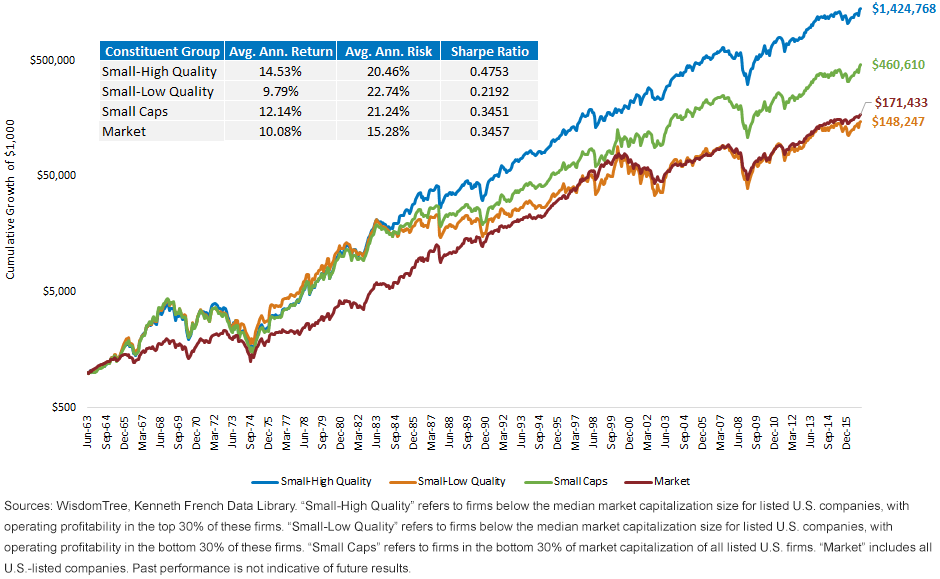
- Small caps vs. the market: Small caps did beat the market by slightly more than 2% per year from June 30, 1963, to December 31, 2016, but this was with about 6% per year in incremental additional volatility. It’s notable that small caps had a lower Sharpe ratio than the market over this period by .0006—meaning that in risk-adjusted terms it would be difficult to say that small caps outperformed the market over this period.
- Not all small caps are equal: In investing, what’s avoided is at times equally (or more) important than what is focused upon. Clearly, there are small-cap, lower-quality firms—specifically with lower operating profitability—that had lower returns and higher risk over this period.
- Small quality: By avoiding the small caps with lower operating profitability and focusing on those with higher profitability, there was a return advantage over simply focusing on small caps alone. However, there was also a risk advantage, leading to a significant increase in the Sharpe ratio.
Conclusion: When investing in small caps, filtering out lower-quality, more speculative companies could be beneficial.
Cumulative Growth of $1,000 (6/30/1963–12/31/16)
How WisdomTree has Avoided Speculative Small-Cap Firms
WisdomTree now has two U.S. small-cap strategies with 10 years of live performance history.
- WisdomTree SmallCap Dividend Index: This is a very broad approach, meant to capture U.S. small-cap companies that pay regular dividends.
- WisdomTree SmallCap Earnings Index: This is also a very broad approach, meant to capture U.S. small cap companies that have generated positive earnings over the four quarters leading up to the annual screening date.
Critical ingredient: Rather than including all small-cap firms, WisdomTree requires that firms must do something deemed to be fundamentally valuable (such as pay a regular dividend or have positive profits) prior to gaining inclusion.
Why Does the Russell 2000 Index Receive So Much Attention?
We wrote recently about the continuum of index construction from Russell to S&P to WisdomTree. In short:
- Russell’s methodology tends to be the most broadly focused.
- One of S&P’s standards for companies to gain initial inclusion is the generation of positive profits.
- WisdomTree’s Earnings family of Indexes requires ongoing profitability—a step further than S&P. Similarly, WisdomTree’s Dividend family of Indexes requires the ongoing payment of regular cash dividends.
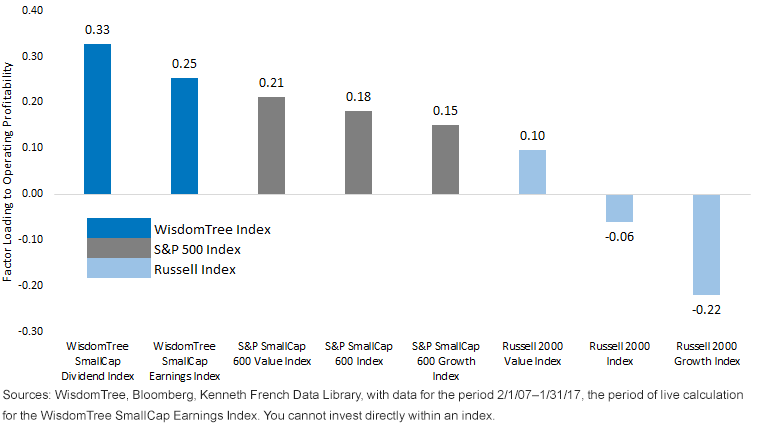
Intuitively, the requirement of paying ongoing dividends or generating positive profits could lead to a focus on higher quality, predominantly by avoiding the more speculative firms that may not meet these criteria. Now, instead of simply stopping there, we tested the factor loading to operating profitability over the live performance history. In a word, the indexes exhibited the exact positioning along the continuum that intuition would predict:
- Russell had the lowest loading to operating profitability.
- S&P had a higher loading to operating profitability than Russell.
- WisdomTree had the highest loading to operating profitability.
Conclusion
If small-cap exposure is desired, we believe that focusing on fundamentals adds an important layer. Both dividend and earnings weighting helped introduce a quality bias to the portfolios. Notably, even within market cap-weighted small-cap indexes there was a big quality differential, so it pays to look deeper at what is driving your index exposure in small caps.
1Cliff Asness, et al., “Size Matters, if You Control Your Junk,” SSRN, first draft 1/23/15.
2Source for data within bullets is Kenneth French Data Library, with data from the period 6/30/1963–12/31/2016.
Important Risks Related to this Article
Dividends are not guaranteed, and a company currently paying dividends may cease paying dividends at any time.
Investments focusing on certain sectors and/or smaller companies increase their vulnerability to any single economic or regulatory development.
Categories
About the contributor

Global Head of Research
Christopher Gannatti began at WisdomTree as a Research Analyst in December 2010, working directly with Jeremy Schwartz, CFA®, Director of Research. In January of 2014, he was promoted to Associate Director of Research where he was responsible to lead different groups of analysts and strategists within the broader Research team at WisdomTree. In February of 2018, Christopher was promoted to Head of Research, Europe, where he was based out of WisdomTree’s London office and was responsible for the full WisdomTree research effort within the European market, as well as supporting the UCITs platform globally. In November 2021, Christopher was promoted to Global Head of Research, now responsible for numerous communications on investment strategy globally, particularly in the thematic equity space. Christopher came to WisdomTree from Lord Abbett, where he worked for four and a half years as a Regional Consultant. He received his MBA in Quantitative Finance, Accounting, and Economics from NYU’s Stern School of Business in 2010, and he received his bachelor’s degree from Colgate University in Economics in 2006. Christopher is a holder of the Chartered Financial Analyst Designation.