

Where’s the Bund?
Published March 11, 2016

Head of Investment and Fixed Income Strategy
Prior to the eurozone crisis, Treasuries typically took their cue from domestic factors such as the U.S. economic and inflation outlook and whatever the Federal Reserve (Fed) policy response could be as a result. Other considerations, such as global sovereign debt markets and foreign exchange developments, were usually merely secondary considerations. However, as investors have witnessed over the last few years, domestic forces no longer provide the sole backdrop for future rate movements, as Treasuries have essentially “gone global.” One of the driving forces in this global landscape has been the developed world’s sovereign debt markets. Within the 10-year sector, the U.S. Treasury maturity currently offers the highest yield available, notwithstanding Portugal and Greece. Underscoring this relative yield advantage, both Japan’s and Switzerland’s 10-year rates are in negative territory. Let’s narrow this universe. Within the developed world, there is little doubt that outside of Treasuries, one of the more closely followed bond markets is Germany. It is interesting to note that in the German bund arena, negative interest rates exist as well, extending all the way out to the 7-year maturity. The 10-year bund is the first maturity to enter into positive territory—but just barely. U.S. 10-Year Treasury vs. German 10-Year Bund Yield (2/1/2011−3/3/2016)
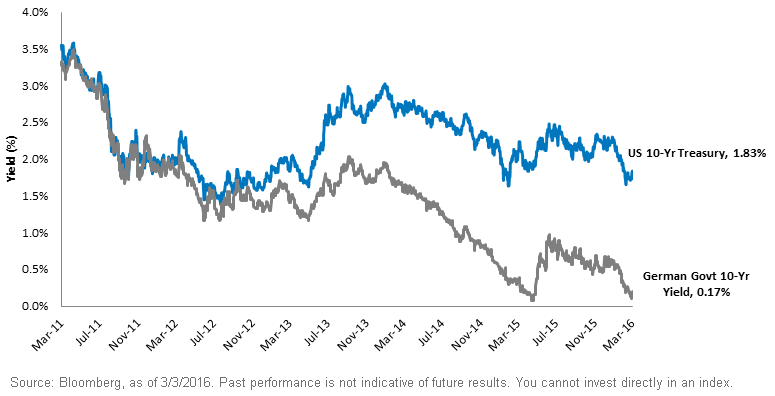
The natural question to ask is why German 10-year yields are so low. There are a host of different reasons. First, much like Treasuries, which are viewed as a safe-haven investment, so are bunds, especially for eurozone investors. This is an important consideration, because “headline risk” continues to hang over the eurozone despite the widely publicized efforts to do “whatever it takes”. Secondly, sluggish growth and a lack of any visible inflation pressures also add to the mix. The final piece of the puzzle comes from the European Central Bank’s (ECB) own quantitative easing program, which it formally announced on January 22, 2015. In fact, it would appear highly likely that the ECB will continue to maintain a historically easy monetary policy for quite some time, a point underscored by their actions at the March policy meeting. Conclusion With 10-year bund yields not too far removed from the zero threshold, comparable-maturity Treasuries should continue to receive support from global fixed income investors. The 10-year Treasury/bund spread resides at roughly +160 basis points (bps), or tilted toward the wider end of the spectrum of the last two years. To provide some perspective, this spread reached a high point of +190 bps, and has produced an average reading of +145 bps since the beginning of 2014. As a result, potential flows that may have been earmarked for bunds in the past are finding their way into Treasuries, given the more favorable yield differential. In our opinion, this factor may serve as a “cap” on 10-year Treasury yields going forward, a situation investors have seen repeatedly over the last few years.
About the contributor

Head of Investment and Fixed Income Strategy
Kevin serves as the Head of Investment and Fixed Income Strategy. In this role, he writes macro and fixed income-related content and works closely with the sales, research and marketing teams. In addition, Kevin conducts client-facing webinars and meetings, providing expertise on WisdomTree’s existing and future bond ETFs. Prior to joining WisdomTree, Kevin spent 30 years at Morgan Stanley, where he was Managing Director and Chief Fixed Income Strategist for Wealth Management. He was responsible for tactical and strategic recommendations and created asset allocation models for fixed income securities. He was a contributor to the Morgan Stanley Wealth Management Global Investment Committee, primary author of Morgan Stanley Wealth Management’s monthly and weekly fixed income publications, and collaborated with the firm’s Research and Consulting Group Divisions to build ETF and fund manager asset allocation models. Kevin has an MBA from Pace University’s Lubin Graduate School of Business, and a B.S. in Finance from Fairfield University.