

Where We See Opportunity in German Equities
Published October 23, 2013

Global Chief Investment Officer
As the economy in the European Monetary Union has improved, the MSCI Germany Index (“German Equities”) has delivered relatively strong returns for the first three quarters of 2013—almost 17%. While this hasn’t quite matched the pace of the S&P 500 Index, it has outperformed the MSCI EAFE Index for this period.1 Of course, the real question regards what the current valuations suggest are the prospects for German Equities going forward. Our research says that German Equities are reasonably priced and attractive based on the historical patterns. Evaluating the Historical Context German Equities have a history going back to December of 1969 and encompassing a variety of market environments. Our goal is, therefore, to construct a framework allowing us to analyze the valuation levels of German Equities over a period of approximately 42 years. While one can never know future performance with certainty, we believe that it is useful to examine valuation levels and how they have coincided with past returns. Year-End Dividend Yield as a Potential Valuation Indicator We believe that the dividend yield for German Equities is an important indicator of their valuation. In fact, as of September 30, 2013, more than 97% of the market capitalization of these stocks had paid at least one dividend over the prior 12 months, indicating that dividend payers make up a large majority of the market.2 With respect to comparisons to its own historical levels, our research shows that the starting trailing 12-month dividend yield for German Equities at the beginning of a calendar year had a strong relationship to the subsequent performance over the next 12-month period. We divided the 42 full years of index data into two baskets sorted by the trailing 12-month dividend yield as of December 31 of each year: • “High Dividend Yield Years”: Years in which the starting trailing 12-month dividend yield was above the median trailing 12-month dividend yield for German Equities. • Median Breakpoint: The median trailing 12-month dividend yield was 2.51%. • “Low Dividend Yield Years”: Years in which the starting trailing 12-month dividend yield was below the median trailing 12-month dividend yield for German Equities.
Analysis of German Equity Performance Following High and Low Dividend Yield Years(12/31/1970–12/31/2012)
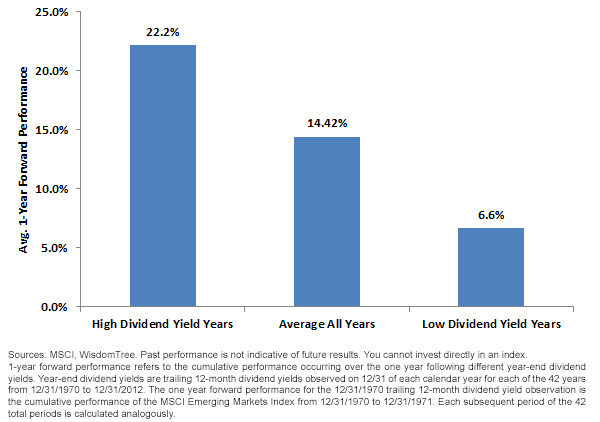
• In the High Dividend Yield Year Range: As of September 30, 2013, German Equities exhibited a trailing 12-month dividend yield of 2.98%, which is above the median dividend yield of our analysis. • Significant Dispersion from High to Low: We’ve certainly pointed to this analysis for other equity markets before. The three bars in this figure make the point that valuation is quite important for German Equities. On average, the returns of High Dividend Yield Years eclipsed those of Low Dividend Yield Years by more than 15%. This suggests that as far as timing goes, it was better from a returns perspective to start during a high dividend yield period such as we see in today’s environment. But What about Price-to-Earnings (P/E) Ratios? Trailing 12-month dividend yield is merely one way to look at the valuation picture for German Equities. Some also look at P/E ratios. We have P/E data extending back to January 1995. From January 1, 1995, to September 30, 2013, the median P/E ratio for German Equities was approximately 13.7x3. As of September 30, 2013, the P/E ratio was indicated to be 13.8x—very much in line with its median4 . Conclusion Our historical valuation work—based primarily around the dividend yield indicator—showed that German Equities performed well following high dividend yield periods. The current levels are indicative of such a period, leading us to conclude that German Equities appear attractively priced based on historical levels. 1Source: WisdomTree, MSCI 2Source: WisdomTree, Bloomberg 3Source: Bloomberg, WisdomTree 4Source: Bloomberg, WisdomTree
Important Risks Related to this Article
Foreign investing involves special risks, such as risk of loss from currency fluctuation or political or economic uncertainty. Investments in currency involve additional special risks, such as credit risk and interest rate fluctuations. Derivative investments can be volatile and these investments may be less liquid than other securities, and more sensitive to the effect of varied economic conditions. Investments focused in Germany are increasing the impact of events and developments associated with the region, which can adversely affect performance. Dividends are not guaranteed and a company’s future abilities to pay dividends may be limited. A company currently paying dividends may cease paying dividends at any time.
About the contributor

Global Chief Investment Officer
Jeremy Schwartz has served as Global Chief Investment Officer since November 2021 and leads WisdomTree’s investment strategy team in the construction of WisdomTree’s equity Indexes, quantitative active strategies and multi-asset Model Portfolios. Jeremy joined WisdomTree in May 2005 as a Senior Analyst, adding Deputy Director of Research to his responsibilities in February 2007. He served as Director of Research from October 2008 to October 2018 and as Global Head of Research from November 2018 to November 2021. Before joining WisdomTree, he was a head research assistant for Professor Jeremy Siegel and, in 2022, became his co-author on the sixth edition of the book Stocks for the Long Run. Jeremy is also co-author of the Financial Analysts Journal paper “What Happened to the Original Stocks in the S&P 500?” He received his B.S. in economics from The Wharton School of the University of Pennsylvania and hosts the Behind the Markets podcast. Jeremy is a member of the CFA Society of Philadelphia.