

What Factors to Own in Today’s Market
Published January 26, 2018

Director, Model Portfolios
Investing is hard. Trying to time the market is harder. Timing return factors at the right time? Forget about it.
The past few years have seen some of the industry’s brightest minds publish papers concerning the feasibility of timing return factors. The conclusions have varied slightly, but most generally agree that when investing in factors, trying to determine which ones to invest in at a given time is an incredibly difficult undertaking.
However, most of these papers analyze factor timing from the lens of the valuations of these factors. What if we take a different approach and see if we can estimate which factors could outperform from the context of where we are in the market cycle?
Where Are We Now?
The U.S. equity bull market started on March 9, 2009. In the almost nine years since then, the S&P 500 has rallied nearly 400%.1 We are certainly not calling for an end to the bull run—in fact, the market environment still appears benign, and corporate earnings have remained strong—but it is certainly not a stretch to claim that we are closer to the end of the cycle than we are to the beginning of it.
As of this writing, we are in the midst of the longest period without a 3% pullback in the history of the S&P 500.2 With implied and realized volatility hovering near their all-time lows, it seems reasonable to expect more choppiness—if not an outright correction—coming in the next few months. Based on what we know from history, what factors tend to outperform in the late stages of market cycles?
Factor Performance Prior to Market Corrections
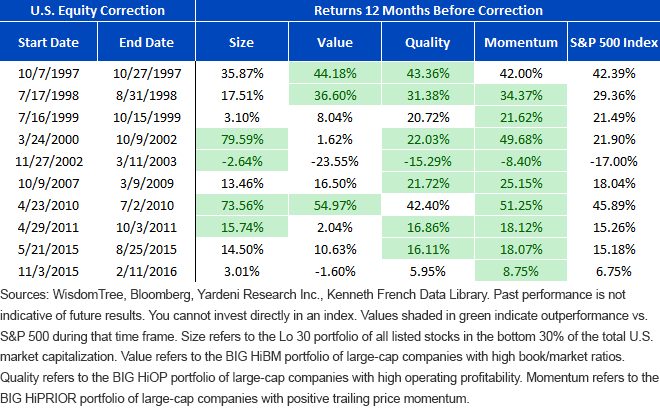
Late-Stage Outperformers: Momentum, Quality
Dating back to 1990, there have been 10 distinct 10% corrections in the S&P 500,3 with bifurcated results in the months preceding the correction. In the lead-up to the downturns, momentum and quality stocks have seen consistent excess performance compared to the market, whereas the size and value factors have generally underperformed.
These results provide an interesting backdrop for today’s market. If we are indeed late in the cycle, and the market dropped 10% tomorrow, this trend would hold true once again. The MSCI Momentum Index and MSCI Quality Index have outperformed the S&P 500 over the last 12 months (by 1,700 and 320 basis points (bps), respectively), whereas the Russell 2000 Index and Russell 1000 Value Index (well-known small-cap and value indexes) have both lagged by more than 700 bps.4
While it is interesting to look at what factors worked well, we think it is also important to analyze what didn’t. If size and value lagged, one can conclude that their complements—large caps and growth companies—outperformed as a result.
Factor Performance During Market Corrections
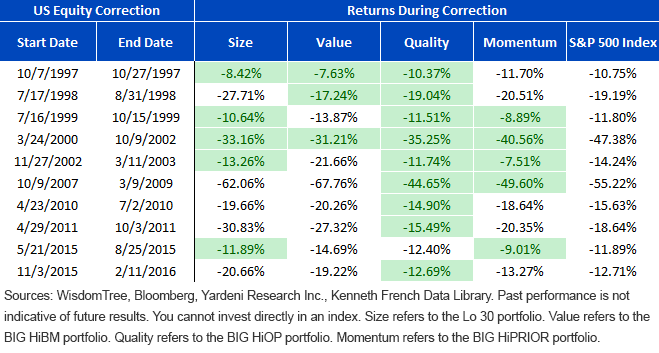
Quality: The Best of Factors in the Worst of Times
Shifting our focus to the market corrections themselves, when the S&P 500 fell at least 10%, it is clear that quality was the most desirable factor by a relatively wide margin. Intuitively, that makes sense—when there is stress in the markets, high-quality companies should help protect investors during market downturns. Encouragingly, the factor excess performance was largest in the most severe market sell-offs (with the quality factor having captured only 74% of the market downside during the tech bubble and 81% during the financial crisis).
Again, value underperforms here, with size and momentum each having relatively more mixed results during market corrections.
What Are Size and Value Good For?
An investor could look at this data and wonder, why would I want to own size and value? Aren’t these stocks supposed to outperform the market? Over the long term, yes, those two factors have shown a propensity to beat the market—with particularly notable excess performance in the early stages of market cycles. Following historical market corrections, immediately after the market bottoms out and reverses upward, size and value have consistently done an effective job of capturing more upside than the market.
Factor Performance Following Market Corrections
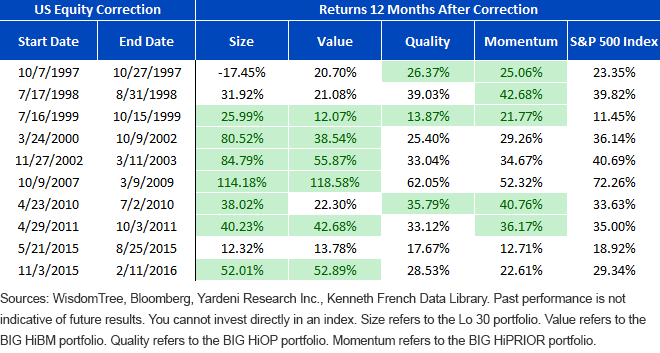
Portfolio Implications for Today
If we are indeed in the late stages of the market cycle, we believe investors should tilt portfolios toward momentum (or growth) and quality. In WisdomTree’s U.S. equity suite, one strategy perfectly fits that bill.
The WisdomTree U.S. Quality Dividend Growth Index methodology implements a ranking system where each stock’s growth and quality fundamentals are equally weighted, with the top scorers being selected for inclusion. While the Index’s performance has beaten the S&P 500 over the last 12 months (by more than 550 bps) and since its inception (by 100 bps annualized),5 we continue to lean into it today it for its attractive quality fundamental characteristics, valuation discount to the S&P, rate-conscious sector exposures and well-positioned factor tilts.
For those reasons, the WisdomTree U.S. Quality Dividend Growth Fund (DGRW), the ETF that tracks the Index, is one of our favored U.S. equity strategies in the current market environment.
Once the inevitable market correction does come, we advise investors to keep a disciplined focus on quality—and be ready to pivot to smaller value companies when the tide turns back around.
1Source: Bloomberg, as of 1/17/18.
2Source: Comerica Wealth Management, as of 1/11/18.
3Source: “Stock Market Briefing: S&P 500 Bull & Bear Market Tables,” Yardeni Research, Inc., last updated 12/1/17.
4Source: Bloomberg, as of 1/17/18.
5Source: Bloomberg, as of 1/17/18.
Important Risks Related to this Article
There are risks associated with investing, including possible loss of principal. Funds focusing their investments on certain sectors may be more vulnerable to any single economic or regulatory development. This may result in greater share price volatility. Please read the Fund’s prospectus for specific details regarding the Fund’s risk profile.
Categories
About the contributor

Director, Model Portfolios
Joe Tenaglia joined WisdomTree as Asset Allocation Strategist in 2016. He is responsible for building and managing WisdomTree’s CIO-managed and custom model portfolios. In this role he focuses on asset allocation, security selection, and portfolio construction for the firm’s open architecture models, with objectives ranging from strategic to tactical. Joe sits on WisdomTree’s Model Portfolio Investment Committee, which oversees the firm’s ETF models and helps shape and communicate WisdomTree’s thoughts on the markets. Prior to joining WisdomTree, he held roles at Emerging Global Advisors (acquired by Columbia Threadneedle) and BNY Mellon. Joe received his B.S. in Finance and Marketing from Boston College. He is a holder of both the Chartered Financial Analyst designation and Chartered Market Technician designation.