

What Economic Indicator Has Been Flying under the Radar? Inflation
Published June 20, 2018

Head of Investment and Fixed Income Strategy
Over the last week to 10 days, investors have been presented with a whole host of news. There have been summits of various kinds as well as central bank meetings of the G-3 (U.S., eurozone and Japan). For good reason, each of these events has generated its own individual headlines, but one particular development has essentially flown under the radar. Indeed, during the period under review, the Bureau of Labor Statistics released its latest report on inflation, the Consumer Price Index (CPI)—and the trend that is beginning to take shape in 2018 is that inflation appears to be on the rise.
Interestingly, the money and bond markets have been down this road before, as 2017 also got off to an ascending trajectory. However, in hindsight, last year’s trend proved to be a false start, as early demand pressures quickly gave way to a declining trend, and the year-over-year increase for headline CPI finished 2017 at +2.1%, identical to 2016.
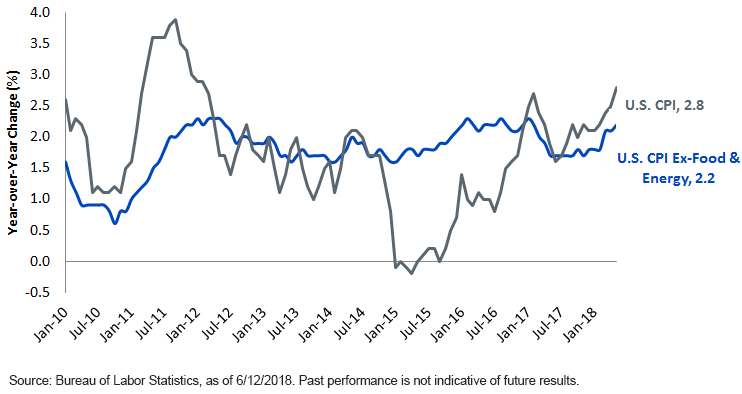
Through the first five months of the current calendar year, the trend has been decidedly up. To be sure, in each of the first five months of 2018, the CPI’s annualized increase has revealed a higher reading. As a result, the year-over-year increase has risen from +2.1% in December 2017 to +2.8% in May of this year. The current figure is the highest reading since 2012. A similar pattern has been observed with CPI, excluding food and energy. This core measure of inflation has risen 0.4 percentage points from the end of last year and now stands at +2.2%.
U.S. CPI vs. U.S. CPI ex-Food & Energy
Year-over-Year Change from 1/ 31/2010 to 5/31/2018
While the U.S. Treasury (UST) market may have been preoccupied with the aforementioned news events, the Federal Reserve (Fed) certainly has taken note. No, this renewed increase in inflation was not an integral factor behind the FOMC’s decision to raise rates at last week’s meeting, but based upon the policy statement and Chairman Powell’s post-convocation presser, the Fed appears to be rather pleased with the direction inflation is finally headed. In fact, Powell stated that recent inflation data has been encouraging, but on the other hand warned that “we don’t want to declare victory” yet. For the record, the Fed’s preferred inflation measure, the personal consumption expenditure (PCE) price index, has also made some progress. The overall PCE gauge has hit the FOMC’s inflation target of +2.0% the last two months, while the core measure resides just below, at +1.8%, but it, too, appears poised to make a run at this goal.
Conclusion
Let’s conclude with the UST market. The UST 10-Year yield has, thus far, really not shown any visible concern on where inflation has been headed of late. One could make the case that the market has already discounted the current trend. In fact, the break-even inflation rate, or the difference between the yield on a nominal bond (such as the U.S. Treasury 10-Year note) and an inflation-linked or real yield bond with the same maturity (such as the 10-Year U.S. Treasury Inflation-Protected Securities or TIPS), has been mired in the same range-bound pattern since January. In my opinion, the potential difference maker that could grab the Treasury market’s attention would be if there was a “breakout to the upside” on the wage front in the months ahead.
Unless otherwise stated, data source is Bloomberg, as of June 15th 2018.
Categories
About the contributor

Head of Investment and Fixed Income Strategy
Kevin serves as the Head of Investment and Fixed Income Strategy. In this role, he writes macro and fixed income-related content and works closely with the sales, research and marketing teams. In addition, Kevin conducts client-facing webinars and meetings, providing expertise on WisdomTree’s existing and future bond ETFs. Prior to joining WisdomTree, Kevin spent 30 years at Morgan Stanley, where he was Managing Director and Chief Fixed Income Strategist for Wealth Management. He was responsible for tactical and strategic recommendations and created asset allocation models for fixed income securities. He was a contributor to the Morgan Stanley Wealth Management Global Investment Committee, primary author of Morgan Stanley Wealth Management’s monthly and weekly fixed income publications, and collaborated with the firm’s Research and Consulting Group Divisions to build ETF and fund manager asset allocation models. Kevin has an MBA from Pace University’s Lubin Graduate School of Business, and a B.S. in Finance from Fairfield University.