

We Believe in Emerging Market Valuations
Published August 18, 2015

Global Head of Research
When we talk about emerging market equities today, we find that people are disappointed: there has been underperformance of late. Additionally, there remain key risks: • The U.S. Federal Reserve (Fed) raises short-term interest rates • Commodity prices decline While each of these well-publicized risks can contribute to further volatility, it’s also quite possible that they are already reflected in emerging market equity valuations today. Dividend Yield as a Barometer for Valuation Opportunities There are many ways to measure equity valuation, and in this case we look at dividend yields. Specifically, we break the available history (starting in 1988) of the MSCI Emerging Markets Index into high- and low-dividend-yield years. • High-Dividend-Yield Years: Years that began with a dividend yield above the median dividend yield for all calendar years. • Low-Dividend-Yield Years: Years that began with a dividend yield below the median dividend yield for all calendar years. • Squarely High Dividend Yields: The median dividend yield was about 2.3% for the full period. 2015 began with a dividend yield of 3.1%1. As of June 30, 2015, the MSCI Emerging Markets Index had a dividend yield of about 3.0%. The Bottom Line: Since high-dividend-yield years indicate lower prices relative to dividends, the key question is whether they exhibited different returns, on average, than the low-dividend-yield years, when price levels relative to dividends were higher. Dividend Yield is a Potential Measure of Relative Valuation in Emerging Markets (12/31/1987 to 6/30/2015)
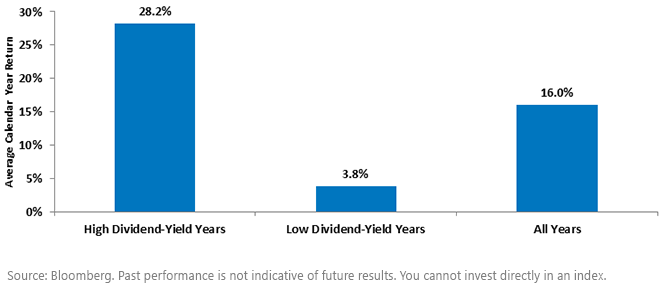
• High-Dividend-Yield Years: When a year began with a high dividend yield, the average return for that year was over 28%. In fact, such values were followed by negative years in only five instances, the worst of which was a negative 25% return in 1998. • Low-Dividend-Yield Years: When a year began with a low dividend yield, the average return for that year was below 4%. Such values were followed by negative years seven times, the worst of which was 2008’s negative 53% return. • Years That Started with Dividend Yields above 3.0%: Actually, we started 2015 not only with a high dividend yield but with one above 3.0%. There have been only five such years before, and although past performance can never predict future returns, the returns were strong in those years, averaging 58%. The lowest return of any of these years was 2012, when the MSCI Emerging Markets Index was up over 18%. Is It Time for the Turnaround? While we strongly believe that emerging markets will come back into favor, it is extremely difficult to predict when this turnaround will occur. There remain very real risks, but the more critical question regards whether the higher dividend yield reflects these risks. Some things that we’re being particularly watchful of: • Stabilization and/or rebound in commodity prices. • Further stimulus in China or other activity relating to China’s currency. • U.S. Federal Reserve raising short-term interest rates to help people put this in the rearview mirror so that other things can move back into focus. There is concern as to how emerging market currencies might react. 1Refers to 12/31/2014.
Important Risks Related to this Article
Dividends are not guaranteed, and a company’s future ability to pay dividends may be limited. A company currently paying dividends may cease paying dividends at any time.
Investments in emerging, offshore or frontier markets are generally less liquid and less efficient than investments in developed markets and are subject to additional risks, such as risks of adverse governmental regulation and intervention or political developments.
About the contributor

Global Head of Research
Christopher Gannatti began at WisdomTree as a Research Analyst in December 2010, working directly with Jeremy Schwartz, CFA®, Director of Research. In January of 2014, he was promoted to Associate Director of Research where he was responsible to lead different groups of analysts and strategists within the broader Research team at WisdomTree. In February of 2018, Christopher was promoted to Head of Research, Europe, where he was based out of WisdomTree’s London office and was responsible for the full WisdomTree research effort within the European market, as well as supporting the UCITs platform globally. In November 2021, Christopher was promoted to Global Head of Research, now responsible for numerous communications on investment strategy globally, particularly in the thematic equity space. Christopher came to WisdomTree from Lord Abbett, where he worked for four and a half years as a Regional Consultant. He received his MBA in Quantitative Finance, Accounting, and Economics from NYU’s Stern School of Business in 2010, and he received his bachelor’s degree from Colgate University in Economics in 2006. Christopher is a holder of the Chartered Financial Analyst Designation.