

Wages: Same As It Ever Was?
Published March 14, 2018

Head of Investment and Fixed Income Strategy
With the second jobs report for 2018 now in the books, investors have once again witnessed a similar tale: solid job growth but no real progress on the wage front. This dynamic has certainly perplexed the money and bond markets, and I’m sure Federal Reserve (Fed) chair Jerome Powell was scratching his head as well. In fact, from a purely domestic fundamental standpoint, how this year’s trend for wages pans out will also help shape where U.S. Treasury (UST) yields will reside as 2018 plays out.
There is certainly no disputing the fact that job creation has been an economic bright spot, resulting in historically low levels of unemployment. The February jobs report did not disappoint on either of these fronts, as total nonfarm payrolls rose by 313,000, or more than 100,000 above consensus forecasts and the best reading since July 2016. Over the last three months, the average pace of payroll gains has come in at +242,000, versus +182,000 per month for all of last year.
The jobless rate remained at 4.1% for the fifth consecutive month, which is the low watermark for this expansion. The alternate measure of job creation, civilian employment, has been surging thus far in 2018, producing a two-month average of just under +600,000.
Average Hourly Earnings
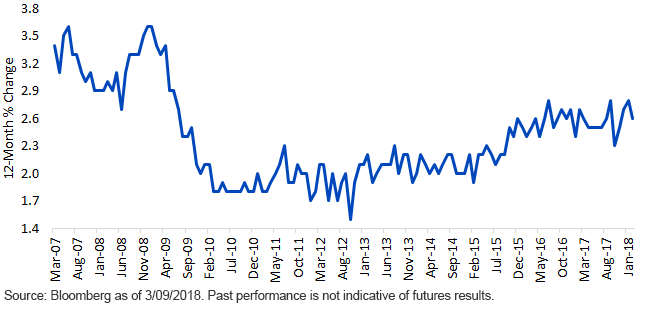
Let’s turn our attention to wages. Average hourly earnings (AHE) rose at an annual rate of +2.6% in February, following a downward revision of 0.1 percentage points for the prior month. In other words, the +2.9% surprise to the upside in January has now been dialed back a bit to +2.8%. Remember, one of the lynchpins behind the rise in the UST 10-Year yield this year was an increase in inflation expectations, led by said “January surprise.” The current pace leaves wages essentially “stuck in the mud,” at least for the time being, illustrated by the fact that the average year-over-year increase over the last two years has been that same +2.6% (see the graph).
Conclusion
So, when will that jobs trend translate to higher wages? According to the new Fed chair, a key force behind the frustrating lack of significant progress has been the result of “the weak pace of productivity growth in recent years.” Powell also stated that given the economic backdrop and strong job creation, he expects to see wages rising. This line of reasoning is definitely justified, but thus far, the results have been lacking. Nevertheless, there does seem to be an expectation that later this year, the annual rate of increase for AHE will eventually hit, and possibly eclipse, the +3.0% threshold. The bottom line is that, barring any unforeseen circumstances, the Fed will not be dissuaded from raising interest rates this year, a development expected for next week’s FOMC meeting.
Unless otherwise noted, all data is Bloomberg, as of March 9, 2018.
Categories
About the contributor

Head of Investment and Fixed Income Strategy
Kevin serves as the Head of Investment and Fixed Income Strategy. In this role, he writes macro and fixed income-related content and works closely with the sales, research and marketing teams. In addition, Kevin conducts client-facing webinars and meetings, providing expertise on WisdomTree’s existing and future bond ETFs. Prior to joining WisdomTree, Kevin spent 30 years at Morgan Stanley, where he was Managing Director and Chief Fixed Income Strategist for Wealth Management. He was responsible for tactical and strategic recommendations and created asset allocation models for fixed income securities. He was a contributor to the Morgan Stanley Wealth Management Global Investment Committee, primary author of Morgan Stanley Wealth Management’s monthly and weekly fixed income publications, and collaborated with the firm’s Research and Consulting Group Divisions to build ETF and fund manager asset allocation models. Kevin has an MBA from Pace University’s Lubin Graduate School of Business, and a B.S. in Finance from Fairfield University.