

Value Is in the Eye of the Beholder
Published April 21, 2015

Director, Research
With equity markets near all-time highs, many pundits are eager to claim that valuations are stretched and the market is ripe for a pullback. One particular segment of the market that always seems to get the most pessimism is the U.S. small-cap market, and everyone seems to highlight the Russell 2000 Index price-to-earnings (P/E) ratio as the example for all small caps. Stocks do often move more than is justified by changes in their underlying fundamentals, especially small caps, and as a result, investors run the risk of paying too much for stocks that have become more expensive relative to their fundamentals. But there are also some biases in the Russell 2000 P/E ratio. For instance, almost 20% of the Russell 2000 is invested in money-losing companies—that is, negative earners—that bias the total P/E ratio upward.1 Not all small caps are created equal, so the Russell 2000 Index should not be used as an indicator for all small caps. We think there are still pockets of value in small caps if investors focus on the higher-quality dividend-growth subset. • The WisdomTree U.S. SmallCap Dividend Growth Index (WTSDG) focuses on stocks that WisdomTree believes have the potential for dividend growth increases, based on a proprietary combination of growth and quality metrics. • Figure 1 compares WTSDG to the Russell 2000 Value Index, which screens for value through the price-to-book (P/B) ratio. Quality Growth More Attractively Priced What is important here is that the Russell 2000 Value attempts to identify the lowest-priced basket of stocks. What is particularly intriguing is that WTSDG, an Index focusing on high-quality dividend payers—with better profitability metrics and growth characteristics—has a lower starting valuation point. This could make for a powerful combination in driving returns. Figure 1: Small-Cap Dividend Growth Offers Better Valuations
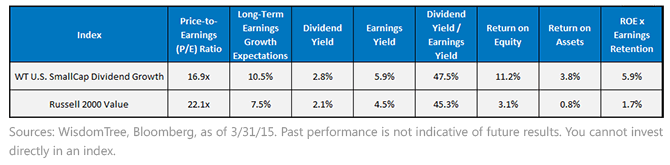
• Lower P/E Ratio: Neither WTSDG nor the Russell 2000 Value Index uses P/E as a selection factor, but because of the unprofitable company exposure in the Russell 2000 Value Index, the P/E ratio of WTSDG is significantly lower. On the other hand, WTSDG does screen based on profitability, so it will typically exclude more of the unprofitable and speculative small caps. • Better Growth Potential: Typically, firms with higher growth expectations tend to trade at higher valuations, but this is not the case when comparing WTSDG to the Russell 2000 Value. WTSDG incorporates long-term earnings growth expectations into its screening process, which helps explains the 3% advantage. • Higher Dividend Yield: WTSDG selects its constituents by growth and quality and then weights these eligible companies based on their dividends, which typically increases the Index dividend yield. • Higher Quality: The selection methodology for WTSDG focuses on quality factors like return on equity (ROE) and return on assets (ROA), and therefore, these numbers are significantly higher for WTSDG compared to the Russell 2000 Value Index. It is important to note that the market often demands a higher price (i.e., higher multiple) for quality companies. Figure 2: Index Performance
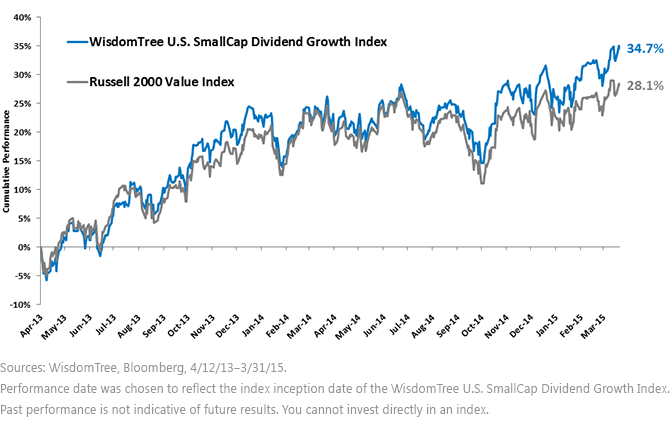
• Higher Cumulative Return: we feel that WTSDG’s ability to offer lower valuations, higher growth expectations and higher quality characteristics is even more impressive considering the performance record. As we mentioned above, people usually equate higher prices with higher valuations, but that isn’t always the case. We feel that the fundamental characteristics of WTSDG are still very attractive across many statistics compared to the Russell 2000 Value, even given the strong outperformance since Index inception. 1Source: Bloomberg, as of 3/31/15.
Categories
About the contributor
