

U.S. Treasuries Watch: Thinking Globally
Published July 1, 2020

Head of Investment and Fixed Income Strategy
When following rate trends here in the U.S., it’s easy to focus only on domestic factors—you know, the Federal Reserve (Fed), the monthly jobs report, etc. However, there have been some interesting developments overseas that have been largely ignored in market commentary and that got me thinking globally.
One of the foundations of the lower U.S. Treasury (UST) 10-Year yield over the last few years has been the lack of any alternatives in the developed world sovereign debt markets. Indeed, negative government bond yields abroad have presented fixed income investors with few, if any, alternatives to consider. While either zero or negative rates are still prevalent in the government bond markets of Japan and various countries within the eurozone, the UST 10-Year yield does not offer the same advantage as it once did.
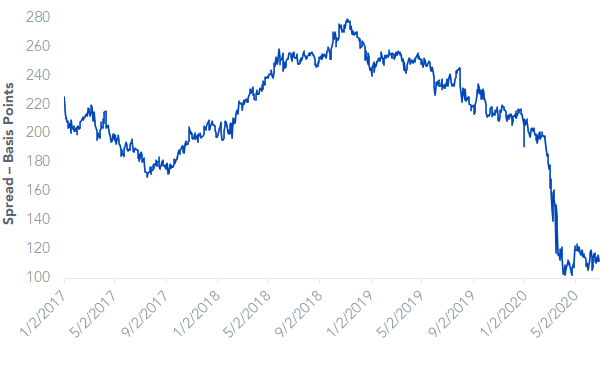
UST 10-Year vs. 10-Year German Bund
UST 10-Year vs. Italian 10-Year
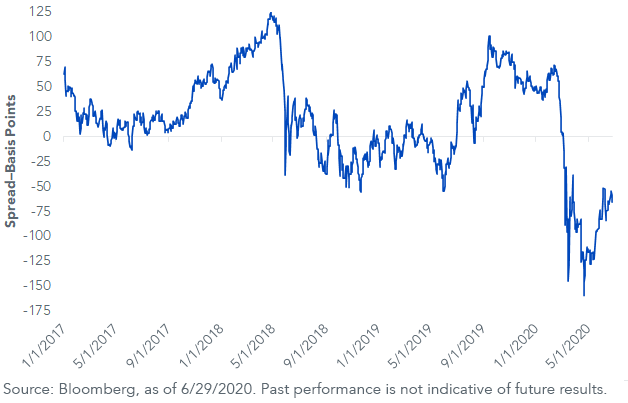
In this blog post, I wanted to highlight the yield differential, or spread, between the UST 10-Year and two other closely watched sovereign debt arenas, Germany and Italy. In each case, it is readily apparent that the spread has narrowed rather considerably over the last year or so.
Let’s look at the 10-year German bund. Back in November 2018, the UST counterpart’s yield was nearly 280 basis points (bps) higher, but that differential has plummeted by roughly 170 bps this year, and now stands at “only” +112 bps as of this writing. For the 10-year Italian BTP, the spread was as high as 100 bps in September of last year but has since reversed course completely and is now in negative territory. In other words, instead of the Treasury 10-Year yielding more than its Italian counterpart, it now yields 65 bps less, a remarkable turn of events.
What’s the main factor at work, you may ask? Interestingly, there has been a divergent pattern in each instance. For the periods under review, the German bund yield fell while the Italian BTP yield actually rose. However, the one key constant is the fact the UST 10-Year yield has plunged. To provide some perspective: in November 2018, the yield was nearly 3.25%, and in September 2019, the level was 1.90%. And as we all know, as of this writing we stand at 0.64%—the math is pretty easy!
Conclusion
While we don’t envision the UST 10-Year yield seeing the aforementioned 2018/2019 levels anytime in the foreseeable future, when thinking globally, its tailwind doesn’t seem quite as strong.
Unless otherwise stated, data source is Bloomberg, as of June 29, 2020.
Categories
About the contributor

Head of Investment and Fixed Income Strategy
Kevin serves as the Head of Investment and Fixed Income Strategy. In this role, he writes macro and fixed income-related content and works closely with the sales, research and marketing teams. In addition, Kevin conducts client-facing webinars and meetings, providing expertise on WisdomTree’s existing and future bond ETFs. Prior to joining WisdomTree, Kevin spent 30 years at Morgan Stanley, where he was Managing Director and Chief Fixed Income Strategist for Wealth Management. He was responsible for tactical and strategic recommendations and created asset allocation models for fixed income securities. He was a contributor to the Morgan Stanley Wealth Management Global Investment Committee, primary author of Morgan Stanley Wealth Management’s monthly and weekly fixed income publications, and collaborated with the firm’s Research and Consulting Group Divisions to build ETF and fund manager asset allocation models. Kevin has an MBA from Pace University’s Lubin Graduate School of Business, and a B.S. in Finance from Fairfield University.