

U.S. Treasuries: Foreign Buying—Who’s No. 1?
Published September 13, 2017

Head of Investment and Fixed Income Strategy
As we put “pen to paper” for this blog post, U.S. Treasury (UST) 10-Year yields have fallen to levels not seen since right after Election Day. An obvious question comes to mind: Can this declining trend be sustained through Q4, and if so, where are the buyers going to come from?
Certainly, one visible buyer of Treasuries, the Federal Reserve (Fed), may be on the verge of paring back its purchases in the not-too-distant future. Indeed, if all goes according to the Fed’s plan, the U.S. central bank will announce at next week’s FOMC meeting that it is going to start down the balance sheet normalization path, beginning the process in October.
Major Foreign Holders of U.S. Treasuries–June 2017
Some perspective is needed here in order to determine just what the UST market could be facing in the months and quarters ahead. According to the Fed’s addendum to its Policy Normalization Principles and Plans released following the June FOMC meeting, the approach will be to start Treasury paydowns
at $6 billion per month “and will increase in steps of $6 billion at three-month intervals over 12 months until it reaches $30 billion per month.” Got that? Translation: $18 billion in Q4, going up to as high as $90 billion per quarter a year later.
Back to who’s going to pick up the Fed’s slack. More often than not, the reply that investors give me is this: How about foreign purchasers? The latest data from the Treasury on this front did reveal that China has, once again, resumed its perch at the top. To be sure, back in October, China had relinquished the No. 1 position to Japan, with its share of total foreign holdings bottoming out at 17.6% in December, the lowest figure since 2006. For the record, a peak reading of 28% was recorded in 2011, while the current tally has nudged back up to 18.6%.
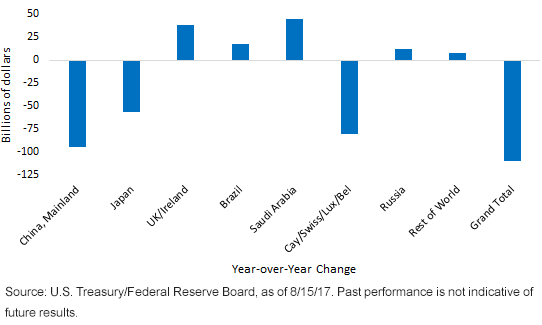
On a year-over-year basis, China’s UST holdings actually declined by nearly $95.0 billion. In fact, total foreign holdings fell by about $110.0 billion, with Japan down $56.3 billion, and the Cayman Islands/Switzerland/Luxembourg/Belgium grouping (countries and areas considered to be custody holders for other nations) dropping $80.9 billion. The only notable buyers were Saudi Arabia ($+44.6 billion) and the UK/Ireland ($+38.6 billion).
The news is not all bad though. Through the first six months of 2017, there have been some notable reversals. To provide some perspective, total holdings are up $165.0 billion, with China in the plus column at $88.1 billion. Interestingly, Japan is unchanged.
Conclusion
Until a couple of years ago, market participants probably thought that foreign investors would more often than not help fill the hole the Fed could be producing. However, recent data suggests foreign UST buying can be volatile and not necessarily something to depend on to fill the pending gap coming from the Fed paydowns.
Unless otherwise noted, data source is U.S. Treasury, as of August 15, 2017.
Important Risks Related to this Article
Fixed income investments are subject to interest rate risk; their value will normally decline as interest rates rise. In addition, when interest rates fall, income may decline. Fixed income investments are also subject to credit risk, the risk that the issuer of a bond will fail to pay interest and principal in a timely manner or that negative perceptions of the issuer’s ability to make such payments will cause the price of that bond to decline.
Categories
About the contributor

Head of Investment and Fixed Income Strategy
Kevin serves as the Head of Investment and Fixed Income Strategy. In this role, he writes macro and fixed income-related content and works closely with the sales, research and marketing teams. In addition, Kevin conducts client-facing webinars and meetings, providing expertise on WisdomTree’s existing and future bond ETFs. Prior to joining WisdomTree, Kevin spent 30 years at Morgan Stanley, where he was Managing Director and Chief Fixed Income Strategist for Wealth Management. He was responsible for tactical and strategic recommendations and created asset allocation models for fixed income securities. He was a contributor to the Morgan Stanley Wealth Management Global Investment Committee, primary author of Morgan Stanley Wealth Management’s monthly and weekly fixed income publications, and collaborated with the firm’s Research and Consulting Group Divisions to build ETF and fund manager asset allocation models. Kevin has an MBA from Pace University’s Lubin Graduate School of Business, and a B.S. in Finance from Fairfield University.