

U.S. Inflation: A Case of High Anxiety?
Published February 28, 2018

Head of Investment and Fixed Income Strategy
There is no doubt that inflation fear has reared its ugly head early in 2018, impacting the money and bond markets in rather noteworthy fashion. Some key headline-grabbing measures, such as wages and the Consumer Price Index (CPI), have come in above consensus forecasts to start the year, fueling a case of high anxiety for the fixed income arena. Naturally, the million (or should it be billion?) dollar question is: Are these heightened inflation fears warranted?
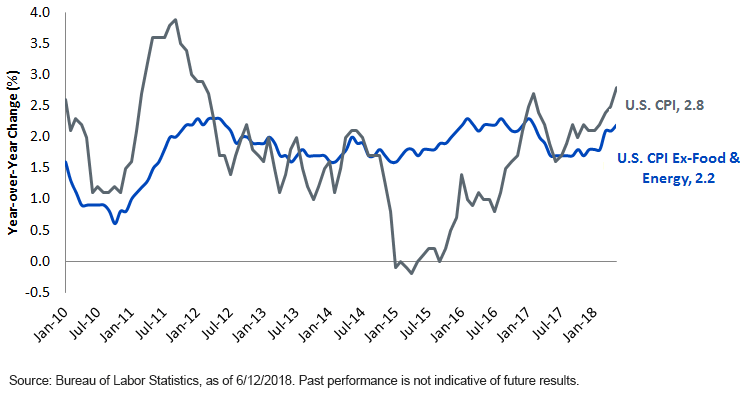
As we entered the new year, consensus forecasts for inflation were that readings at both the overall and core (ex-food and energy) levels would essentially remain unchanged. Interestingly, economists’ projections have been revised upward of late and now post slightly elevated readings. Indeed, the CPI is now expected to come in at a year-over-year rate of +2.3%, or 0.2 percentage points (pp) higher than the prior projection. The alternate measure, the personal consumption expenditures (PCE) price index, has been changed to a +1.9% increase (also up 0.2 pp), with the core PCE gauge being lifted 0.1 pp to +1.8%. The bottom line is that these revised estimates now all look for some modest increase from 2017 levels.
U.S. CPI vs. U.S. CPI ex-Food & Energy
Year-over-Year Change from 1/31/2010 to 1/31/2018
What about the Federal Reserve (Fed)? For now, all investors have to go by is the policy makers’ December projections. The March FOMC meeting, scheduled for March 21st, will be the Fed’s next chance to make any potential adjustments to their prior forecasts.. The preferred measure is the PCE price index, and the policy makers provide projections for both the overall and core PCE gauges. The Fed’s central tendency estimate is similar to the revised market consensus, with a range of +1.7% to +1.9% for each index. It should be noted that both the economists’ and the Fed’s current PCE projections still fall below the +2.0% target laid out by the policy makers.
So, let’s take another look at the aforementioned wages and CPI numbers. Of the two upside surprises, in my opinion, the one that carries more weight for the Fed is the increase in wages. Average hourly earnings rose at an annual rate of +2.9% in January, the highest reading since 2009. This compensation measure has failed on many occasions to break above this upper bound of the range, but there seems to be a growing belief that this year will finally see an increase with a “3” handle. Such a development could make the difference, at least in the bond market’s mind, between the Fed’s projected three rate hikes for 2018 and the bond market’s newfound concern that four increases could be coming this year.
Although the overall and core CPI readings came in above consensus in January, the year-over-year gains were unchanged from the prior month’s levels. In other words, there was no uptick in inflation on an annualized basis. In fact, one could make the case that these increases won’t be replicated next month, as three outsized gains for apparel, hospital services and motor vehicle insurance were partly responsible for the end result. Odds are this development won’t be repeated, and oftentimes gains like these tend to get reversed over subsequent months.
Conclusion
Here’s a question for the reader: Do you remember the 2017 inflation scare? It happened during Q1 as well, with both the CPI and PCE measures posting their highest annualized increases since 2012. Wages were rising as well. Obviously, that scare didn’t last long, as all of these inflation gauges finished little changed on a December/December basis. For 2018 as a whole, the trend seems to be on a slightly different course, as investors might very well end up seeing some modest elevation, albeit not necessarily at a pace that should create undue stress.
Unless otherwise noted, data source is Bloomberg, as of February 14, 2018.
Categories
About the contributor

Head of Investment and Fixed Income Strategy
Kevin serves as the Head of Investment and Fixed Income Strategy. In this role, he writes macro and fixed income-related content and works closely with the sales, research and marketing teams. In addition, Kevin conducts client-facing webinars and meetings, providing expertise on WisdomTree’s existing and future bond ETFs. Prior to joining WisdomTree, Kevin spent 30 years at Morgan Stanley, where he was Managing Director and Chief Fixed Income Strategist for Wealth Management. He was responsible for tactical and strategic recommendations and created asset allocation models for fixed income securities. He was a contributor to the Morgan Stanley Wealth Management Global Investment Committee, primary author of Morgan Stanley Wealth Management’s monthly and weekly fixed income publications, and collaborated with the firm’s Research and Consulting Group Divisions to build ETF and fund manager asset allocation models. Kevin has an MBA from Pace University’s Lubin Graduate School of Business, and a B.S. in Finance from Fairfield University.