

U.S. Econ Watch: Time of the Season
Published May 3, 2017

Head of Investment and Fixed Income Strategy
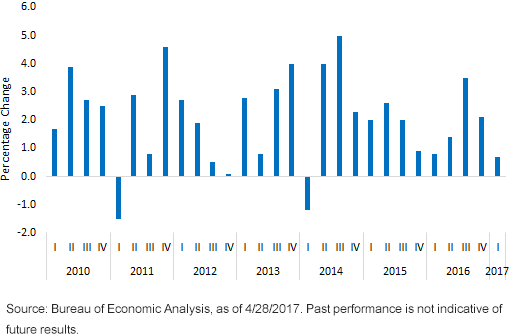
Continuing a pattern that has been evident over the last few years, U.S. economic growth in the first three months of the calendar year, once again, was rather lackluster. Indeed, The Bureau of Economic Analysis (BEA) reported that in Q1 2017, real GDP rose by a modest +0.7%, representing the lowest tally in three years. This was the seventh time in the last eight years that Q1 real GDP came in below the prior quarter’s growth rate. Naturally, this raises the question: Does the BEA have a seasonal adjustment problem during this time of the year?
Without going into an Econ 101 dissertation, it would indeed appear as if there are some “seasonality” issues. In fact, in five out of the six times that growth has underwhelmed during Q1, real GDP then posted a higher reading in the subsequent quarter. With respect to the seventh observation, that is obviously the 2017 experience, so we’ll have to wait and see if history is repeated, but based on initial economists’ projections, the expectation is for another Q2 growth rebound.
U.S. Real GDP
So, who were the culprits this time around? In a surprising turn of events, a visible slowdown in personal consumption expenditure (PCE) certainly stands out. To provide some perspective, PCE rose by a scant +0.3% in Q1, following a +3.5% gain in Q4. In fact, this was the slowest quarterly pace of spending since 2009. It appears as if this reduced pace may have been due to weather and some delays in tax refunds during the period. As these forces recede, consumer spending can be expected to bounce back in Q2. Also, the recent improvement in wages should provide support as well, and potentially prevent a recurrence of the Q1 experience.
The inventories grouping has a tendency to be a bit of a “wild card” for GDP data. After adding a full percentage point to growth in the fourth quarter, this component reversed course almost completely and subtracted nearly as much in the first three months of 2017. As we noted in a recent blog “US Economy Watch: Growing Pains,” inventories can increase for two essential reasons: 1) businesses voluntarily increase their positions because they foresee an increase in demand that will need to be met (a positive); or 2) positions were involuntarily increased because demand declined (a negative). Future trends could very well lie with the consumer, and whether the slowdown in consumption to begin the year was just a blip on the radar or the beginning of a more sustained softening in household spending remains to be seen. We tend to lean toward the assumption that the consumer will snap back and provide more visible support to overall growth in the quarters to come.
Conclusion
The bottom line is that even though GDP figures can definitely capture the headlines, and potentially impact the U.S. Treasury (UST) market, the Q1 report has apparently done very little to sway fixed income investors. In addition, we don’t feel the lackluster growth figure will necessarily sway the Federal Reserve (Fed) from its 2017 policy course either.
Unless otherwise noted, source is Bureau of Economic Analysis; as of 4/28/2017.
Categories
About the contributor

Head of Investment and Fixed Income Strategy
Kevin serves as the Head of Investment and Fixed Income Strategy. In this role, he writes macro and fixed income-related content and works closely with the sales, research and marketing teams. In addition, Kevin conducts client-facing webinars and meetings, providing expertise on WisdomTree’s existing and future bond ETFs. Prior to joining WisdomTree, Kevin spent 30 years at Morgan Stanley, where he was Managing Director and Chief Fixed Income Strategist for Wealth Management. He was responsible for tactical and strategic recommendations and created asset allocation models for fixed income securities. He was a contributor to the Morgan Stanley Wealth Management Global Investment Committee, primary author of Morgan Stanley Wealth Management’s monthly and weekly fixed income publications, and collaborated with the firm’s Research and Consulting Group Divisions to build ETF and fund manager asset allocation models. Kevin has an MBA from Pace University’s Lubin Graduate School of Business, and a B.S. in Finance from Fairfield University.