

Understanding the Drivers of U.S. Equities in 2017
Published August 31, 2017

Global Head of Research
One of the best aspects that WisdomTree brings to the table is the sheer breadth of investment strategies. If we think in terms of U.S. equities, as an example, there are 15 exchange-traded funds (ETFs) tracking the returns of 15 proprietary Indexes.
What IS (and ISN’T) working at a particular time tells us important information about the U.S. equity market.
WisdomTree’s U.S. Equity ETFs in 2017
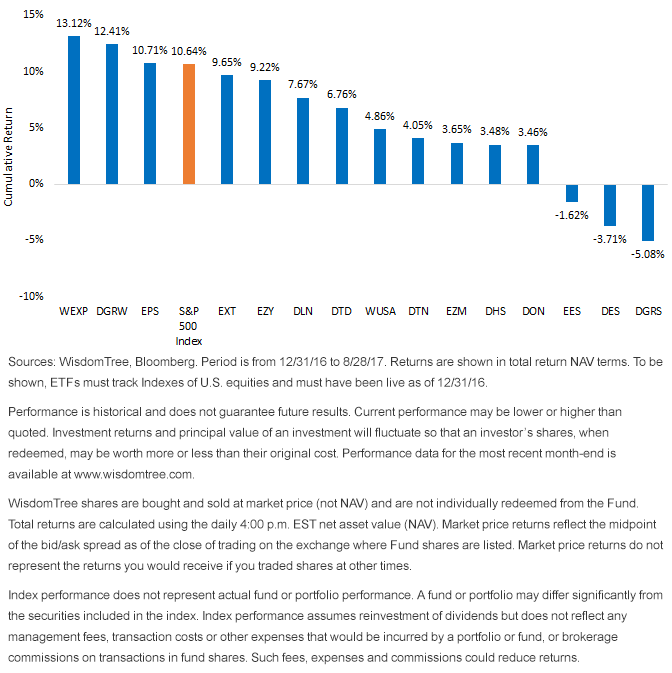
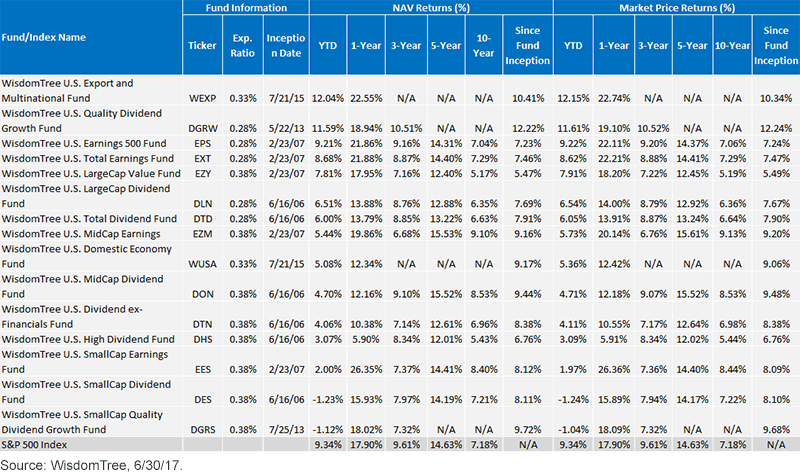
- What’s Working: The WisdomTree U.S. Export and Multinational Fund (WEXP) stands out as the strongest performer across the 15 strategies, delivering a 13% cumulative return. WEXP tracks the returns of the WisdomTree U.S. Export and Multinational Index. While that Index name may seem like a mouthful, the bottom line is that it focuses on companies that derive the majority of their revenues from OUTSIDE the U.S. This means that if the U.S. dollar depreciates compared to international currencies, it creates a potentially more favorable environment for these firms, and over this period the Bloomberg Dollar Spot Index has declined 9.3%1—a veritable perfect storm. The WisdomTree U.S. Quality Dividend Growth Fund (DGRW) is the other strategy that outperformed the S&P 500 Index over this period. In a way, its WisdomTree U.S. Quality Dividend Growth Index taps into that same multinational, large-company theme—albeit without that specific focus. Both WEXP and DGRW have had large exposure to Information Technology stocks—a strong sector over this period.
- What Isn’t Working: The WisdomTree U.S. SmallCap Earnings Fund (EES), the WisdomTree U.S. SmallCap Dividend Fund (DES) and the WisdomTree U.S. SmallCap Quality Dividend Growth Fund (DGRS) track the WisdomTree U.S. SmallCap Earnings, U.S. SmallCap Dividend and U.S. SmallCap Quality Dividend Growth Indexes, respectively. The common theme—small caps. In 2016, EES, DES and DGRS delivered 29.96%, 31.06% and 30.60% total returns, respectively, so one can clearly see the implied influence of the “Trump trade” in the 2016 results and then the cooling off of the Trump trade in the 2017 results. We think small caps have lagged so much in 2017 that if the government surprises us with a tax plan this year, there may be a reaction additional to what we saw after 2016 since investors have become just THAT pessimistic. Also notable is WUSA, tracking the WisdomTree U.S. Domestic Economy Index. This is the opposite of WEXP and would more likely deliver its above-market returns in stronger-dollar environments. While that hasn’t been the case in this period, it’s notable to think of WEXP and WUSA offering an interesting expression of a “dollar view” in U.S. equities.
Bottom Line of 2017: Taxes & Geographic Revenue
We can look under the hood of 2017’s performance thus far:
Geographic Revenue Picture: Certain Strategies with Larger Companies and Less Revenue from Inside the U.S. Have Been Strong
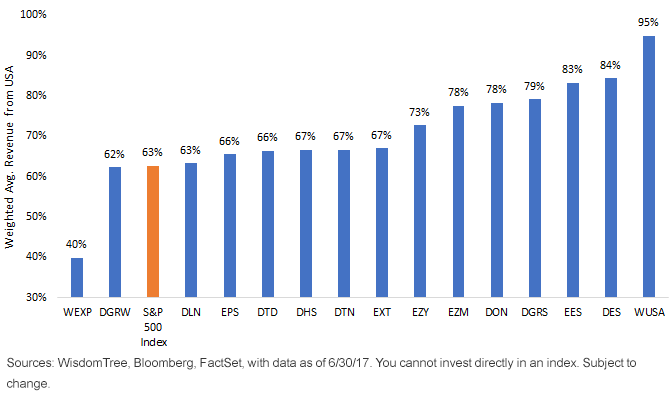
- WEXP is tracking an Index that is designed to focus on exporters, which explains why its weighted average revenue from within the U.S. (40%) is so differentiated from basically all of the other Indexes. DGRW, the other outperformer over the S&P 500 Index shown earlier, also derives less revenue from within the U.S. than the S&P 500 Index.
- DGRS, EES and DES derive a LOT of weighted average revenue from within the U.S. In a stronger-dollar environment, that might be an advantage for these strategies over the S&P 500 Index. In the 2017 weaker-dollar environment, it has not been an advantage.
Effective Tax Rates Have Favored Large-Cap Funds with Revenues Outside the U.S.
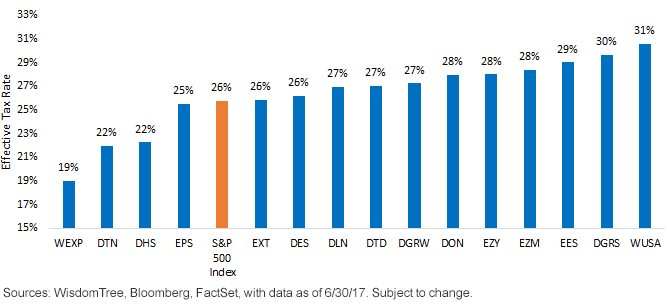
- WEXP had the lowest effective tax rate of all the strategies shown. With all of the discussions occurring with respect to tax policy, this has been such an important factor in 2017. Given that this basket of companies is already below the consensus 25% level (what people think might happen with corporate tax policy) and close to the 15% level (what President Trump campaigned on), this has been an advantage. It’s notable that the WisdomTree U.S. Domestic Economy Fund (WUSA) (with 95% of its weighted average revenue from INSIDE the U.S.) had the highest effective tax rate of the strategies shown. Like we indicated with small caps, WUSA may be an interesting strategy if the government surprises us with a corporate tax plan before the end of 2017.
WEXP & WUSA Represent Effective Tools for the Current Environment
One of the best aspects of the U.S.-listed ETF market is the innovation. Instead of thinking about the S&P 500 Index for U.S. equity exposure, investors can now think about geographic revenues and effective tax rates, and fine-tune their approaches to each of these characteristics while reforms are being discussed.
1Source: Bloomberg, with period from 12/31/16 to 8/28/17.
Important Risks Related to this Article
There are risks associated with investing, including possible loss of principal. Stocks that previously exhibited a positive correlation in equity performance to a strong U.S. dollar may not do so in the future, which could negatively impact Fund performance. A Fund that has exposure to one or more sectors may increase the Fund’s vulnerability to any single economic or regulatory development. This may result in greater share price volatility. Please read the Fund’s prospectus for specific details regarding the Fund’s risk profile.
There are risks associated with investing, including possible loss of principal. Funds focusing their investments on certain sectors and/or smaller companies increase their vulnerability to any single economic or regulatory development. This may result in greater share price volatility. Please read the Fund’s prospectus for specific details regarding the Fund’s risk profile.
Double-digit returns were achieved primarily during favorable market conditions. Investors should not expect that such favorable returns can be consistently achieved. A fund’s performance, especially for very short time periods, should not be the sole factor in making your investment decision.
The Global Industry Classification Standard (“GICS”) was developed by and is the exclusive property and a service mark of MSCI Inc. (“MSCI”) and Standard & Poor’s (“S&P”), a division of The McGraw-Hill Companies, Inc. and is licensed for use by WisdomTree Investments, Inc. Neither MSCI, S&P nor any other party involved in making or compiling the GICS or any GICS classifications makes any express or implied warranties or representations with respect to such standard or classification (or the results to be obtained by the use thereof), and all such parties hereby expressly disclaim all warranties of originality, accuracy, completeness, merchantability and fitness for a particular purpose with respect to any such standard or classification. Without limiting any of the foregoing, in no event shall MSCI, S&P, any of their affiliates or any third party involved in making or compiling the GICS or any GICS classifications have any liability for any direct, indirect, special, punitive, consequential or any other damages (including lost profits) even if notified of the possibility of such damages.
About the contributor

Global Head of Research
Christopher Gannatti began at WisdomTree as a Research Analyst in December 2010, working directly with Jeremy Schwartz, CFA®, Director of Research. In January of 2014, he was promoted to Associate Director of Research where he was responsible to lead different groups of analysts and strategists within the broader Research team at WisdomTree. In February of 2018, Christopher was promoted to Head of Research, Europe, where he was based out of WisdomTree’s London office and was responsible for the full WisdomTree research effort within the European market, as well as supporting the UCITs platform globally. In November 2021, Christopher was promoted to Global Head of Research, now responsible for numerous communications on investment strategy globally, particularly in the thematic equity space. Christopher came to WisdomTree from Lord Abbett, where he worked for four and a half years as a Regional Consultant. He received his MBA in Quantitative Finance, Accounting, and Economics from NYU’s Stern School of Business in 2010, and he received his bachelor’s degree from Colgate University in Economics in 2006. Christopher is a holder of the Chartered Financial Analyst Designation.