

U.S. Rates: A Case of One Step Forward, Two Steps Back
Published January 28, 2016

Head of Investment and Fixed Income Strategy
The Federal Reserve (Fed) finally gave the financial markets ‘liftoff’ in mid-December, but ever since, the U.S. rate development is a case of “one step forward, two steps back.” Indeed, in the aftermath of the Fed’s decision to raise the Federal Funds target by a quarter-point, the U.S. 10-Year Treasury (UST) yield reached a high point of 2.31%, only to reverse course and penetrate the 2% threshold in recent weeks. There is little doubt that the UST market’s focus early in the new year has been on other financial arenas. The visible drop in crude oil and attendant decline in equity valuations have once again spurred safe-haven buying, a scene we’ve seen played out many times over the last few years. Slowing global growth concerns have also come into play, led by worries about China’s economy, while global rates and monetary policy in the developed world also remain active considerations. Here in the U.S., the economic news has been a bit more mixed, as a robust jobs report has been offset by softer readings for manufacturing. Thus, real gross domestic product (GDP) for 2016 is not expected to be too far off the +2.2% average since the end of the Great Recession in mid-2009. What about the Fed? Consensus wisdom coming into 2016 has centered around the notion that policy makers would announce four additional rate hikes this calendar year (March, June, September, December), a view basically confirmed by Fed officials themselves. With the first Federal Open Market Committee (FOMC) meeting of the year now behind us, the Fed is left with seven future gatherings in which to effectuate these possible tightening moves. Given the newfound uncertainty at the beginning of the year, it seems difficult to envision four hikes will be in the offing; perhaps two, maybe three seem a better likelihood at this point. Within the UST arena, recent history has shown that one month’s rate movement is not necessarily a harbinger of what lies ahead. Our current rate outlook anticipates a gradual low-trajectory rise in UST yields from here, with a range-bound seesaw type of pattern along the way. One of the key reasons we believe any increase will be tempered actually lies with the Fed and is due to not only the scaled-back rate hike expectations but also to balance sheet considerations. Federal Reserve Securities Held Outright-Breakdown
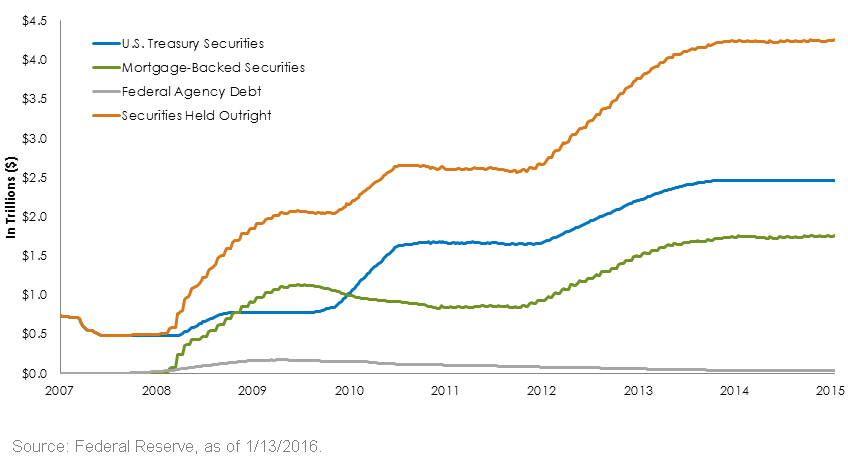
Phase 2 of the Fed’s “normalization” playbook involves its holdings of securities—Treasuries, federal agencies and mortgage-backed securities (MBS). As of this writing, its System Open Market Account, or SOMA, totaled $4.25 trillion, with Treasuries standing at $2.46 trillion or 58% of that amount. It has been reported that, for the first time, the Fed will have a sizeable amount of Treasuries (the figure has been placed at roughly $215 billion) rolling off the books in 2016. Recent Fed commentary has reiterated its intention to reinvest any maturing holdings until the normalization of rates is well under way. As a result, the UST market should continue to receive support from the Fed this year to offset potential selling pressure from global central banks. When combined with the aforementioned forces, any rise in rates from current levels appears to be capped. Against this backdrop, WisdomTree feels fixed income investors would be prudent to enhance their yield. Rather than focusing on the Barclays U.S. Aggregate Index (Agg), an alternate approach to achieve this goal could be the Barclays U.S. Aggregate Enhanced Yield Index strategy. That Index looks to enhance yields vis-à-vis the Agg by re-weighting its components to enhance income while broadly retaining its risk characteristics. While investors have in recent years stretched for yield in more speculative credits, they might have overlooked the potential to get more income out of their core fixed income by looking inside the Agg itself.
Important Risks Related to this Article
Fixed income investments are subject to interest rate risk; their value will normally decline as interest rates rise. In addition, when interest rates fall, income may decline. Fixed income investments are also subject to credit risk, the risk that the issuer of a bond will fail to pay interest and principal in a timely manner or that negative perceptions of the issuer’s ability to make such payments will cause the price of that bond to decline.
About the contributor

Head of Investment and Fixed Income Strategy
Kevin serves as the Head of Investment and Fixed Income Strategy. In this role, he writes macro and fixed income-related content and works closely with the sales, research and marketing teams. In addition, Kevin conducts client-facing webinars and meetings, providing expertise on WisdomTree’s existing and future bond ETFs. Prior to joining WisdomTree, Kevin spent 30 years at Morgan Stanley, where he was Managing Director and Chief Fixed Income Strategist for Wealth Management. He was responsible for tactical and strategic recommendations and created asset allocation models for fixed income securities. He was a contributor to the Morgan Stanley Wealth Management Global Investment Committee, primary author of Morgan Stanley Wealth Management’s monthly and weekly fixed income publications, and collaborated with the firm’s Research and Consulting Group Divisions to build ETF and fund manager asset allocation models. Kevin has an MBA from Pace University’s Lubin Graduate School of Business, and a B.S. in Finance from Fairfield University.