

U.S. Fixed Income: Give Them Some Credit
Published February 10, 2016

Head of Investment and Fixed Income Strategy
With the lion’s share of headlines centered on the turbulence in the equity and crude oil markets thus far in 2016, some developments in the U.S. credit arena have moved to the back burner. Certainly, the decline in U.S. Treasury (UST) yields has garnered its fair share of visibility, and rightfully so, given the fact the 10-Year note seems once again to be testing technical levels to the downside on a regular basis. However, within corporate bonds, recent events in the investment-grade (IG) market appear to have flown under the radar. Since the calendar turned to the new year, IG spreads have seemingly been on a one-way trip to wider levels. Indeed, as of this writing, according to the Barclays U.S. Corporate Index, spreads have risen more than 30 basis points (bps) and now reside at levels we haven’t seen since mid-2012. While all credit ratings within the IG sphere have participated in this widening phenomenon, the Baa sector has experienced the most pronounced move, almost doubling the moves that have been witnessed in both AA and single-A corporates. In fact, one has to go even a bit further back in time to the late 2011/early 2012 timeframe to have seen Baa spreads at these lofty readings. US Baa Corporate vs. U.S. Corporate Spreads
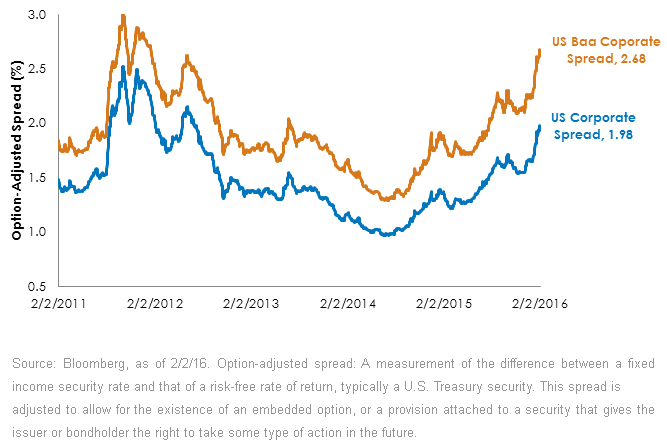
At that time, the money and bond markets were dealing with negative news coming out of the eurozone, as fears of Greece leaving the single currency and the potentially negative ramifications associated with such an event were dominating the newswires. With IG spreads at such wide levels some four to five years later, it is natural to wonder what is behind this latest move. In fact, from a historical perspective, Baa spreads are now at readings that have only been witnessed a few times over the last 20 years. The average yield for an investment-grade corporate bond is more than double the yield of a similar-maturity Treasury.1 This has happened only twice before: during the 2008 financial crisis and the aforementioned 2011–2012 period. Typically in the past, current levels would raise a red flag that a potential recession was looming, but as we saw in the 2011–2012 period, a one-sided “risk off trade” can also be a powerful force. So where do we stand this time around? We believe the widening in spreads, especially over the last month or so, reflects increasing investor concerns about developments abroad and how they may ultimately impact the U.S. economy. Although we do not envision any renewed momentum for the U.S. expansion, we do expect the domestic economy to avoid a recession and continue to muddle through around the +2% growth threshold. In fact, the case could be made that the current landscape within the IG market has “discounted” quite a bit of negative news already. The recent rate cut from the Bank of Japan and the expectation that China’s policy makers will succeed in avoiding too hard of a landing are two important factors in our base case. In addition, as European Central Bank (ECB) president Mario Draghi stated in his “Whatever It Takes” speech in July 2012, the ECB looks like it will deliver another round of policy easing at its next meeting in March. Against this backdrop, we believe IG corporates offer fixed income investors an opportunity to increase credit allocations within their core and core plus fixed income portfolios. 1Source: Bloomberg.
Important Risks Related to this Article
Fixed income investments are subject to interest rate risk; their value will normally decline as interest rates rise. In addition, when interest rates fall, income may decline. Fixed income investments are also subject to credit risk, the risk that the issuer of a bond will fail to pay interest and principal in a timely manner or that negative perceptions of the issuer’s ability to make such payments will cause the price of that bond to decline.
Categories
About the contributor

Head of Investment and Fixed Income Strategy
Kevin serves as the Head of Investment and Fixed Income Strategy. In this role, he writes macro and fixed income-related content and works closely with the sales, research and marketing teams. In addition, Kevin conducts client-facing webinars and meetings, providing expertise on WisdomTree’s existing and future bond ETFs. Prior to joining WisdomTree, Kevin spent 30 years at Morgan Stanley, where he was Managing Director and Chief Fixed Income Strategist for Wealth Management. He was responsible for tactical and strategic recommendations and created asset allocation models for fixed income securities. He was a contributor to the Morgan Stanley Wealth Management Global Investment Committee, primary author of Morgan Stanley Wealth Management’s monthly and weekly fixed income publications, and collaborated with the firm’s Research and Consulting Group Divisions to build ETF and fund manager asset allocation models. Kevin has an MBA from Pace University’s Lubin Graduate School of Business, and a B.S. in Finance from Fairfield University.