

U.S. Fixed Income: Get Smart … Beta
Published April 27, 2016

Head of Investment and Fixed Income Strategy
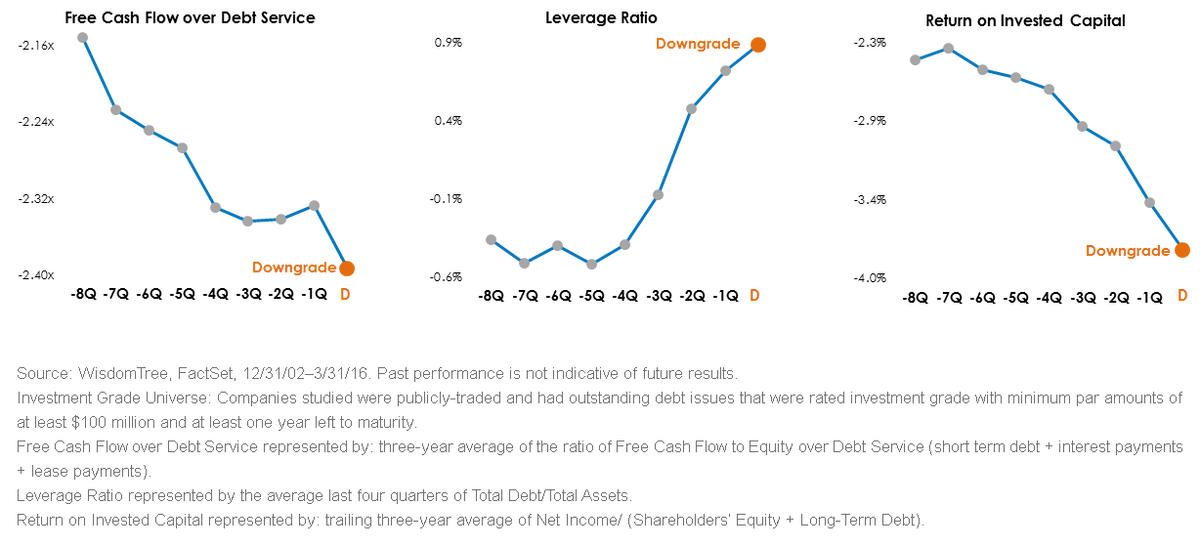
Trading activity in the U.S. corporate bond market thus far in 2016 has certainly resembled a roller-coaster ride. Indeed, two distinct patterns have been on display, as early weakness has given way to a newfound trend of improvement. This volatility has highlighted the notion that credit quality will remain an active consideration for the fixed income investor. The pertinent question to ask is, has the fundamental backdrop changed all that much over the last three to four months? Certainly, the widening in credit spreads that occurred earlier in the year was a function of the broader markets reacting to disappointing economic data here in the U.S., as well as concerns about global growth prospects, with a particular focus on China. In addition, the plunge in oil prices played an integral role, resulting in heightened anxieties regarding the risks of a potentially elevated pace of downgrades, and more importantly defaults, for energy-related issues. Although the U.S. corporate bond market has rebounded in a visible fashion from midwinter, investors are still faced with the prospect of potentially negative headlines. To provide some perspective, additional news stories regarding potential default fallout from the plunge in energy prices remains a distinct possibility. Conventional wisdom seems to be gravitating toward the U.S. speculative-grade, or high-yield, default rate rising to the 6% threshold, or essentially double the 3.17% trailing 12-month figure that Moody’s Investors Service registered in December 2015. Our research has identified some key factors to focus on when trying to foreshadow future downgrades and defaults. For investment-grade (IG) corporates, we found that analyzing quarterly levels of free cash flow over debt service, leverage ratio (total debt vs. total assets) and return on invested capital (ROIC) over time helped identify potential downgrade candidates by one of the major ratings agencies (figure 1). Figure 1: Trailing 8Q Median of Fundamental Factor Levels Relative to Sector Peers Prior to Downgrade
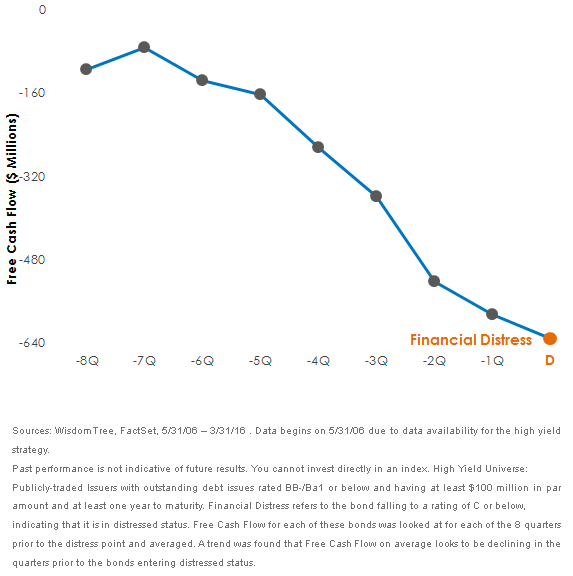
For the high-yield (HY) universe, it is important to note that a large majority of companies in distressed situations tend to begin with cash flow problems. Against this backdrop, similar to the IG analysis, our work revealed that companies with sustained negative free cash flow often experienced an eventual downgrade (figure 2). It is important to keep in mind that within the HY sector there is less cushion on this front, and downgrades can lead to default concerns quickly. Figure 2: High-Yield Corporates: Free Cash Flow Prior to Distress
WisdomTree has been at the forefront of smart beta for some time, and we are now taking the next step forward for investors, and that is using this same approach for fixed income. Specifically, the fundamental, or smart beta, methodology follows a rules-based approach to fixed income investing with the emphasis being on fundamentals, not market cap. In this case, we utilize the above analysis, and for IG, cut the worst 20% from the defined universe. In HY, we eliminate all issuers with negative free cash flow and also remove the 5% with the lowest estimated liquidity. WisdomTree fixed income fundamentally-based, or smart beta, products-The WisdomTree Fundamental U.S. Corporate Bond Fund (WFIG), the WisdomTree Fundamental U.S. Short-Term Corporate Bond Fund (SFIG), the WisdomTree Fundamental U.S. High Yield Corporate Bond Fund (WFHY) and the WisdomTree Fundamental U.S. Short-Term High Yield Corporate Bond Fund (SFHY) emphasize a qualitative approach, with a tilt toward income. With interest rates expected to remain in a range-bound pattern and credit concerns (downgrades and defaults) making headlines, fixed income investors will likely be searching for solutions that provide relative income opportunities in an environment in which increased credit quality is desired. With that in mind, we believe fixed income investors would benefit from a fundamental, rules-based approach to investing. Conclusion The WisdomTree fundamental fixed income Funds can be used as either a substitute or complement in a fixed income portfolio. They fit inside WisdomTree’s suite of fixed income products, potentially serving as the allocation to U.S.-based fixed income, specifically in the credit sector.
Important Risks Related to this Article
Fixed income investments are subject to interest rate risk; their value will normally decline as interest rates rise. Fixed income investments are also subject to credit risk, the risk that the issuer of a bond will fail to pay interest and principal in a timely manner or that negative perceptions of the issuer’s ability to make such payments will cause the price of that bond to decline.
High-yield or “junk” bonds have lower credit ratings and involve a greater risk to principal.
While the Funds attempt to limit credit and counterparty exposure, the value of an investment in the Funds may change quickly and without warning in response to issuer or counterparty defaults and changes in the credit ratings of each Fund’s portfolio investments. Please read each Fund’s prospectus for specific details regarding each Fund’s risk profile.
About the contributor

Head of Investment and Fixed Income Strategy
Kevin serves as the Head of Investment and Fixed Income Strategy. In this role, he writes macro and fixed income-related content and works closely with the sales, research and marketing teams. In addition, Kevin conducts client-facing webinars and meetings, providing expertise on WisdomTree’s existing and future bond ETFs. Prior to joining WisdomTree, Kevin spent 30 years at Morgan Stanley, where he was Managing Director and Chief Fixed Income Strategist for Wealth Management. He was responsible for tactical and strategic recommendations and created asset allocation models for fixed income securities. He was a contributor to the Morgan Stanley Wealth Management Global Investment Committee, primary author of Morgan Stanley Wealth Management’s monthly and weekly fixed income publications, and collaborated with the firm’s Research and Consulting Group Divisions to build ETF and fund manager asset allocation models. Kevin has an MBA from Pace University’s Lubin Graduate School of Business, and a B.S. in Finance from Fairfield University.