

U.S. Dividend Growth Hits Record High—Will Investors Capitalize?
Published May 16, 2013

Global Chief Investment Officer
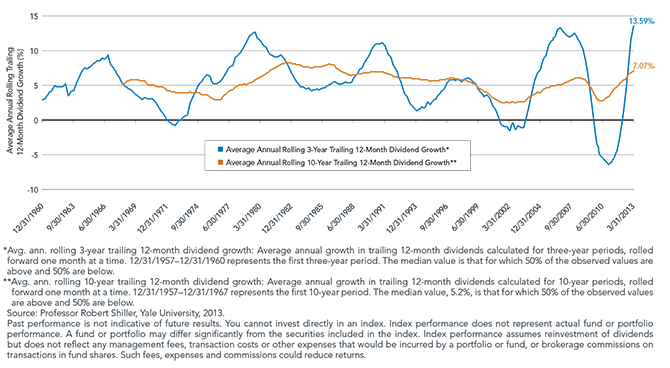
In today’s environment, investors are in an almost constant search of income-producing asset classes. One particular area of focus has been dividend-paying equities—made attractive not only because of the current income but also because of the potential for future growth of that income. We believe the recent trends for dividend growth discussed below have become an unmistakably positive signal for the market’s underlying fundamental value. Putting Recent Growth in Historical Perspective We examined the history of dividend growth of the S&P 500 index, as it is one of the most commonly used benchmarks available to measure the performance of U.S. equity markets and has dividend data extending back to its inception in 1957. There are two notable points when we compare the latest readings to historical data: 1) Record Three-Year Growth: The recent three-year average annual dividend growth—13.59% for the period ending March 30, 2013—is a record in the history of the S&P 500. To be fair, this follows a record fall in dividends that occurred a few years earlier and in some ways represents a normalization of dividend levels. 2) 10-Year Growth Impresses: Despite the record fall in dividends during the last 10 years, the 10-year average annual dividend growth of 7.07% is still approximately 2 percentage points above the median 10-year growth rate. This gives us confidence about future dividend growth.
Rolling 3-Year and 10-Year Growth of Trailing 12-Month Dividend for S&P 500 Index(12/31/1960-3/31/2013)
Changing Composition of Dividend Stream® Has Driven This Result There have been two major trends driving the bulk of growth in the Dividend Stream in the United States in recent periods: • Financials: Many financial firms were forced to cut or eliminate their dividend payments as they received government assistance during the height of the crisis. Today, those that remain are in a much stronger position and are in the process of returning their dividend payments to normalized levels. o Examples of Dividend Normalization: Wells Fargo increased its dividend per share twice thus far in 2013 (through April 30) for a total increase of 36%—meaning that approximately $1.7 billion more will be returned to shareholders. J.P. Morgan increased its dividend per share 27% during the same period, resulting in an incremental increase of $1.26 billion being returned to shareholders. • Information Technology: Tech firms have historically been associated with reinvesting the bulk of their profits back into their businesses to finance future growth. More recently, when returning money to shareholders, they have heavily favored share buybacks over dividend payments. While both of these characteristics remain true, some of the largest tech firms in the United States have so much cash that they are also becoming some of the largest payers of indicated cash dividends. o Specific examples of technology dividend leaders: • Apple: With the re-instatement of its first dividend since 1996, Apple is currently (as of April 30, 2013) indicated to be the largest dividend payer in the United States, with a cash Dividend Stream of nearly $11.5 billion per year. According to an April 23, 2013, announcement, this dividend is part of a plan to return approximately $100 billion to shareholders by the end of 2015.1 • Cisco introduced its first dividend in April of 2011. At the time, Cisco was indicated to be the 40th-largest dividend payer in the U.S. based on its indicated cash dividends.2 With following dividend hikes of 75% in the third quarter of 2012 and another 21% in the first quarter of 2013, it became one of the 20 largest dividend payers in the U.S. Conclusion We find it interesting that the trend in U.S. dividend payments has shifted so quickly from basically a record fall to record acceleration. Additionally, we believe that the sector trends we’ve outlined—specifically in Information Technology—have the potential to continue. In our next blog, we’ll discuss what we believe to be the potential consequences of missing the trends in these sectors, thereby potentially missing significant drivers of dividend growth in the United States. Read our full research here. View Jeremy Schwartz discuss dividends. (Video) 1Apple Press Info, “Apple More than Doubles Capital Return Program,” April 23, 2013. 2Based on the 11/30/2011 screening for the WTDI, a screening that does not include any growth-of-dividend qualifications to determine constituent eligibility.
Important Risks Related to this Article
Dividends are not guaranteed and a company’s future abilities to pay dividends may be limited. A company currently paying dividends may cease paying dividends at any time.
Categories
About the contributor

Global Chief Investment Officer
Jeremy Schwartz has served as Global Chief Investment Officer since November 2021 and leads WisdomTree’s investment strategy team in the construction of WisdomTree’s equity Indexes, quantitative active strategies and multi-asset Model Portfolios. Jeremy joined WisdomTree in May 2005 as a Senior Analyst, adding Deputy Director of Research to his responsibilities in February 2007. He served as Director of Research from October 2008 to October 2018 and as Global Head of Research from November 2018 to November 2021. Before joining WisdomTree, he was a head research assistant for Professor Jeremy Siegel and, in 2022, became his co-author on the sixth edition of the book Stocks for the Long Run. Jeremy is also co-author of the Financial Analysts Journal paper “What Happened to the Original Stocks in the S&P 500?” He received his B.S. in economics from The Wharton School of the University of Pennsylvania and hosts the Behind the Markets podcast. Jeremy is a member of the CFA Society of Philadelphia.