

“Tougher Than the Rest”
Published August 31, 2016

Head of Investment and Fixed Income Strategy
With two-thirds of the third quarter just about in the books, investors are still left wondering about the state of the U.S. economy. While discussions regarding a tilt into recession territory have been tabled of late, it certainly appears that the predominant expectation is not to look for any visible rebound in economic activity during the second half of 2016 either. Certainly, the first six months of the year did not give anyone reason to be overly optimistic, as overall growth increased by roughly +1.0%. After a slow start to begin the year, real GDP was surprisingly soft in Q2, rising +1.1%, or about half the pace of growth that was expected among consensus forecasts. Fixed investment, inventories, net exports and government spending have all been wild cards recently, with all but net exports contributing to the disappointing performance in the April–June period. The sizable drop in the inventory component will more than likely not be repeated and could potentially serve as a positive force for Q3, in our view. The stalwart for economic activity and key to future growth prospects have been, and will continue to be, personal consumption expenditures (PCE). Indeed, the consumer was on full display in Q2, as household spending surged by +4.4%. This resulted in a net positive contribution of 2.9 percentage points (pp) to real GDP, as all the remaining components actually subtracted 1.8 pp. Average Hourly Earnings
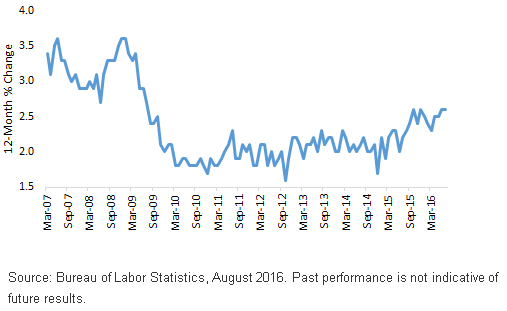
Admittedly, it will be a tall task for the consumer to replicate the Q2 performance. So, what should investors expect to see from the personal spending side of the ledger going forward? The first litmus test, July retail sales, seemed to confirm the notion that the consumer may not be as strong a contributor to the economy to begin the second half of the year. However, as we have said before, it is usually prudent not to read too much into a single month’s data. To be sure, there are many supporting influences that suggest the consumer should not be written off quite yet. Key wealth effect forces such as stock and home prices have remained supportive for the spending outlook. In addition, the Bloomberg U.S. Financial Conditions Index (which measures the overall level of stress in the U.S. financial markets as well as the availability and cost of credit) has continued to improve, rising appreciably from its 2016 and post-Brexit lows. Gasoline prices remain supportive, falling -4.7% in July, while food prices have been either flat or slightly negative for the last three months, according to data from the Bureau of Labor Statistics (BLS). Another important development to keep an eye on is the latest trend on the wage front. The July jobs report revealed that average hourly earnings (AHE) increased at an annual rate of +2.6%, maintaining the pace at the upper end of the recent range. The last time investors witnessed this type of sustained increase was 2009. In addition, the growth in AHE was widespread, with construction, manufacturing, wholesale trade, utilities, information, financial activities as well as leisure and hospitality all producing year-over-year gains in excess of the overall pace. Conclusion Based on the latest report from the University of Michigan’s Surveys of Consumers, any household concerns regarding Brexit were relatively short-lived. However, the next headline-making event, the U.S. presidential election, is receiving increasing attention and carries the potential for near-term uncertainty. According to the report, “consumers are nearly equally split on whether either candidate would actually improve overall economic conditions,”1 which is why investors should instead maintain their focus on upcoming wage trends to gauge future household spending plans. 1Source: University of Michigan’s Survey of Consumers preliminary results August 2016.
Important Risks Related to this Article
Fixed income investments are subject to interest rate risk; their value will normally decline as interest rates rise. In addition, when interest rates fall, income may decline. Fixed income investments are also subject to credit risk, the risk that the issuer of a bond will fail to pay interest and principal in a timely manner or that negative perceptions of the issuer’s ability to make such payments will cause the price of that bond to decline.
Categories
About the contributor

Head of Investment and Fixed Income Strategy
Kevin serves as the Head of Investment and Fixed Income Strategy. In this role, he writes macro and fixed income-related content and works closely with the sales, research and marketing teams. In addition, Kevin conducts client-facing webinars and meetings, providing expertise on WisdomTree’s existing and future bond ETFs. Prior to joining WisdomTree, Kevin spent 30 years at Morgan Stanley, where he was Managing Director and Chief Fixed Income Strategist for Wealth Management. He was responsible for tactical and strategic recommendations and created asset allocation models for fixed income securities. He was a contributor to the Morgan Stanley Wealth Management Global Investment Committee, primary author of Morgan Stanley Wealth Management’s monthly and weekly fixed income publications, and collaborated with the firm’s Research and Consulting Group Divisions to build ETF and fund manager asset allocation models. Kevin has an MBA from Pace University’s Lubin Graduate School of Business, and a B.S. in Finance from Fairfield University.