

Thoughtful Index Construction Brings Scale to Emerging Markets Investing
Published April 17, 2013

Global Chief Investment Officer
Until fairly recently, investors relied on actively managed mutual funds to gain exposure to the markets—especially for the emerging markets, where many believe that opportunities are ripe for active managers to add value. Some of these active strategies have delivered exceptional performances and, as a result, have attracted large pools of assets. However, many active managers admit that with greater asset levels comes greater difficulty in continuing to deliver superior performance. So far in 2013, we have seen a number of actively managed funds focused on emerging market equity investments announce that they are shutting their doors to new investors. Index-Based Strategies Offer a New Option During the last decade a plethora of index-based emerging market investments have gained traction—from traditional index-based mutual funds to exchange-traded funds (ETFs), each designed to track the performance of a particular index after accounting for requisite fees and expenses. Some of these indexes are quite broad and feature greater numbers of constituents than typical actively managed mutual funds. Active managers add value through selecting only stocks that look favorable according to their own metrics, whereas indexes typically generate exposure to a large universe of equities in accordance with a defined set of rules. Index methodology and design is crucial to determining both capacity and representation, as not every index tracking the performance of emerging market equities is designed with scale in mind. For example, indexes focused on weighting by dividend yield or dividend per share—which work more like modified equal-weighted indexes—have a bias toward small-cap stocks and have a greater probability of placing larger weights on smaller companies. This may boost the index’s dividend yield, but by the same token, as assets grow within any strategies tracking these indexes, it may also increase the percentage ownership in these underlying companies and reduce the strategy’s capacity. Building Scalable Indexes WisdomTree built its Indexes with scalability in mind. To accomplish more capacity in its Index tracking strategies, WisdomTree designed its Indexes to emphasize the cash dividends that each company pays—but to do so in a way that gives greater weight to bigger companies. In most cases, WisdomTree weights and rebalances its Indexes annually according to their dividend stream. Dividend Stream® = Dividends per share x shares outstanding By including shares outstanding in the weighting, we believe we introduce greater capacity to our Index tracking strategies. It is important to set a baseline when discussing the concept of capacity, as it can mean a number of different things. We define one measure of capacity as: “At what asset level would an index-tracking strategy hold more than 10% of a particular underlying holding?” The WisdomTree Emerging Markets Equity Income Index Incorporates Significant Scalability
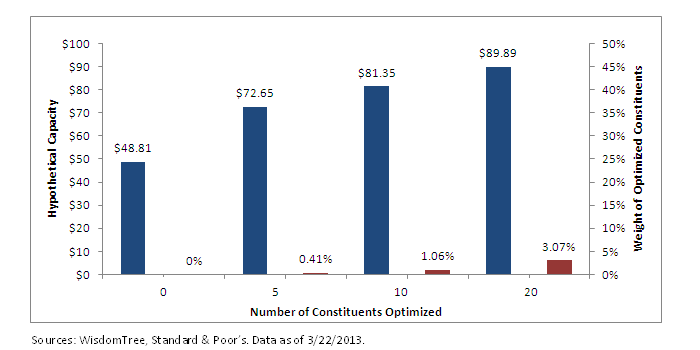
(For definitions in this chart, please refer to our glossary: Hypothetical capacity, Number of constituents optimized, Weight of optimized constituents.) • Scalable Methodology: On March 22, 2013, the WisdomTree Emerging Markets Equity Income Index (WTEMHY) had 331 constituents. Almost $49 billion of hypothetical assets could track WTEMHY prior to that strategy holding 10% of an underlying firm. • Optimization Helps Further: Were any hypothetical strategy tracking WTEMHY to optimize around the 5, 10 or even 20 most constraining firms, the level of hypothetical assets prior to reaching a 10% position in any underlying firm could become significantly larger. To be fair, optimization such as this could lead to greater potential for tracking error, but we believe it is important to note that even with taking the 20 most constraining firms out of the mix, this would represent only about 3% of WTEMHY’s total weight. Innovative Methodology Drives This Result WTEMHY is designed to weight relatively high-yielding equities within emerging markets on the basis of their cash dividend streams. In contrast to different yield-focused weighting methodologies, weighting by cash dividend stream lends a degree of scalability to the Index in that it accounts for the number of shares outstanding—something that weighting solely by dividend yield does not do. The closing of a number of high-profile active strategies re-emphasizes a benefit of index-based strategies, both in terms of their potential scalability and larger capacity. For current holdings in the WisdomTree Emerging Markets Equity Income Index (WTEMHY), click here.
Important Risks Related to this Article
You cannot invest directly in an index. There are risks associated with investing, including possible loss of principal. Foreign investing involves special risks, such as risk of loss from currency fluctuation or political or economic uncertainty. Investments in emerging, offshore or frontier markets are generally less liquid and less efficient than investments in developed markets and are subject to additional risks, such as risks of adverse governmental regulation and intervention or political developments.
Categories
About the contributor

Global Chief Investment Officer
Jeremy Schwartz has served as Global Chief Investment Officer since November 2021 and leads WisdomTree’s investment strategy team in the construction of WisdomTree’s equity Indexes, quantitative active strategies and multi-asset Model Portfolios. Jeremy joined WisdomTree in May 2005 as a Senior Analyst, adding Deputy Director of Research to his responsibilities in February 2007. He served as Director of Research from October 2008 to October 2018 and as Global Head of Research from November 2018 to November 2021. Before joining WisdomTree, he was a head research assistant for Professor Jeremy Siegel and, in 2022, became his co-author on the sixth edition of the book Stocks for the Long Run. Jeremy is also co-author of the Financial Analysts Journal paper “What Happened to the Original Stocks in the S&P 500?” He received his B.S. in economics from The Wharton School of the University of Pennsylvania and hosts the Behind the Markets podcast. Jeremy is a member of the CFA Society of Philadelphia.