

There’s No Such Thing as a Free Lunch
Published March 10, 2021

Head of Investment and Fixed Income Strategy
Without a doubt, the biggest story in bond-land, if not the financial markets in general, thus far in 2021 has been the spike in the U.S. Treasury 10-year yield. This increase has been fueled by a variety of factors, but there is one aspect that has not received the lion’s share of attention, and after I did a little research, it really caught my eye; the size of Treasury auctions.
When budget deficits are running in the multi-trillions, guess what? You have to finance this huge gap. That is exactly what is happening for the Treasury debt managers. At this point, the federal government’s financing needs reflect the baseline trillion-dollar deficit coming into this fiscal year as well as any holdovers from the prior pandemic-related fiscal stimulus packages that were enacted. Thus, the $900 billion package from December is part of the mix, but the $1.9 trillion dollar proposal currently being debated in the Senate would be another enormous add-on.
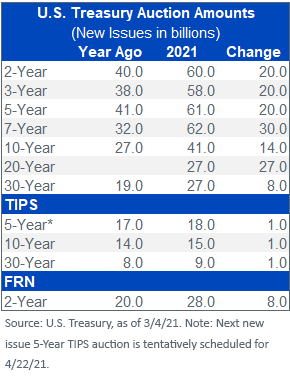
The enclosed table highlights the auction amounts currently in place versus the totals that were being auctioned for each security/maturity a year ago. Certainly, the 20-Year bond stands out as this issue was not being offered at this time in 2020. For the record, this maturity was brought back in May of last year to help with the debt load for the first time since 1986.
The other issue to stand out is the 7-Year note, where the present auction amount is an incredible $30 billion more than a year ago. The abysmal reception at the most recent auction for this maturity not only made headlines, but also got me thinking that maybe there are limits as to how much paper can be digested without investors commanding higher yields in return. The remaining note structure (2-, 3-, 5-Year) is $20 billion higher for each maturity, with the aforementioned 10-Year note being $14 billion above its 2020 reading.
Interestingly, the TIPS line-up is ‘only’ up $1 billion each, while the FRN offering got an $8 billion boost. It seems apparent the debt managers felt the FRN structure would be a preferred vehicle to raise cash rather than TIPS.
Conclusion
So, that raises the question: what is too big? Up until the very disappointing 7-Year note auction last month, it appeared as if auction sizes did not have any near-term limitations. However, maybe, just maybe, budget deficits do matter after all because someone has to finance them, and to quote: “There’s no such thing as a free lunch.”
Categories
About the contributor

Head of Investment and Fixed Income Strategy
Kevin serves as the Head of Investment and Fixed Income Strategy. In this role, he writes macro and fixed income-related content and works closely with the sales, research and marketing teams. In addition, Kevin conducts client-facing webinars and meetings, providing expertise on WisdomTree’s existing and future bond ETFs. Prior to joining WisdomTree, Kevin spent 30 years at Morgan Stanley, where he was Managing Director and Chief Fixed Income Strategist for Wealth Management. He was responsible for tactical and strategic recommendations and created asset allocation models for fixed income securities. He was a contributor to the Morgan Stanley Wealth Management Global Investment Committee, primary author of Morgan Stanley Wealth Management’s monthly and weekly fixed income publications, and collaborated with the firm’s Research and Consulting Group Divisions to build ETF and fund manager asset allocation models. Kevin has an MBA from Pace University’s Lubin Graduate School of Business, and a B.S. in Finance from Fairfield University.