

The Strong U.S. Dollar Is Changing the Competitive Landscape
Published July 28, 2022

Head of Equity Strategy
It’s not often that markets offer currency moves that have us looking at exchange rates from the pre-Plaza Accord era.
That 1985 agreement by representatives from Germany, France, Britain, Japan and the U.S. came into being because the super strong dollar of the mid-1980s was messing up the U.S. trade deficit and keeping overseas inflation stubbornly high.
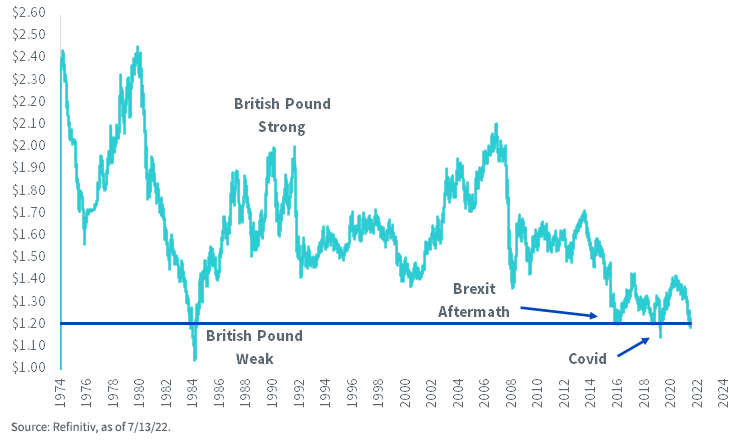
Look at the recent action in sterling (figure 1). Because the dollar continues to be relentlessly bid in 2022, the British pound is now as weak as it was in the aftermath of the Brexit vote. If things keep going like this, maybe the levels last witnessed in the pre-Plaza Accord era will be challenged.
Figure 1: USD to British Pound Exchange Rate
Sterling is not alone; the yen is also falling out of bed.
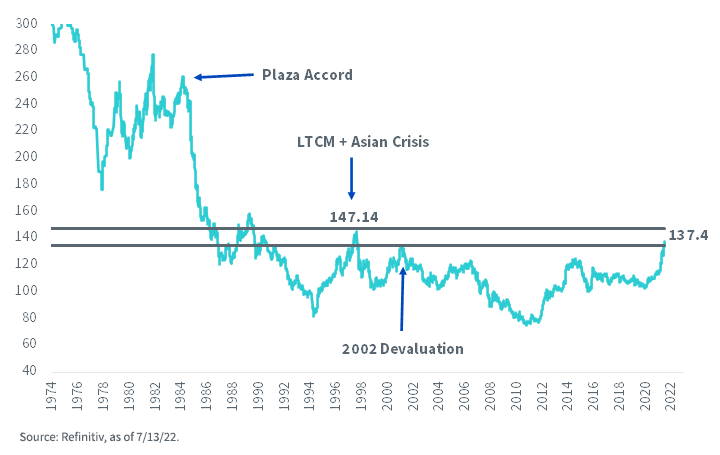
Though the yen is still a long way from its 1970s era weakness—when ¥200-300 per dollar was the norm—the currency is back at levels rarely seen in the last quarter-century. At this moment, the yen’s decline has it bopping around levels last seen in its 2002 devaluation, with not much room to go before challenging the 1998 weakness that came following the collapse of hedge fund Long-Term Capital Management (LTCM).
Figure 2: Japanese Yen per USD
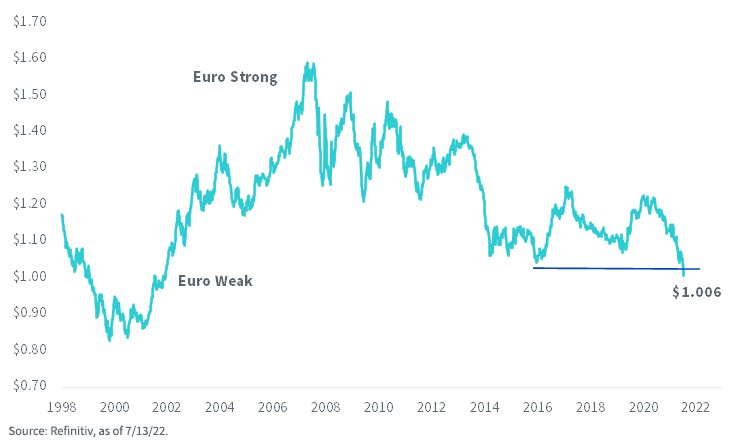
Meantime, the other big one—the euro—has achieved parity with the U.S. dollar. It just broke below its post-Brexit lows (figure 3).
Figure 3: USD to Euro Exchange Rate
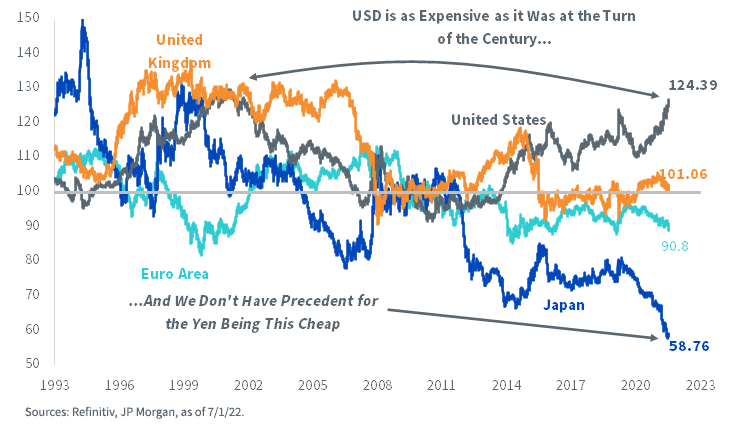
Coming out of the global financial crisis, these four majors—the dollar, sterling, euro and yen—each had CPI-based real effective exchange rates that were largely in balance. As the dollar strengthened over the years, that has changed, with EUR and JPY showing up on the cheap side on this metric.
Figure 4: Real Effective Exchange Rate (CPI, 2010 = 100)
Granted, I write this as Germany is in the process of bailing out Uniper, its big natural gas user, and as Japan scrambles to figure out if it should give nuclear power a hug once again. Unless the Russia-Ukraine war suddenly ends, the energy crisis could haunt these countries in the coming months and years.
Still, there is a lot of sobriety baked into the MSCI EAFE index of developed market stocks. Hard to believe, but MSCI EAFE is currently having a conversation with its old March 2000 highs. Aside from dividends, it’s largely unchanged since then.
Figure 5: MSCI EAFE Index
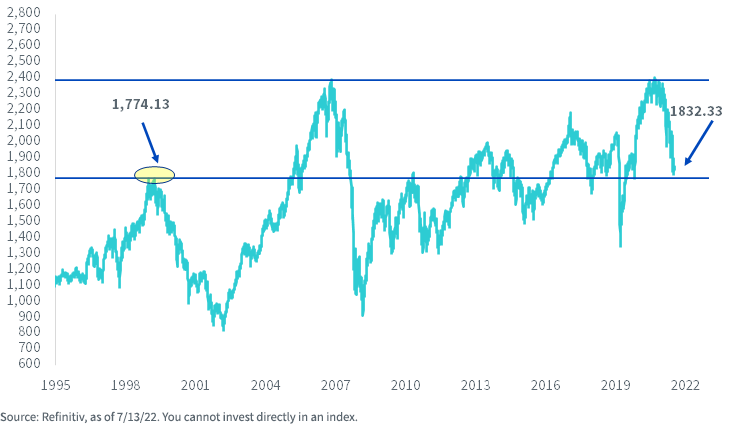
MSCI EAFE’s lost quarter-century comes in sharp contrast to the action in the NASDAQ. In figure 6, I put it next to the “Stages of a Mania” image that sometimes makes the rounds. I don’t know what the future holds, but I think about this frequently.
Figure 6: “Stages of a Mania” vs. NASDAQ Composite
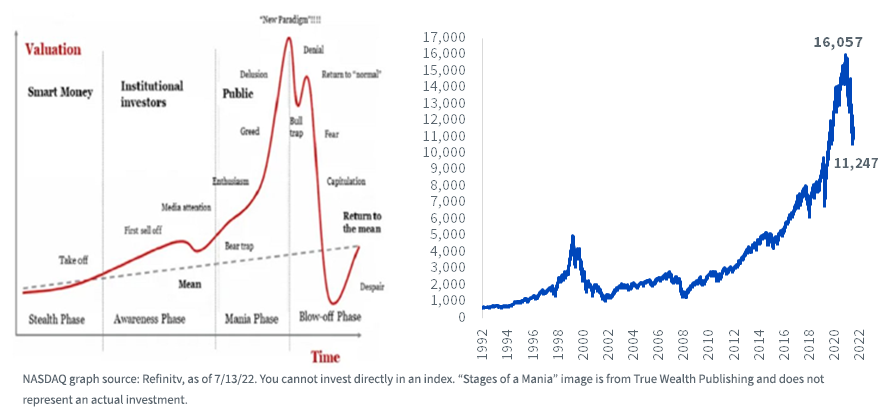
If the coming years present a scenario in which U.S. stocks must unwind a bull market that got too far out of hand, maybe owning beleaguered overseas markets is the way to navigate it.
Here are three ideas for each of the currency approaches.
Currency-Hedged
WisdomTree Japan Hedged Equity Fund (DXJ)
WisdomTree Europe Hedged Equity Fund (HEDJ)
WisdomTree International Hedged Quality Dividend Growth Fund (IHDG)
No Currency Hedge
WisdomTree Japan Small Cap Dividend Fund (DFJ)
WisdomTree Europe Quality Dividend Growth Fund (EUDG)
WisdomTree International Quality Dividend Growth Fund (IQDG)
Rules-Based Hedging (ranging from 0%-100% for each currency)
WisdomTree Dynamic Currency-Hedged International Equity Fund (DDWM)
WisdomTree Dynamic Currency-Hedged International Small Cap Equity Fund (DDLS)
About the contributor

Head of Equity Strategy
Jeff Weniger, CFA, has been with WisdomTree since 2017 and serves as the Head of Equities. He shapes the firm’s market outlook through a combination of macroeconomic and fundamental analysis. With more than two decades in investment strategy, Jeff is known for his work on market cycles and valuations. Before joining WisdomTree, Jeff was with BMO Private Bank and BMO Global Asset Management for 11 years. At BMO, he sat on the firm’s Asset Allocation Committee and co-managed ETF model portfolios across the U.S. and Canada. In 2013, at age 32, he became the youngest member of BMO’s Global Investment Forum. When he left BMO to come to WisdomTree, his final role was Director, Senior Strategist in the Office of the CIO in 2017.
Jeff is a frequent television guest on networks such as CNBC, Bloomberg, and Schwab, with regular print appearances in The Wall Street Journal, Barron’s and Reuters. He also appears weekly on the Behind the Markets podcast and is a regular on SiriusXM’s The Business Briefing. On X, Jeff has developed one of the larger followings in financial media. He earned a B.S. in Finance from the University of Florida and an MBA from the University of Notre Dame. He has held the CFA charter since 2006.