

The S&P 500: Our Industry’s Oops
Published April 1, 2019

Head of Equity Strategy
The S&P 500 Index has not been around as long as you think. I encourage you to investigate the events that led to it becoming a $9.9 trillion monster.
You know the methodology: each of the 500 stocks is weighted by its market capitalization. The supposed catalyst for choosing that methodology in 1957? The Efficient Markets Hypothesis (EMH)—the theory that all market-influencing information is already priced into stocks.
But wait a minute…that may not have been the catalyst at all.
Oops
There is a dog-eared copy of Princeton Professor Burton Malkiel’s EMH groundbreaker, A Random Walk Down Wall Street, on every good academic’s shelf. But after EMH was challenged, first in the wake of the 1987 market crash and then amid the dot.com rubble, Malkiel picked up his pen in 2003, citing no less than 57 works on the subject. Aside from Graham and Dodd—two academics who epitomize the opposite of efficient markets dogma—every single paper cited by Malkiel was written after 1957.
The S&P 500 Index wasn’t designed to be an investment. We know this because it came before the EMH. Don’t forget that Jack Bogle’s index fund was born in the mid-1970s, not a moment earlier.
Figure 1: Malkiel’s Citations
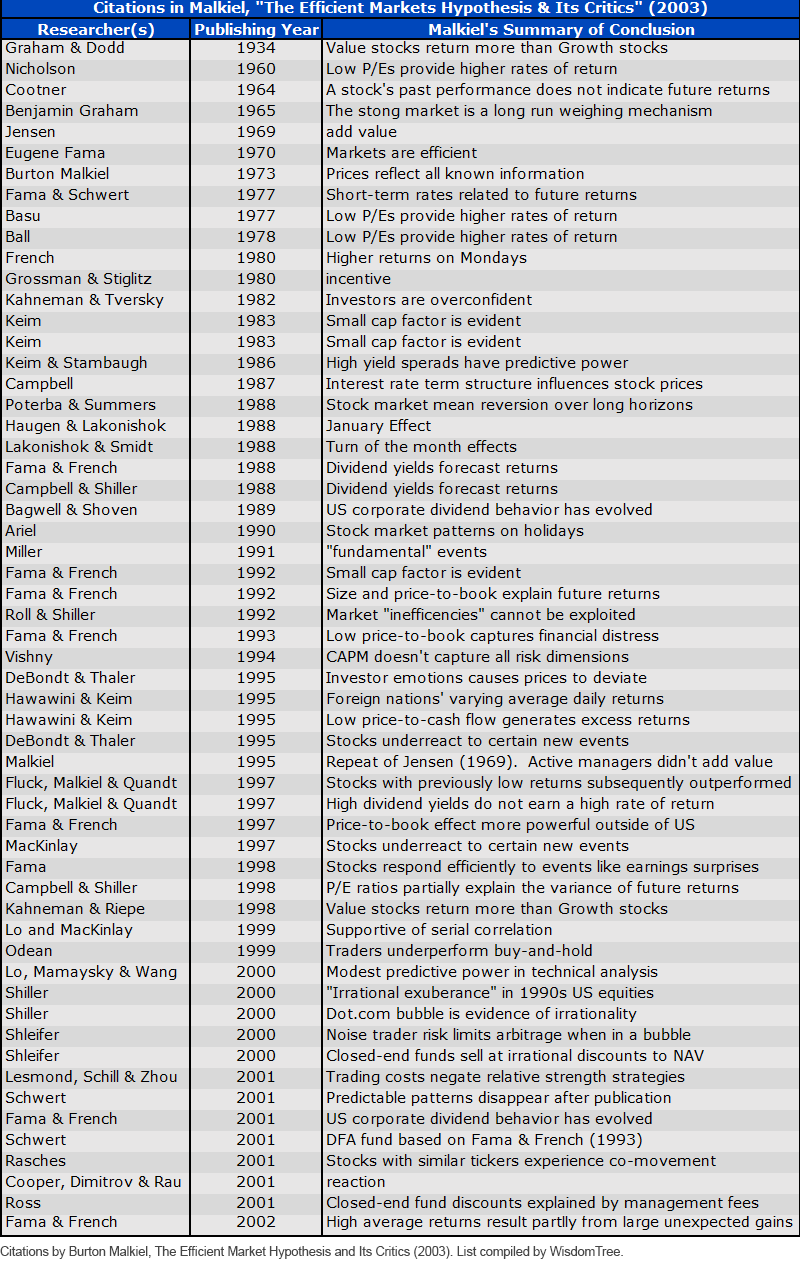
What do we think? Cap-weighted indexing as an investment is an accident of circumstance.
In retrospect, the rise of the methodology makes sense. The industry rightly benchmarked active managers against the commonly-cited S&P 500. The fund managers weren’t so bad; their fees were. It wasn’t that the S&P 500 was so superior; it was that it was being compared to mutual funds hindered by their own expenses.
Here’s a simple study: 1957–2018, weighting stocks by their earnings. Every December 31, rebalance. If S&P wanted an investable index, this earnings-weighting would have been a killer.
Figure 2: S&P 500 P/E Quintile Returns, 1957–2018
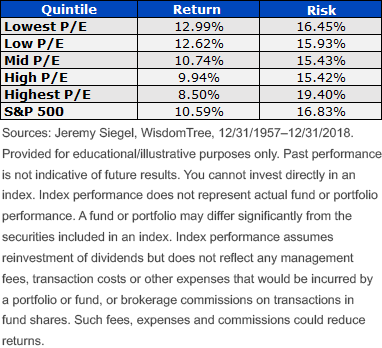
Take the huge fee gap out and ask why old school beta makes sense in a 2019 fee structure world.
We recently cut the expense ratio on our earnings-weighted broad market “beta” fighter, the WisdomTree U.S. LargeCap Fund (EPS), to 8 basis points (bps) from 28 bps. Some chunk of the S&P’s $9.9 trillion is tracking an accident of happenstance for fee reasons, not merit. Think of EPS as merit-based beta for those of us who believe fundamentals matter.
Important Risks Related to this Article
There are risks associated with investing, including possible loss of principal. Funds focusing their investments on certain sectors increase their vulnerability to any single economic or regulatory development. This may result in greater share price volatility. Please read the Fund’s prospectus for specific details regarding the Fund’s risk profile.
Categories
About the contributor

Head of Equity Strategy
Jeff Weniger, CFA, has been with WisdomTree since 2017 and serves as the Head of Equities. He shapes the firm’s market outlook through a combination of macroeconomic and fundamental analysis. With more than two decades in investment strategy, Jeff is known for his work on market cycles and valuations. Before joining WisdomTree, Jeff was with BMO Private Bank and BMO Global Asset Management for 11 years. At BMO, he sat on the firm’s Asset Allocation Committee and co-managed ETF model portfolios across the U.S. and Canada. In 2013, at age 32, he became the youngest member of BMO’s Global Investment Forum. When he left BMO to come to WisdomTree, his final role was Director, Senior Strategist in the Office of the CIO in 2017.
Jeff is a frequent television guest on networks such as CNBC, Bloomberg, and Schwab, with regular print appearances in The Wall Street Journal, Barron’s and Reuters. He also appears weekly on the Behind the Markets podcast and is a regular on SiriusXM’s The Business Briefing. On X, Jeff has developed one of the larger followings in financial media. He earned a B.S. in Finance from the University of Florida and an MBA from the University of Notre Dame. He has held the CFA charter since 2006.