

The Power of Fundamentals among Small Caps
Published September 3, 2015

Director, Research
We continue to see proliferation of the term “smart beta,” which in its simplest terms indicates an index construction that does not weight constituents by market capitalization but incorporates some type of rules-based rebalancing process. We believe that smart beta fits between traditional market capitalization-weighted approaches and active management, by offering some of the best attributes of each. A wide array of smart beta indexes are starting to have live performance histories greater than five years, and we evaluated the WisdomTree Indexes focused on small-cap equity markets with at least that much history. Previously we discussed how these strategies compared against active managers, but below we will compare them to market capitalization-weighted indexes. Are Markets Always Efficient? The Efficient Market Hypothesis posits that the market price of any security reflects the most accurate possible estimate of the firm’s fundamental value—there are no “bubbles,” or periods when stocks may be bid up in price due to excitement or euphoria. We believe that this isn’t always the case, and therefore we believe that markets are not always efficient, and the default weighting shouldn’t always be based on market cap. WisdomTree believes that screening and weighting equity markets based on fundamentals such as dividends or earnings can help produce higher total and risk-adjusted returns over a complete market cycle. The Annual Rebalance One of the most important elements of a fundamental index is the annual rebalance process, where the index screens the eligible universe and then weights those securities based on their fundamentals. In essence, the process takes a detailed look at the relationship between the underlying fundamentals and price performance. WisdomTree’s Dividend Index rebalance process typically is driven by: • Dividend Growth: Companies increasing dividends see their weight increased. • Relative Performance:
• Underperformers typically see their weight increased.• Outperformers often see their weight decreased. In the charts below, we compare the absolute and risk-adjusted performance for various WisdomTree SmallCap Dividend Indexes against a comparative market cap-weighted index. Figure 1a: Average Annual Performance since WisdomTree Index Inceptions
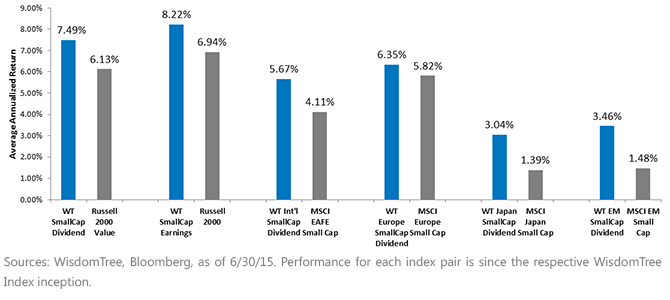
Figure 1b: Standardized Index Performance
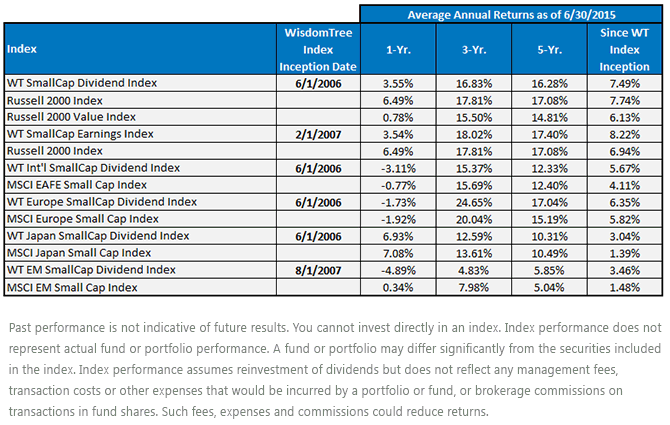
• WisdomTree Indexes Displayed Higher Absolute Returns: WisdomTree believes that the more inefficient the market, the greater the potential for fundamentally weighted indexes to outperform market capitalization-weighted indexes. Therefore, it has come as no surprise to us that, since their inception, WisdomTree’s fundamentally weighted Indexes have produced some of the greatest outperformance compared to their cap-weighted peers in the small-capitalization size segments. In arguably one of the most inefficient small-cap markets, the emerging markets, the WisdomTree Emerging Markets SmallCap Dividend Index outperformed by approximately 2% per annum. Figure 2: Risk-Adjusted Performance (Sharpe Ratio) since WisdomTree Index Inceptions
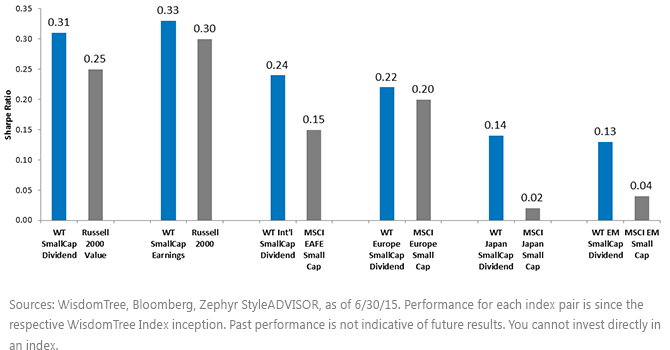
• WisdomTree Indexes Displayed Higher Risk-Adjusted Returns: We find it impressive that in every instance above, across many regional markets, all of the WisdomTree Indexes also outperformed on a risk-adjusted basis compared to their market cap-weighted peer indexes since their inception. Inefficient markets are typically those where there is less analyst coverage and where stock prices may tend to exhibit greater fluctuations in price (i.e., higher volatility), compared to the true underlying value of the firm. Therefore, we believe fundamentals become even more important and help control for valuation risks.
Important Risks Related to this Article
Dividends are not guaranteed, and a company’s future ability to pay dividends may be limited. A company currently paying dividends may cease paying dividends at any time.
Investments focusing on certain sectors and/or smaller companies increase their vulnerability to any single economic or regulatory development.
Categories
About the contributor
