

The Opportunity of European Dividend Growth
Published May 6, 2014

Global Chief Investment Officer
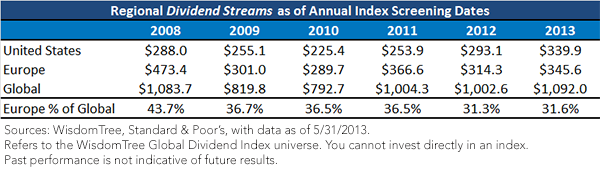
Recently, European markets have performed strongly, with many investors focusing on the economic recovery. It is becoming difficult to remember that a few short years ago there was widespread debate about whether the European Monetary Union (EMU) would continue to exist. WisdomTree thinks it is important to remember that Europe represents a large share of the global markets. On a market capitalization basis, developed Europe makes up approximately 26% of the global opportunity set. At $345 billion of dividends paid as of last May 31, over 31% of global dividends came from Europe, which was greater than the sum paid by firms in the United States.1 The Opportunity: While the United States is setting new highs for its Dividend Stream®, Europe’s earnings and dividends—similar to the general European economy—are still catching up to their highs set prior to the 2008–09 global financial crisis. Europe needs dividends to grow at least 37% more before the aggregate dividends from these firms reach their 2008 levels. WisdomTree thus believes the time is ripe to apply its proprietary dividend growth methodology to a universe of European stocks. The Opportunity for Dividend Growth in Europe
Introducing the WisdomTree Europe Dividend Growth Index The universe of eligible companies begins with the European countries in the WisdomTree DEFA Index2. The European dividend-paying segment included 916 investable dividend payers as of January 31, 20143. After applying a minimum-size threshold of $1 billion and a dividend coverage ratio greater than 1.0x, the following screens are applied:
• The Index includes the 300 companies with the best combined rank of growth and quality factors from this universe. • Growth Ranking 50%: Derived from long-term earnings growth expectations, which ultimately encompass the estimated growth in operating earnings per share over the company’s next full business cycle, typically three to five years • Quality Ranking 50%: Split evenly between three-year average return on assets (ROA) and three-year average return on equity (ROE)
A Focus on Growth and Quality Factors That Drive Dividend GrowthQuality Factors: In finance literature, return on equity is critically linked to dividend growth and intrinsic value of companies. The dividend discount model (DDM) for stock valuation states: The value of a stock = DPS (1) / (R-G) Where: G = Growth rate in dividends = ROE x earnings retention (or 1 minus dividend payout ratio) Simply stated, the growth of dividends is determined by the fraction of earnings that is put back into the firm and how profitable those earnings are in their subsequent use. A sustainable dividend growth rate is thus critically linked in finance theory to ROE. On a more practical level, Warren Buffett and Charlie Munger—aside from theorists, arguably the best stock pickers in recent history—discuss return on capital and quality as the critical factors they focus on: “We've really made the money out of high quality businesses . . . if the business earns 6% on capital over 40 years and you hold it for that 40 years, you’re not going to make much different than a 6% return even if you originally buy it at a huge discount. Conversely, if a business earns 18% on capital over 20 or 30 years, even if you pay an expensive looking price, you’ll end up with a fine result.” – Charlie Munger at USC Business School in 1994. Growth Factor: We believe companies that can grow their earnings have the greatest potential to raise their dividends, which is why long-term earnings growth expectations make up 50% of our selection criteria. We believe earnings growth is a necessary consideration for future dividend increases. Why Weight by Dividends? Weighting by dividends, in effect, is how the Index methodology rests on the foundation of relative value . The index gives greater weight to companies growing their dividends. Simply, at each annual rebalance in June, the following adjustments occur: • Typical Additions in Weight: Firms whose share prices may have performed poorly or stayed flat but whose dividends increased. • Typical Reductions in Weight: Firms whose share prices may have performed quite well but whose dividend growth was negative or flat. In future blog pieces, we will explore some of the characteristics of this new Index. In short, we believe the new Europe Dividend Growth index is a useful addition to the Indexes that represent the European growth opportunity. In particular, this Index focuses on companies WisdomTree believes have prospects for sustainable long-term growth in their dividends. 1Refers to the 5/31/2013 WisdomTree Global Dividend Index screening date, the most recent available. 2Refers to Austria, Belgium, Denmark, Finland, France, Germany, Ireland, Italy, Netherlands, Norway, Portugal, Spain, Sweden, Switzerland and the United Kingdom. 3The screening date for initial constituents for this Index. The Index screens annually on May 31.
Important Risks Related to this Article
Foreign investing involves special risks, such as risk of loss from currency fluctuation or political or economic uncertainty. Investments focused in Europe are increasing the impact of events and developments associated with the region, which can adversely affect performance. Dividends are not guaranteed, and a company’s future ability to pay dividends may be limited. A company currently paying dividends may cease paying dividends at any time.
Categories
About the contributor

Global Chief Investment Officer
Jeremy Schwartz has served as Global Chief Investment Officer since November 2021 and leads WisdomTree’s investment strategy team in the construction of WisdomTree’s equity Indexes, quantitative active strategies and multi-asset Model Portfolios. Jeremy joined WisdomTree in May 2005 as a Senior Analyst, adding Deputy Director of Research to his responsibilities in February 2007. He served as Director of Research from October 2008 to October 2018 and as Global Head of Research from November 2018 to November 2021. Before joining WisdomTree, he was a head research assistant for Professor Jeremy Siegel and, in 2022, became his co-author on the sixth edition of the book Stocks for the Long Run. Jeremy is also co-author of the Financial Analysts Journal paper “What Happened to the Original Stocks in the S&P 500?” He received his B.S. in economics from The Wharton School of the University of Pennsylvania and hosts the Behind the Markets podcast. Jeremy is a member of the CFA Society of Philadelphia.