

The Next Test for U.S. Dividends
Published June 22, 2020

Director, Research
Should banks suspend dividends?
For European bank regulators, the answer is yes.
Most major European banks have suspended share buybacks and dividends since being directed by regulators to do so in March.
This coordinated decision provided cover for the weakest banks to slash payouts. It was also good PR for regulators, since the cuts are perceived as providing greater capacity for lending to struggling small businesses and households.
For U.S. regulators, the answer to this question has been “wait and see.” Federal Reserve (Fed) Chair Jerome Powell has opposed a blanket ban, saying the banks are “highly capitalized, with more high-quality capital than before the financial crisis.”
Faith in Stress Tests
Some notable differences between U.S. and European banks have influenced divergent dividend paths:
- European banks tend to pay dividends annually, in the spring, whereas U.S. banks tend to pay in quarterly increments.
- U.S. bank profitability was much higher heading into this crisis than that of European banks, which have struggled with earnings amid negative interest rates.
- U.S. banks return more of their capital via share buybacks, making dividends a much smaller portion of overall payouts.
But perhaps the biggest reason for the lack of regulatory action on U.S. dividends is the Fed’s annual stress tests that determine dividend decisions. The results of these tests will be released on June 25, giving the Fed the opportunity to make assessments that are specific to each bank’s capital distribution plans.
This approach, rather than a wholesale ban on dividends, enforces the Fed’s faith in the stress test process.
Financials Slide in 2020
Financials have been the second-worst performing sector in the S&P 500 this year. Most banks recorded billions in loan loss provisions during the first quarter, with further losses expected in the second quarter.
These losses, and a uniform suspension of share buybacks from the largest banks that was made in March, have weighed heavily on the sector’s performance.
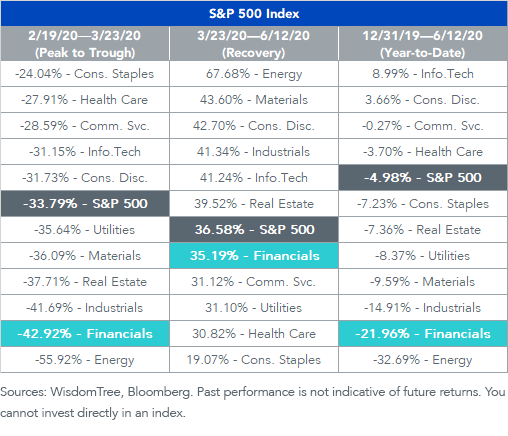
More recently, investors have questioned if dividend cuts will follow as a result of the deteriorating economy. The list of advocates for banks halting dividends is distinguished, including former Fed Chair Janet Yellen.1
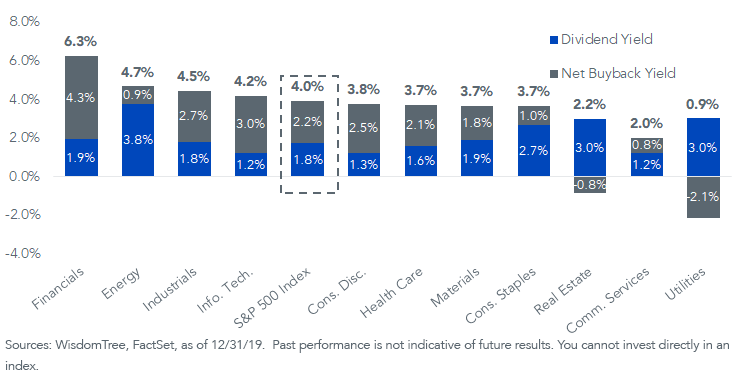
Entering 2020, Financials offered the highest total shareholder yield (dividends + net buybacks), but more than two-thirds of their payouts came from buybacks. This is why the decision by the banks to suspend buybacks in March was more important to preserving capital than slashing dividends.
S&P 500 Index - Total Shareholder Yield by Sector
Wells Fargo with Highest Payout Ratio
If we look at the total payout ratios for the eight U.S. global systemically important banks (G-SIBs), the average payout was 121% for 2019. That means that, on average, the banks paid out more than 100% of their earnings on dividends and share buybacks.
However, the average dividend payout ratio was only 29%, which was well below the 43% for European G-SIBs.
Wells Fargo (WFC) paid out the highest dividends and looks to be the most at risk of having its dividend cut.
2019 Payout Ratio
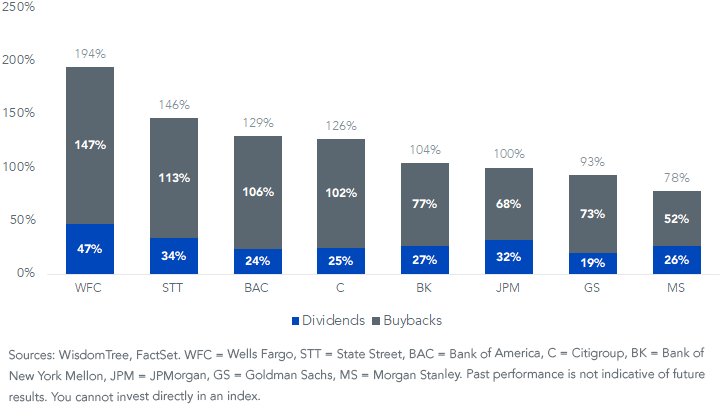
According to Goldman Sachs, the options market implies an average dividend cut of 32% for 2021 dividends for large U.S. banks relative to the trailing 12 months—WFC had the highest cut expectation with a more than 60% implied cut.2
Based on Goldman’s own forecast, WFC will be the only bank forced to pare back its dividends from 1Q20 levels.
Potential Catalyst for Banks
Should the Fed allow banks to maintain, or even increase, dividend payouts, it could be a positive catalyst for Financials—and for many of the value indexes that are over-weight the sector.
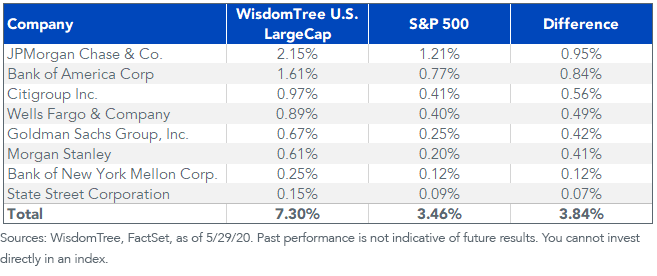
The WisdomTree U.S. LargeCap Index is a value-tilted index with an over-weight of about 6% in Financials relative to the S&P 500.
The Index weights the 500 largest profitable U.S. companies by earnings. Because of the cyclicality of earnings for banks, and the currently depressed expectations for their near-term earnings, the large banks all have lower weights in the market cap-weighted benchmark than in the earnings-weighted index.
Index Weights in U.S. G-SIBs
1Andrew Ackerman and Nick Timiraos, “Fed Unlikely to Order Big U.S. Banks to Suspend Dividends,” The Wall Street Journal, 4/3/20.
2“Reassessing bank profitability and dividend sustainability; we see risk only to WFC’s dividend,” Goldman Sachs Equity Research, 6/15/20.
Categories
About the contributor

Director, Research
Matt Wagner joined WisdomTree in May 2017 as an Analyst on the Research team. He currently serves as a Director, where he supports the creation, maintenance, and reconstitution of WisdomTree’s indexes and actively managed ETFs. Matt began his career at Morgan Stanley, working as an analyst in Treasury Capital Markets from 2015 to 2017, focusing on unsecured funding planning, execution, and risk management. He graduated magna cum laude from Boston College in 2015 with a B.A. in International Studies, concentrating in Economics. In 2020, he earned a Certificate in Advanced Valuation from NYU Stern. He is also a Chartered Financial Analyst (CFA) charterholder.