

The New NAFTA: Can We Yawn Now?
Published October 5, 2018

Head of Equity Strategy
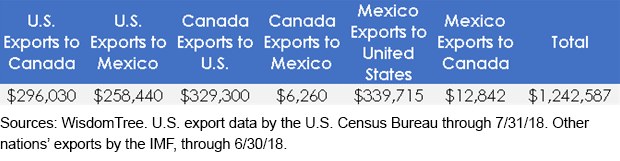
NAFTA is gone, replaced by largely the same agreement with a different name. Talk about tinkering around the edges. The USMCA—a forgettable acronym—stands for the United States-Mexico-Canada Agreement. But an agreement on what? An agreement to keep NAFTA going with a few tweaks. First, the table stakes. Figure 1 shows each nation’s respective annual trade with the others, a sum of $1.24 trillion.
Figure 1: Annual North American Exports (in US$ Millions)
Tweaks
One of the big sticking points for Trump was the requirement to increase the percentage of each automobile coming from one of the three nations. The rate will rise from five-eighths of the car to three-quarters under the USMCA. The net effect is that the three countries can “stick it” to China. That is a political winner for all three, so long as auto inflation is tame. Some minimum wages for auto workers were also added, a burden shouldered by Mexico.
Canada was the wild card because Mexico and the U.S. agreed in principle to terms several weeks ago. As we get into the numbers, use U.S. and Canadian GDP of $20.4 trillion and $1.74 trillion, respectively, for context.1 That gives reason to collectively yawn at the new allowance for 3.5% U.S. market share in the $16 billion to $20 billion Canadian dairy industry. This is a commercial opportunity worth less than $1 billion, frankly.
The much-maligned steel and aluminum export tariffs remain. This too is an afterthought. With steel equal to 1.5% of Canada’s export total, and with 91% of it going to the United States, about $4.5 billion worth of Canadian steel will be affected. But as we pointed out in basically every trade-related piece we wrote this past summer, levying a tariff does not make all cross-border trade disappear.2 Even if the 25% levy causes half of Canadian steel exports to the U.S. to completely evaporate, we are talking about $2.25 billion. Also, from a global perspective, presumably most or all of the disappeared Canadian steel would shift someplace else, seemingly the U.S. Again, we are talking about two economies collectively worth about $22 trillion, yet the news cycle is harping on a few billion dollars.
Sensationalism at its finest.
As for aluminum, Trading Economics puts Canadian exports at $9.82 billion in 2017, with 87% headed to the U.S. How much of that $8.54 billion of U.S. sales is going to totally disappear because of a 10% tariff? One billion? Two billion? Add up the dairy, steel and aluminum hit to Canada, and we are talking about numbers that are Big Picture insignificant—for all parties.
Global Trade Peace
With NAFTA seemingly resolved, it is time for the market to move off the tired “global trade war” theme. We suggest “global trade peace,” because there looks to be more evidence of that than the former. Yes, Brexit remains front and center until its March 2019 deadline, and we grant this is an obstacle. We will also grant the remaining Sino-U.S. frictions, although anyone who hasn’t read “Forget the Trade War, Already: China Is Cutting Taxes” may want to investigate Beijing’s massive fiscal stimulus.
In the meantime, the market is glossing over a series of very significant positives on the trade front. First, Japan just inked a new free trade deal with the European Union in August. It is scarcely discussed. Also, keep close watch on improving relations between China and Japan, a breath of fresh air from President Xi Jinping and Prime Minister Shinzo Abe. A partial offset to years of increasingly fraught tensions in the East China Sea is welcome.
Next, of course, there is the massive Belt and Road Initiative (BRI), China’s neocolonialist venture to build a multitrillion-dollar land and maritime “Silk Road.” Yes, BRI has problems, including its plunking of massive debt on countries like Pakistan and rampant corruption in Malaysia, to name just two. Nevertheless, it is an initiative designed to increasing commercial cooperation between China and upward of not one, not two, but perhaps a hundred nations.
Some “global trade war” this turned out to be.
1Sources: Bureau of Economic Analysis for the U.S., Bloomberg for Canada, both as of 6/30/18.
2Global Steel Trade Monitor, Steel Exports Report: Canada, September 2018, U.S. Department of Commerce.
Categories
About the contributor

Head of Equity Strategy
Jeff Weniger, CFA, has been with WisdomTree since 2017 and serves as the Head of Equities. He shapes the firm’s market outlook through a combination of macroeconomic and fundamental analysis. With more than two decades in investment strategy, Jeff is known for his work on market cycles and valuations. Before joining WisdomTree, Jeff was with BMO Private Bank and BMO Global Asset Management for 11 years. At BMO, he sat on the firm’s Asset Allocation Committee and co-managed ETF model portfolios across the U.S. and Canada. In 2013, at age 32, he became the youngest member of BMO’s Global Investment Forum. When he left BMO to come to WisdomTree, his final role was Director, Senior Strategist in the Office of the CIO in 2017.
Jeff is a frequent television guest on networks such as CNBC, Bloomberg, and Schwab, with regular print appearances in The Wall Street Journal, Barron’s and Reuters. He also appears weekly on the Behind the Markets podcast and is a regular on SiriusXM’s The Business Briefing. On X, Jeff has developed one of the larger followings in financial media. He earned a B.S. in Finance from the University of Florida and an MBA from the University of Notre Dame. He has held the CFA charter since 2006.