

The Flows Don’t Lie
Published January 16, 2013

CEO of WisdomTree
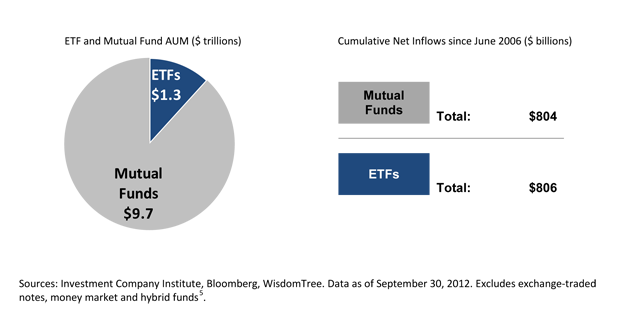
Due to their intraday liquidity and convenience as trading tools, ETFs are a fast and efficient way to express investment sentiment about a given sector, asset class or region. For this reason, ETFs can serve as price discovery tools as well as leading indicators of a shift in broader market sentiment. In fact, in 2010 ETFs accounted for roughly 18% of U.S. equity trading volume, with trading often exceeding 2 billion shares per day.1 Yet ETFs are more than just flexible trading tools. Their tax efficiency2, transparency and other structural benefits can help make ETFs great vehicles for long-term investors, too. However, when it comes to these long-term investors, the financial media, research groups and asset management firms tend to focus solely on flows into traditional mutual funds, not ETFs. After all, even with $1.3 trillion in assets,3 ETFs are still dwarfed by mutual funds, only representing about 13% of the $9.7 trillion mutual fund market. But I believe these traditionalists are missing a critical trend. Even from their relatively small asset base, over the last five years ETFs accounted for roughly 50% of total long-term flows4. No complex math necessary—that’s a fraction of the market taking half the total pie. Simply put, the new money coming from the sidelines has been going into ETFs at the expense of such traditional product structures as mutual funds. For traditional asset managers, the truth may hurt. But, we believe, the flows don’t lie.
In the weeks to come, we will dig deeper into where these net inflows are going. Here’s a hint: We believe equity investing is alive and well, depending on where you look. 1Abner, David, The ETF Handbook, Hoboken: John Wiley & Sons, Inc., 2010. 2The creation/redemption mechanism of ETFs is what allows them to be very tax efficient. Specifically, when portfolio holdings can be transferred on an “in-kind” basis during redemptions, it allows ETFs to be very tax efficient and able to minimize their capital gains distributions. The reason: When shares are redeemed in-kind, the ETF is not liquidating or selling shares on the market, which would trigger gains inside the ETF; rather, with in-kind redemptions, an exchange is made between qualified institutional investors and the fund company—in exchange for shares of the ETF, the qualified institutional investor receives underlying holdings of the fund on an in-kind basis, and this swapping of holdings for ETF shares does not trigger a taxable event for the fund. 3Source: ETF Industry Association, www.etf-ia.com. 4Long-term flows: Allocations into investment products with an average holding period of greater than one year. Source: Investment Company Institute. 5Hybrid funds: A category of mutual fund that is characterized by portfolios that are made up of a mix of stocks and bonds, which can vary proportionally over time or remain fixed.
Categories
About the contributor

CEO of WisdomTree
Prior to establishing WisdomTree, Jonathan founded, and served as Chairman and CEO of Individual Investor Group, Inc. From 1998 to 2004, he held the role of Editor-in-Chief of Individual Investor and Ticker magazines. Before his entrepreneurial accomplishments, Jonathan was an Analyst in the Mergers & Acquisitions division at Bear Stearns & Co. He attended The Wharton School at the University of Pennsylvania and is the author of Midas Investing, published by Random House in 1996.